Department of Pharmacology and Chemical Biology, University of Pittsburgh Cancer Institute, University of Pittsburgh School of Medicine, Pittsburgh, Pennsylvania, USA.
Mol Cancer Ther. 2010 Nov;9(11):2893-902. doi: 10.1158/1535-7163.MCT-10-0635. Epub 2010 Oct 26.
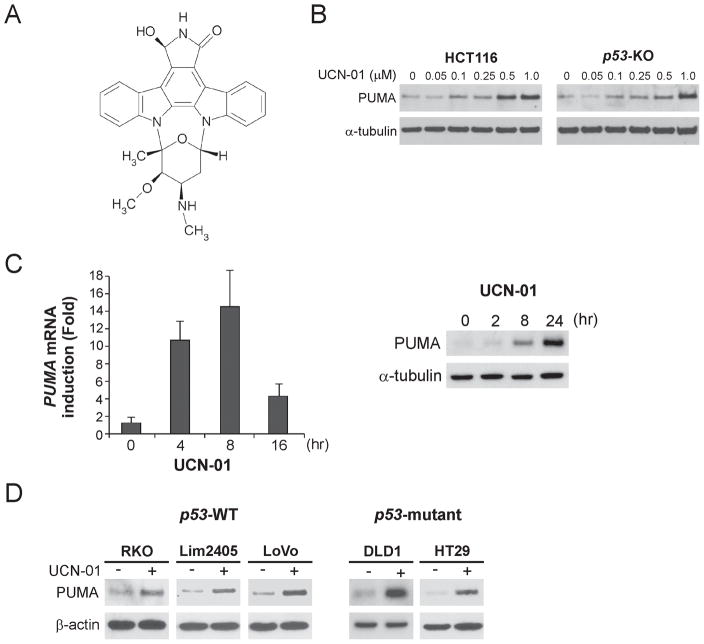
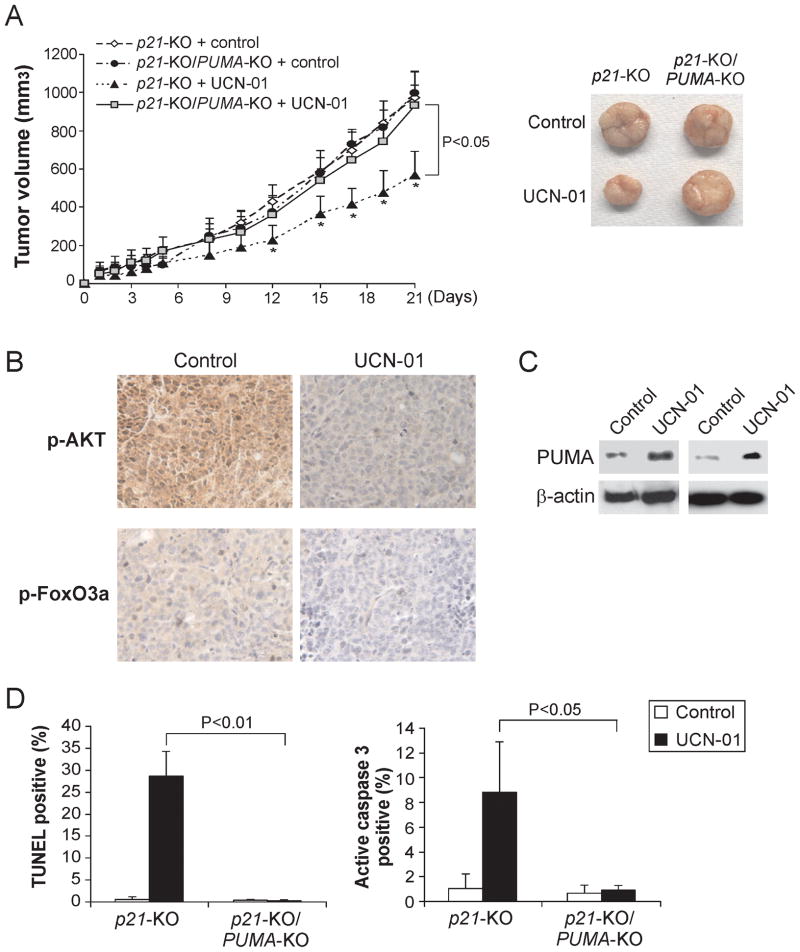
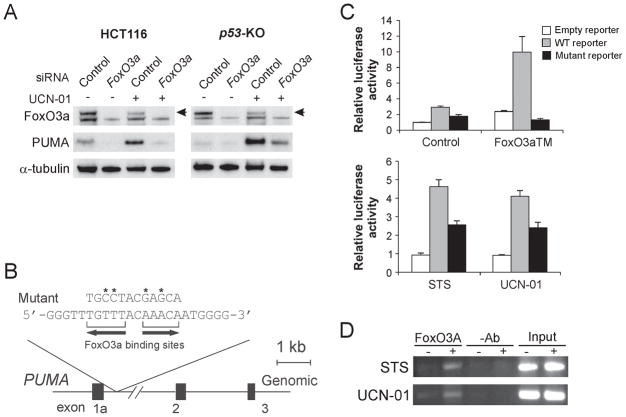
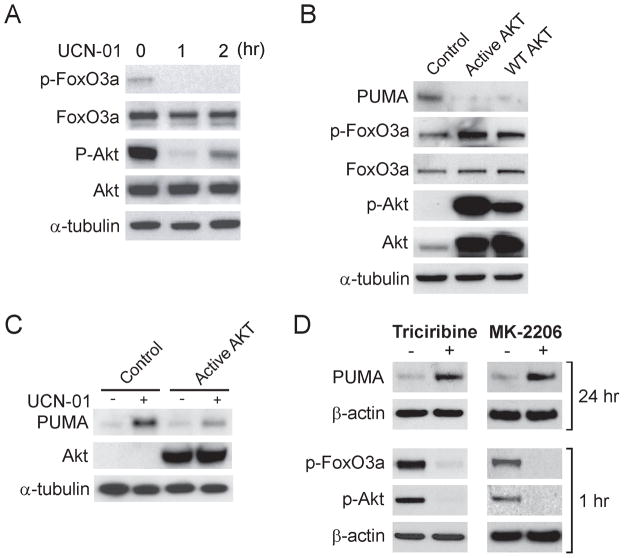
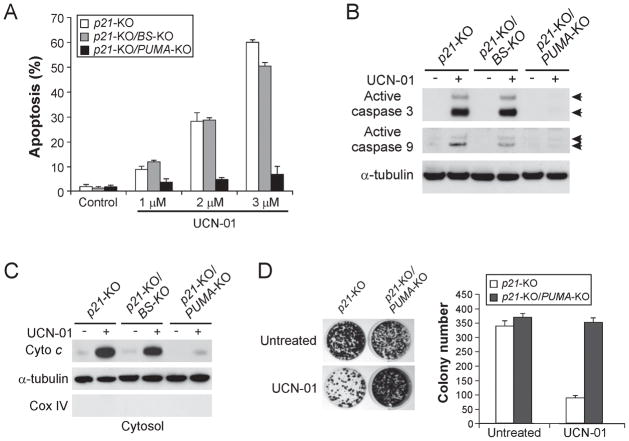
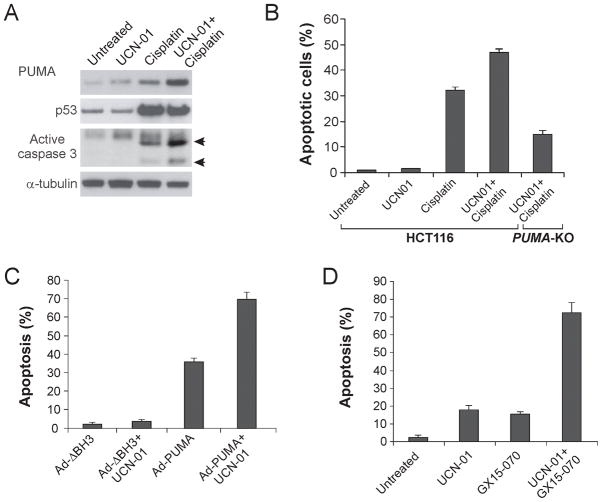
Most targeted anticancer drugs are inhibitors of kinases that are aberrantly activated in cancer cells. However, the mechanisms by which kinase inhibitors suppress tumor growth remain unclear. In this study, we found that UCN-01, a staurosporine analogue and broad-range kinase inhibitor used in clinical trials, inhibits colon cancer cell growth by inducing apoptosis via PUMA, a BH3-only Bcl-2 family member and a p53 target. PUMA expression was markedly elevated in a p53-independent fashion following UCN-01 treatment. The induction of PUMA by UCN-01 was mediated by direct binding of FoxO3a to the PUMA promoter following inhibition of AKT signaling. Deficiency in PUMA abrogated UCN-01-induced apoptosis, caspase activation, and mitochondrial dysfunction, and rendered UCN-01 resistance in a clonogenic assay, whereas elevated PUMA expression or a BH3 mimetic sensitized UCN-01 induced apoptosis. Chemosensitization by UCN-01 seemed to involve simultaneous PUMA induction through both p53-dependent and p53-independent mechanisms. Furthermore, deficiency in PUMA suppressed the antitumor effects of UCN-01 in a xenograft model, concurrent with reduced apoptosis and caspase activation in vivo. These results suggest that PUMA-mediated apoptosis is pivotal for the anticancer activities of UCN-01, and possibly other clinically used kinase inhibitor drugs, and that PUMA manipulation may be useful for improving their anticancer activities.
大多数靶向抗癌药物都是激酶抑制剂,这些激酶在癌细胞中异常激活。然而,激酶抑制剂抑制肿瘤生长的机制仍不清楚。在这项研究中,我们发现 UCN-01,一种临床上用于临床试验的星孢菌素类似物和广谱激酶抑制剂,通过诱导 PUMA 介导的细胞凋亡来抑制结肠癌细胞的生长,PUMA 是一种 BH3 仅 Bcl-2 家族成员和 p53 靶标。UCN-01 处理后,PUMA 的表达以一种不依赖 p53 的方式显著上调。UCN-01 通过 AKT 信号抑制后,FoxO3a 直接结合到 PUMA 启动子上,从而介导 PUMA 的诱导。PUMA 缺陷消除了 UCN-01 诱导的细胞凋亡、半胱天冬酶激活和线粒体功能障碍,并在集落形成试验中赋予 UCN-01 耐药性,而升高的 PUMA 表达或 BH3 模拟物则敏化 UCN-01 诱导的细胞凋亡。UCN-01 的化学增敏作用似乎涉及通过 p53 依赖和 p53 非依赖机制同时诱导 PUMA。此外,PUMA 缺陷抑制了 UCN-01 在异种移植模型中的抗肿瘤作用,同时体内凋亡和半胱天冬酶激活减少。这些结果表明,PUMA 介导的细胞凋亡是 UCN-01 抗癌活性的关键,可能也是其他临床应用的激酶抑制剂药物的关键,并且操纵 PUMA 可能有助于提高它们的抗癌活性。