Zhang Yong-Qing, Chen Rui-Lin, Shang Li-Qun, Yang Shu-Mei
Department of Respiratory and Critical Care Medicine, Shaanxi Provincial People's Hospital, Xi'an, Shaanxi 710068, P.R. China.
Oncol Lett. 2022 Jun 14;24(2):260. doi: 10.3892/ol.2022.13380. eCollection 2022 Aug.
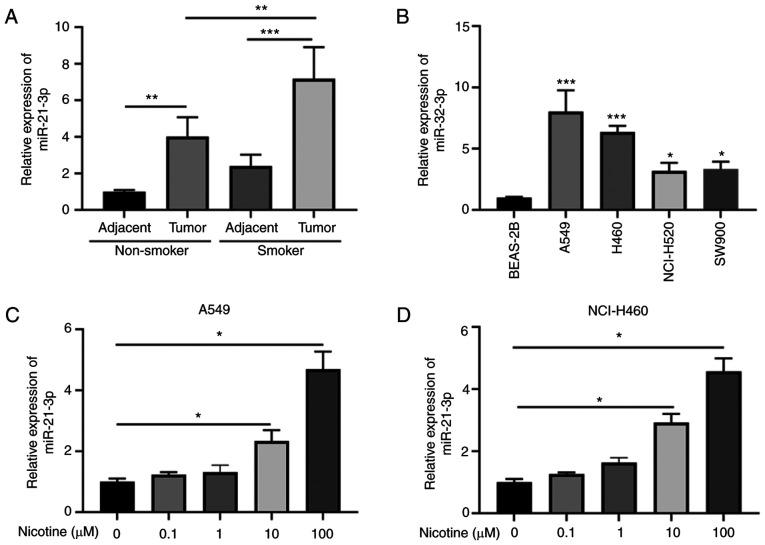
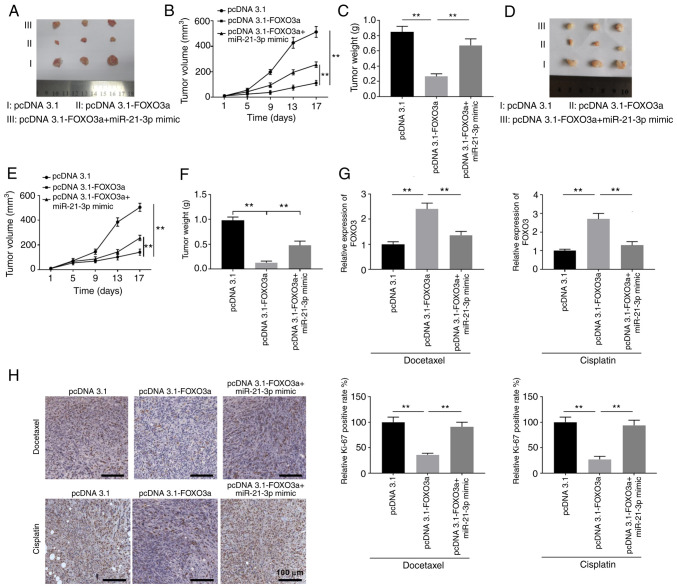
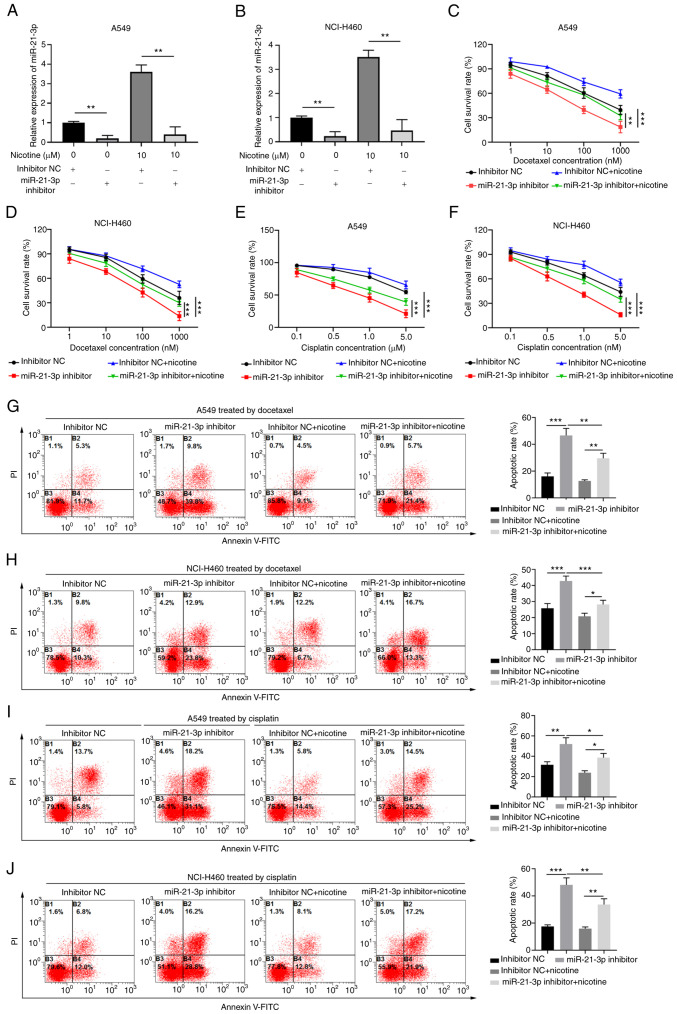
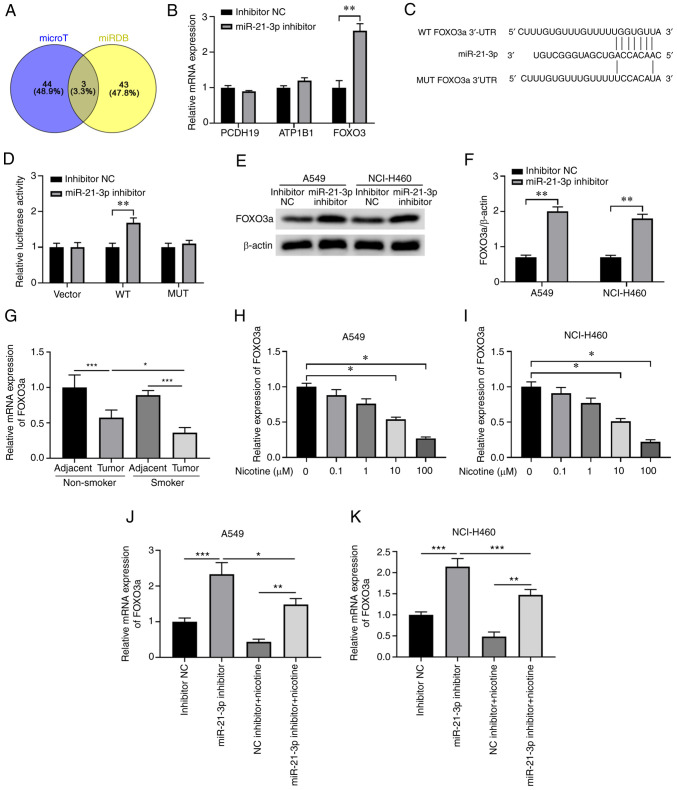
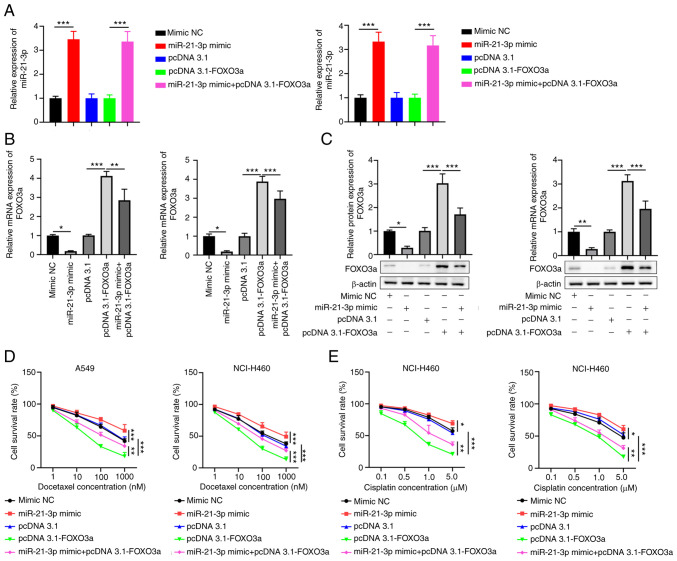
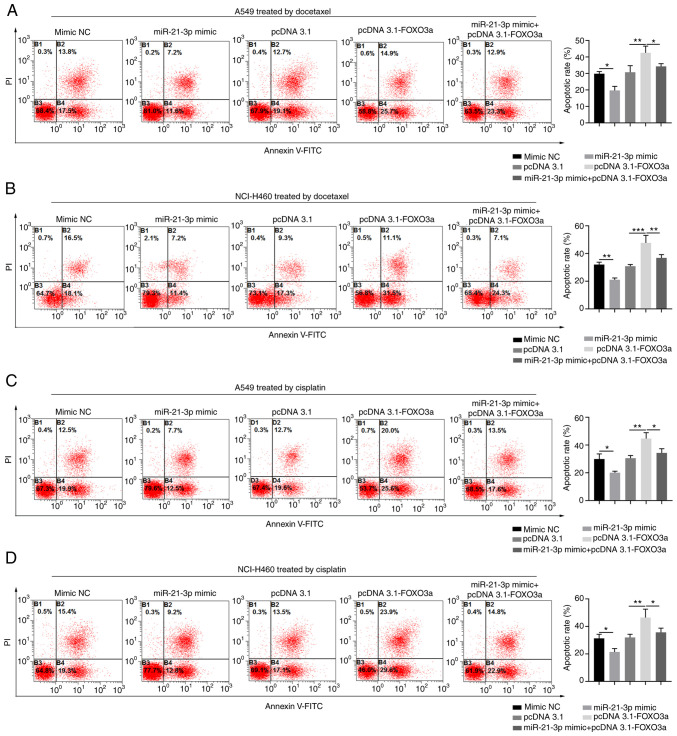
Lung cancer is the leading cause of cancer-related mortality worldwide and cigarette smoking is reported to contribute to the lung cancer-related mortality. The present study aimed to investigate the molecular mechanism underlying nicotine-induced chemoresistance in lung cancer. The expression of microRNA (miR)-21-3p and its predicted target FOXO3a in lung cancer cells was detected via reverse transcription-quantitative PCR, in the presence or absence of nicotine. The regulatory effect of miR-21-3p and FOXO3a on lung cancer cell proliferation and apoptosis induced by docetaxel or cisplatin treatment was evaluated by performing Cell Counting Kit-8 and Annexin V/PI staining assays, respectively. The interaction between miR-21-3p and FOXO3a was analyzed by performing luciferase reporter assays and western blotting. FOXO3a overexpression rescue experiments were conducted and using a xenograft mouse model to assess the function of miR-21-3p/FOXO3a in lung cancer. Nicotine induced miR-21-3p expression in lung cancer cells in a dose-dependent manner. miR-21-3p downregulated FOXO3a expression by directly binding to the 3'-untranslated region of FOXO3a. Moreover, miR-21-3p knockdown sensitized lung cancer cells to docetaxel or cisplatin treatment. Mechanistically, FOXO3a was predicted as a direct target of miR-21-3p. FOXO3a overexpression promoted the chemosensitivity of lung cancer cells to docetaxel or cisplatin treatment. Furthermore, FOXO3a overexpression antagonized the regulatory function of miR-21-3p on docetaxel- or cisplatin-treated lung cancer cells. In the docetaxel- or cisplatin-treated lung cancer xenograft mouse model, miR-21-3p promoted chemoresistance via negatively regulating FOXO3a. Therefore, the present study demonstrated that nicotine-induced miR-21-3p promoted chemoresistance to docetaxel or cisplatin treatment via negatively regulating FOXO3a, which may serve as a novel therapeutic strategy for the treatment of patients with chemoresistant lung cancer.
肺癌是全球癌症相关死亡的主要原因,据报道吸烟会导致与肺癌相关的死亡。本研究旨在探讨尼古丁诱导肺癌细胞产生化学抗性的分子机制。在有或没有尼古丁的情况下,通过逆转录定量PCR检测肺癌细胞中微小RNA(miR)-21-3p及其预测靶点FOXO3a的表达。分别通过细胞计数试剂盒-8和膜联蛋白V/碘化丙啶染色试验评估miR-21-3p和FOXO3a对多西他赛或顺铂治疗诱导的肺癌细胞增殖和凋亡的调节作用。通过荧光素酶报告基因试验和蛋白质免疫印迹分析miR-21-3p与FOXO3a之间的相互作用。进行了FOXO3a过表达挽救实验,并使用异种移植小鼠模型评估miR-21-3p/FOXO3a在肺癌中的功能。尼古丁以剂量依赖性方式诱导肺癌细胞中miR-21-3p的表达。miR-21-3p通过直接结合FOXO3a的3'-非翻译区下调FOXO3a的表达。此外,敲低miR-21-3p可使肺癌细胞对多西他赛或顺铂治疗敏感。机制上,FOXO3a被预测为miR-21-3p的直接靶点。FOXO3a过表达促进肺癌细胞对多西他赛或顺铂治疗的化学敏感性。此外,FOXO3a过表达拮抗miR-21-3p对多西他赛或顺铂处理的肺癌细胞的调节功能。在多西他赛或顺铂处理的肺癌异种移植小鼠模型中,miR-21-3p通过负向调节FOXO3a促进化学抗性。因此,本研究表明,尼古丁诱导的miR-21-3p通过负向调节FOXO3a促进对多西他赛或顺铂治疗的化学抗性,这可能为治疗化学抗性肺癌患者提供一种新的治疗策略。