Georges Lemaître Centre for Earth and Climate Research, Earth and Life Institute, University of Louvain, 3 place Pasteur, Louvain-la-Neuve, B-1348, Belgium.
Int J Health Geogr. 2010 Oct 27;9:54. doi: 10.1186/1476-072X-9-54.
Landscape attributes influence spatial variations in disease risk or incidence. We present a review of the key findings from eight case studies that we conducted in Europe and West Africa on the impact of land changes on emerging or re-emerging vector-borne diseases and/or zoonoses. The case studies concern West Nile virus transmission in Senegal, tick-borne encephalitis incidence in Latvia, sandfly abundance in the French Pyrenees, Rift Valley Fever in the Ferlo (Senegal), West Nile Fever and the risk of malaria re-emergence in the Camargue, and rodent-borne Puumala hantavirus and Lyme borreliosis in Belgium.
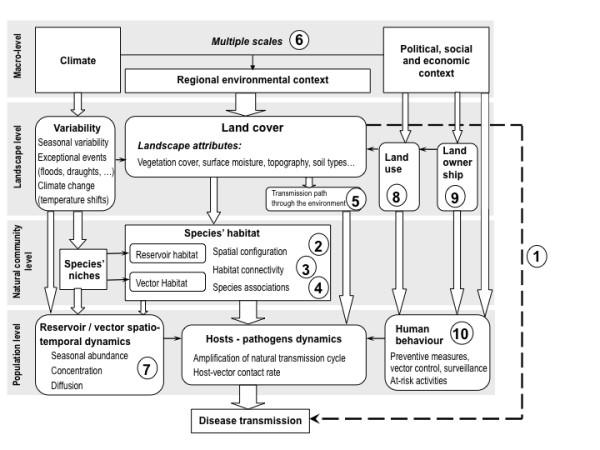
We identified general principles governing landscape epidemiology in these diverse disease systems and geographic regions. We formulated ten propositions that are related to landscape attributes, spatial patterns and habitat connectivity, pathways of pathogen transmission between vectors and hosts, scale issues, land use and ownership, and human behaviour associated with transmission cycles.
A static view of the "pathogenecity" of landscapes overlays maps of the spatial distribution of vectors and their habitats, animal hosts carrying specific pathogens and their habitat, and susceptible human hosts and their land use. A more dynamic view emphasizing the spatial and temporal interactions between these agents at multiple scales is more appropriate. We also highlight the complementarity of the modelling approaches used in our case studies. Integrated analyses at the landscape scale allows a better understanding of interactions between changes in ecosystems and climate, land use and human behaviour, and the ecology of vectors and animal hosts of infectious agents.
景观属性会影响疾病风险或发病率的空间变化。我们回顾了在欧洲和西非进行的八项案例研究的主要结果,这些研究涉及土地变化对新出现或再现的虫媒传染病和/或人畜共患病的影响。这些案例研究涉及塞内加尔的西尼罗河病毒传播、拉脱维亚的蜱传脑炎发病率、法国比利牛斯山脉的沙蝇丰度、塞内加尔的裂谷热、塞内加尔的费洛的西尼罗河热和疟疾再现风险、比利时的鼠传普马拉汉坦病毒和莱姆病。
我们确定了这些不同疾病系统和地理区域景观流行病学的一般原则。我们提出了十个命题,这些命题与景观属性、空间格局和栖息地连通性、媒介与宿主之间病原体传播的途径、规模问题、土地利用和所有权以及与传播周期相关的人类行为有关。
将景观的“病原体”静态地视为覆盖了媒介及其栖息地、携带特定病原体的动物宿主及其栖息地以及易感人类宿主及其土地利用的空间分布地图。更强调这些因素在多个尺度上的时空相互作用的动态观点更为合适。我们还强调了我们案例研究中使用的建模方法的互补性。在景观尺度上进行综合分析可以更好地理解生态系统和气候变化、土地利用和人类行为以及传染病媒介和动物宿主的生态学之间的相互作用。