Department of Environmental Health, Boston University School of Public Health, Boston, MA, USA.
Environ Health. 2010 Oct 27;9:65. doi: 10.1186/1476-069X-9-65.
Traffic congestion is a significant issue in urban areas in the United States and around the world. Previous analyses have estimated the economic costs of congestion, related to fuel and time wasted, but few have quantified the public health impacts or determined how these impacts compare in magnitude to the economic costs. Moreover, the relative magnitudes of economic and public health impacts of congestion would be expected to vary significantly across urban areas, as a function of road infrastructure, population density, and atmospheric conditions influencing pollutant formation, but this variability has not been explored.
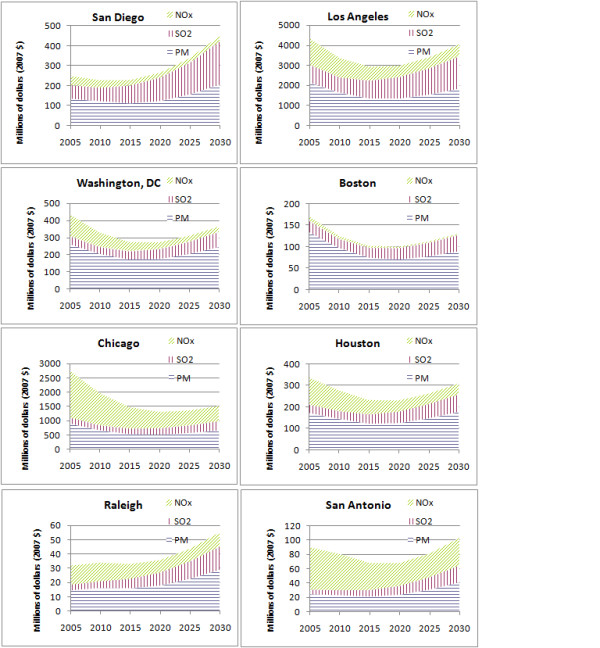
In this study, we evaluate the public health impacts of ambient exposures to fine particulate matter (PM2.5) concentrations associated with a business-as-usual scenario of predicted traffic congestion. We evaluate 83 individual urban areas using traffic demand models to estimate the degree of congestion in each area from 2000 to 2030. We link traffic volume and speed data with the MOBILE6 model to characterize emissions of PM2.5 and particle precursors attributable to congestion, and we use a source-receptor matrix to evaluate the impact of these emissions on ambient PM2.5 concentrations. Marginal concentration changes are related to a concentration-response function for mortality, with a value of statistical life approach used to monetize the impacts.
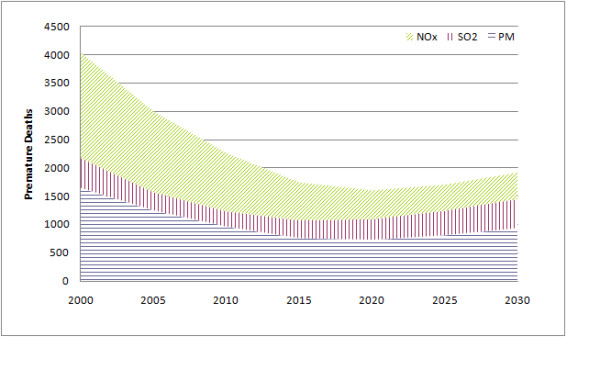
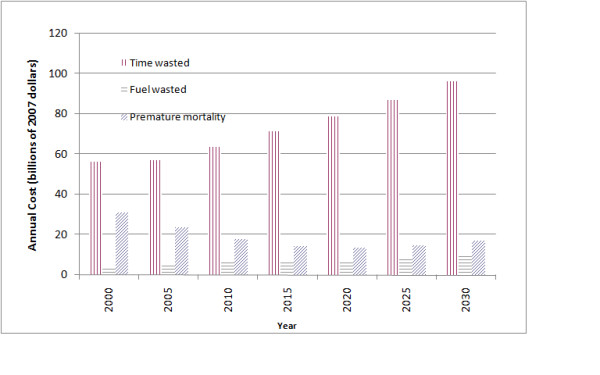
We estimate that the monetized value of PM2.5-related mortality attributable to congestion in these 83 cities in 2000 was approximately $31 billion (2007 dollars), as compared with a value of time and fuel wasted of $60 billion. In future years, the economic impacts grow (to over $100 billion in 2030) while the public health impacts decrease to $13 billion in 2020 before increasing to $17 billion in 2030, given increasing population and congestion but lower emissions per vehicle. Across cities and years, the public health impacts range from more than an order of magnitude less to in excess of the economic impacts.
Our analyses indicate that the public health impacts of congestion may be significant enough in magnitude, at least in some urban areas, to be considered in future evaluations of the benefits of policies to mitigate congestion.
交通拥堵是美国和世界各地城市面临的一个重大问题。先前的分析已经估算了拥堵造成的经济成本,包括浪费的燃料和时间,但很少有人量化拥堵造成的公共卫生影响,也没有确定这些影响在多大程度上与经济成本相当。此外,由于道路基础设施、人口密度以及影响污染物形成的大气条件不同,拥堵的经济和公共卫生影响的相对程度预计会在各个城市之间有很大差异,但这种可变性尚未得到探索。
在这项研究中,我们评估了与预测的交通拥堵的常规情景相关的环境细颗粒物(PM2.5)浓度暴露对公共卫生的影响。我们使用交通需求模型评估了 83 个单独的城市,以估算每个城市从 2000 年到 2030 年的拥堵程度。我们将交通量和速度数据与 MOBILE6 模型结合使用,以描述拥堵造成的 PM2.5 和颗粒物前体物的排放,并使用源受体矩阵来评估这些排放对环境 PM2.5 浓度的影响。边际浓度变化与死亡率的浓度反应函数有关,使用统计生命价值方法来货币化这些影响。
我们估计,在 2000 年,这 83 个城市中因拥堵造成的与 PM2.5 相关的死亡的货币化价值约为 310 亿美元(2007 年美元),而浪费的时间和燃料的价值为 600 亿美元。在未来几年,经济影响(到 2030 年超过 1000 亿美元)增长,而公共卫生影响(到 2020 年降至 130 亿美元,然后到 2030 年增至 170 亿美元),这是由于人口和拥堵增加,但每辆车的排放量减少。在不同的城市和年份,公共卫生影响的范围从数量级上低于经济影响到超过经济影响。
我们的分析表明,拥堵造成的公共卫生影响在某些城市可能大到足以在未来评估缓解拥堵政策的收益时加以考虑。