• 文献检索
  • 文档翻译
  • 深度研究
  • 学术资讯
  • Suppr Zotero 插件Zotero 插件
  • 邀请有礼
  • 套餐&价格
  • 历史记录
应用&插件
Suppr Zotero 插件Zotero 插件浏览器插件Mac 客户端Windows 客户端微信小程序
定价
高级版会员购买积分包购买API积分包
服务
文献检索文档翻译深度研究API 文档MCP 服务
关于我们
关于 Suppr公司介绍联系我们用户协议隐私条款
关注我们

Suppr 超能文献

核心技术专利:CN118964589B侵权必究
粤ICP备2023148730 号-1Suppr @ 2026

文献检索

告别复杂PubMed语法,用中文像聊天一样搜索,搜遍4000万医学文献。AI智能推荐,让科研检索更轻松。

立即免费搜索

文件翻译

保留排版,准确专业,支持PDF/Word/PPT等文件格式,支持 12+语言互译。

免费翻译文档

深度研究

AI帮你快速写综述,25分钟生成高质量综述,智能提取关键信息,辅助科研写作。

立即免费体验

三种红外热探测系统与自我报告在大规模发热筛查中的比较。

Comparison of 3 infrared thermal detection systems and self-report for mass fever screening.

机构信息

Centers for Disease Control and Prevention, Atlanta, Georgia 30333, USA.

出版信息

Emerg Infect Dis. 2010 Nov;16(11):1710-7. doi: 10.3201/eid1611.100703.

DOI:10.3201/eid1611.100703
PMID:21029528
原文链接:https://pmc.ncbi.nlm.nih.gov/articles/PMC3294528/
Abstract

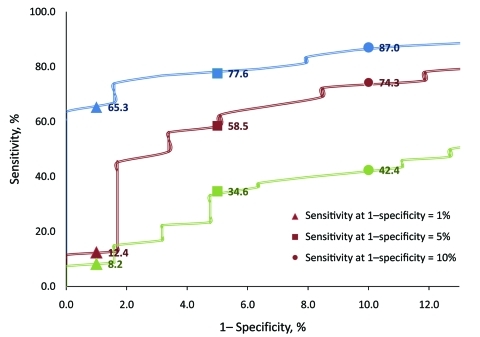
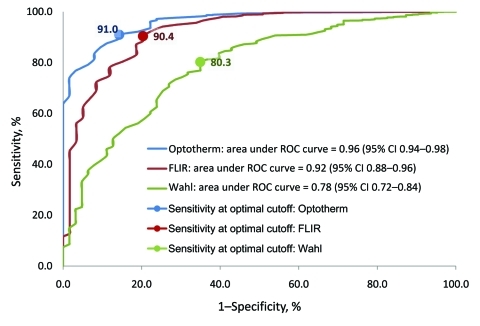
Despite limited evidence regarding their utility, infrared thermal detection systems (ITDS) are increasingly being used for mass fever detection. We compared temperature measurements for 3 ITDS (FLIR ThermoVision A20M [FLIR Systems Inc., Boston, MA, USA], OptoTherm Thermoscreen [OptoTherm Thermal Imaging Systems and Infrared Cameras Inc., Sewickley, PA, USA], and Wahl Fever Alert Imager HSI2000S [Wahl Instruments Inc., Asheville, NC, USA]) with oral temperatures (≥ 100 °F = confirmed fever) and self-reported fever. Of 2,873 patients enrolled, 476 (16.6%) reported a fever, and 64 (2.2%) had a confirmed fever. Self-reported fever had a sensitivity of 75.0%, specificity 84.7%, and positive predictive value 10.1%. At optimal cutoff values for detecting fever, temperature measurements by OptoTherm and FLIR had greater sensitivity (91.0% and 90.0%, respectively) and specificity (86.0% and 80.0%, respectively) than did self-reports. Correlations between ITDS and oral temperatures were similar for OptoTherm (ρ = 0.43) and FLIR (ρ = 0.42) but significantly lower for Wahl (ρ = 0.14; p < 0.001). When compared with oral temperatures, 2 systems (OptoTherm and FLIR) were reasonably accurate for detecting fever and predicted fever better than self-reports.

摘要

尽管红外热检测系统(ITDS)的实用性证据有限,但它们越来越多地被用于大规模发热检测。我们比较了 3 种 ITDS(FLIR ThermoVision A20M [FLIR Systems Inc.,马萨诸塞州波士顿,美国]、OptoTherm Thermoscreen [OptoTherm Thermal Imaging Systems and Infrared Cameras Inc.,宾夕法尼亚州 Sewickley,美国]和 Wahl Fever Alert Imager HSI2000S [Wahl Instruments Inc.,北卡罗来纳州阿什维尔,美国])的温度测量值与口腔温度(≥100°F=确诊发热)和自我报告的发热情况。在纳入的 2873 名患者中,476 名(16.6%)报告有发热,64 名(2.2%)有确诊发热。自我报告的发热具有 75.0%的敏感性、84.7%的特异性和 10.1%的阳性预测值。在检测发热的最佳截断值下,OptoTherm 和 FLIR 的温度测量值具有更高的敏感性(分别为 91.0%和 90.0%)和特异性(分别为 86.0%和 80.0%),而自我报告的发热则不然。OptoTherm(ρ=0.43)和 FLIR(ρ=0.42)的 ITDS 与口腔温度之间的相关性相似,但 Wahl 的相关性明显较低(ρ=0.14;p<0.001)。与口腔温度相比,2 种系统(OptoTherm 和 FLIR)在检测发热方面具有相当的准确性,并且比自我报告的发热预测更好。
https://cdn.ncbi.nlm.nih.gov/pmc/blobs/60dc/3294528/43cd42ab1844/10-0703-F2.jpg
https://cdn.ncbi.nlm.nih.gov/pmc/blobs/60dc/3294528/64fb940ee041/10-0703-F1.jpg
https://cdn.ncbi.nlm.nih.gov/pmc/blobs/60dc/3294528/43cd42ab1844/10-0703-F2.jpg
https://cdn.ncbi.nlm.nih.gov/pmc/blobs/60dc/3294528/64fb940ee041/10-0703-F1.jpg
https://cdn.ncbi.nlm.nih.gov/pmc/blobs/60dc/3294528/43cd42ab1844/10-0703-F2.jpg

相似文献

1
Comparison of 3 infrared thermal detection systems and self-report for mass fever screening.三种红外热探测系统与自我报告在大规模发热筛查中的比较。
Emerg Infect Dis. 2010 Nov;16(11):1710-7. doi: 10.3201/eid1611.100703.
2
Mass screening for fever in children: a comparison of 3 infrared thermal detection systems.儿童发热的大规模筛查:三种红外热检测系统的比较
Pediatr Emerg Care. 2013 Mar;29(3):305-13. doi: 10.1097/PEC.0b013e3182854465.
3
Comparison of Infrared Thermal Detection Systems for mass fever screening in a tropical healthcare setting.热带医疗环境中用于大规模发热筛查的红外热检测系统比较
Public Health. 2015 Nov;129(11):1471-8. doi: 10.1016/j.puhe.2015.07.023. Epub 2015 Aug 18.
4
Is thermal scanner losing its bite in mass screening of fever due to SARS?在对非典引发的发热进行大规模筛查时,热扫描仪是否正失去其效力?
Med Phys. 2005 Jan;32(1):93-7. doi: 10.1118/1.1819532.
5
Utility of infrared thermography for screening febrile subjects.红外热成像技术在发热患者筛查中的应用。
Hong Kong Med J. 2013 Apr;19(2):109-15.
6
Simple infrared thermometry in fever detection: consideration in mass fever screening.发热检测中的简易红外测温法:大规模发热筛查中的考量
Am J Disaster Med. 2015 Winter;10(1):69-74. doi: 10.5055/ajdm.2015.0190.
7
Evaluation of an infrared thermal detection system for fever recognition during the H1N1 influenza pandemic.甲型 H1N1 流感大流行期间用于发热识别的红外热探测系统评估。
Infect Control Hosp Epidemiol. 2011 May;32(5):504-6. doi: 10.1086/659404.
8
Temperature-compensated infrared-based low-cost mobile platform module for mass human temperature screening.用于大规模人体体温筛查的基于温度补偿红外的低成本移动平台模块。
Appl Opt. 2020 Jun 10;59(17):E112-E117. doi: 10.1364/AO.388313.
9
Non-contact infrared thermal imagers may still be useful for mass fever screening.
Hong Kong Med J. 2006 Aug;12(4):328.
10
Analysis of IR thermal imager for mass blind fever screening.用于大规模盲测发热筛查的红外热成像仪分析
Microvasc Res. 2004 Sep;68(2):104-9. doi: 10.1016/j.mvr.2004.05.003.

引用本文的文献

1
Introducing the Pi-CON Methodology to Overcome Usability Deficits during Remote Patient Monitoring.引入 Pi-CON 方法学以克服远程患者监护中的可用性缺陷。
Sensors (Basel). 2024 Apr 2;24(7):2260. doi: 10.3390/s24072260.
2
"Smart markets": harnessing the potential of new technologies for endemic and emerging infectious disease surveillance in traditional food markets.“智能市场”:利用新技术在传统食品市场进行地方病和新发传染病监测的潜力
J Virol. 2024 Feb 20;98(2):e0168323. doi: 10.1128/jvi.01683-23. Epub 2024 Jan 16.
3
Use of Infrared Thermography in Medical Diagnosis, Screening, and Disease Monitoring: A Scoping Review.

本文引用的文献

1
Entry screening to delay local transmission of 2009 pandemic influenza A (H1N1).入境筛查可延缓 2009 年大流行流感 A(H1N1)的本地传播。
BMC Infect Dis. 2010 Mar 30;10:82. doi: 10.1186/1471-2334-10-82.
2
What is the evidence base for the assessment and evaluation of body temperature?评估和评价体温的证据基础是什么?
Nurs Times. 2010;106(1):10-3.
3
Lack of airborne transmission during outbreak of pandemic (H1N1) 2009 among tour group members, China, June 2009.2009 年 6 月,中国暴发的甲型 H1N1 流感疫情期间,旅行团成员中未发生空气传播。
红外热成像在医学诊断、筛查和疾病监测中的应用:范围综述。
Medicina (Kaunas). 2023 Dec 9;59(12):2139. doi: 10.3390/medicina59122139.
4
Non-Contact Infrared Thermometers and Thermal Scanners for Human Body Temperature Monitoring: A Systematic Review.非接触式红外体温计和热扫描仪在人体体温监测中的应用:系统评价。
Sensors (Basel). 2023 Aug 26;23(17):7439. doi: 10.3390/s23177439.
5
Infrared image method for possible COVID-19 detection through febrile and subfebrile people screening.通过发热和低热人群筛查进行可能的 COVID-19 检测的红外图像方法。
J Therm Biol. 2023 Feb;112:103444. doi: 10.1016/j.jtherbio.2022.103444. Epub 2022 Dec 28.
6
Determination of Internal Temperature by Measuring the Temperature of the Body Surface Due to Environmental Physical Factors-First Study of Fever Screening in the COVID Pandemic.环境物理因素导致体表温度测量的体内温度测定——COVID 大流行中发热筛查的初步研究。
Int J Environ Res Public Health. 2022 Dec 8;19(24):16511. doi: 10.3390/ijerph192416511.
7
Statistical Study on Human Temperature Measurement by Infrared Thermography.红外热成像技术测量人体温度的统计研究。
Sensors (Basel). 2022 Nov 1;22(21):8395. doi: 10.3390/s22218395.
8
Physician perceptions of surveillance: Wearables, Apps, and Chatbots for COVID-19.医生对监测的看法:用于新冠肺炎的可穿戴设备、应用程序和聊天机器人
Digit Med. 2022 May 12. doi: 10.4103/digm.digm_28_21.
9
Pilot Influenza Syndromic Surveillance System Based on Absenteeism and Temperature in China: Development and Usability Study.基于缺勤和体温的中国流感综合征监测系统:开发和可用性研究。
JMIR Public Health Surveill. 2022 Oct 14;8(10):e37177. doi: 10.2196/37177.
10
Wireless Technologies for Social Distancing in the Time of COVID-19: Literature Review, Open Issues, and Limitations.COVID-19 时期用于社交隔离的无线技术:文献综述、开放性问题和局限性。
Sensors (Basel). 2022 Mar 17;22(6):2313. doi: 10.3390/s22062313.
Emerg Infect Dis. 2009 Oct;15(10):1578-81. doi: 10.3201/eid1510.091013.
4
U.S. airport entry screening in response to pandemic influenza: modeling and analysis.美国应对大流行性流感的机场入境筛查:建模与分析。
Travel Med Infect Dis. 2009 Jul;7(4):181-91. doi: 10.1016/j.tmaid.2009.02.006. Epub 2009 Apr 14.
5
Circadian temperature variation and ageing.昼夜体温变化与衰老。
Ageing Res Rev. 2010 Jan;9(1):51-60. doi: 10.1016/j.arr.2009.07.003. Epub 2009 Jul 18.
6
International travels and fever screening during epidemics: a literature review on the effectiveness and potential use of non-contact infrared thermometers.国际旅行与疫情期间的发热筛查:关于非接触式红外体温计有效性及潜在用途的文献综述
Euro Surveill. 2009 Feb 12;14(6):19115.
7
Remote-sensing infrared thermography.遥感红外热成像技术。
IEEE Eng Med Biol Mag. 2009 Jan-Feb;28(1):76-83. doi: 10.1109/MEMB.2008.931018.
8
Mass screening of suspected febrile patients with remote-sensing infrared thermography: alarm temperature and optimal distance.利用遥感红外热成像技术对疑似发热患者进行大规模筛查:报警温度与最佳距离
J Formos Med Assoc. 2008 Dec;107(12):937-44. doi: 10.1016/S0929-6646(09)60017-6.
9
Cutaneous infrared thermometry for detecting febrile patients.用于检测发热患者的皮肤红外测温法。
Emerg Infect Dis. 2008 Aug;14(8):1255-8. doi: 10.3201/eid1408.080059.
10
Guidelines for evaluation of new fever in critically ill adult patients: 2008 update from the American College of Critical Care Medicine and the Infectious Diseases Society of America.危重症成年患者新发发热评估指南:美国重症医学会和美国感染病学会2008年更新版
Crit Care Med. 2008 Apr;36(4):1330-49. doi: 10.1097/CCM.0b013e318169eda9.