Human Sciences Research Council, Pretoria, South Africa.
Subst Use Misuse. 2010 Nov;45(13):2221-43. doi: 10.3109/10826084.2010.481594.
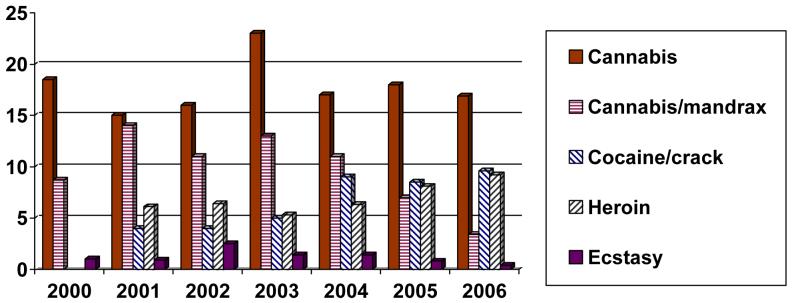
This review synthesizes available epidemiological data on current drug use and substance user treatment admissions in South Africa since 1994, and how changes in the political, economic, and social structures within South Africa, both before and after Apartheid, has made the country more vulnerable to drug use. Based on national surveys, current use of cannabis ranged among adolescents from 2% to 9% and among adults it was 2%, cocaine/crack (0.3%), mandrax/sedatives (0.3%), club drugs/amphetamine-type stimulants (0.2%), opiates (0.1%), and hallucinogens (0.1%). The use of primary illicit substance at admission to South African drug user treatment centers was cannabis 16.9%, methamphetamine (tik) 12.8%, crack/cocaine 9.6%, cannabis and mandrax 3.4%, heroin/opiates 9.2%, and prescription and OTC drugs 2.6%. An increase in substance user treatment admissions has increased. While the prevalence of illicit drug use in South Africa is relatively low compared to the United States and Australia, prevention and intervention policies need to be designed to reduce these levels by targeting the more risky subpopulations identified from this review.
这篇综述综合了自 1994 年以来南非可用的药物使用和药物使用者治疗入院的流行病学数据,以及南非国内外政治、经济和社会结构的变化如何使该国更容易受到药物使用的影响。基于全国性调查,青少年中目前使用大麻的比例为 2%至 9%,成年人中为 2%,可卡因/快克(0.3%),苯丙胺类兴奋剂(0.2%),阿片类药物(0.1%)和迷幻剂(0.1%)。南非药物使用者治疗中心入院时主要非法物质的使用情况为大麻 16.9%,冰毒(蒂克)12.8%,快克/可卡因 9.6%,大麻和苯丙胺 3.4%,海洛因/阿片类药物 9.2%,处方和 OTC 药物 2.6%。药物使用者治疗入院人数有所增加。虽然与美国和澳大利亚相比,南非非法药物使用的流行率相对较低,但需要制定预防和干预政策,通过针对从本次综述中确定的更危险的亚人群来降低这些水平。