eHealth Research Group, Centre for Population Health Sciences, The University of Edinburgh, Edinburgh, UK.
BMC Med Inform Decis Mak. 2010 Nov 1;10:67. doi: 10.1186/1472-6947-10-67.
Actor-Network Theory (ANT) is an increasingly influential, but still deeply contested, approach to understand humans and their interactions with inanimate objects. We argue that health services research, and in particular evaluations of complex IT systems in health service organisations, may benefit from being informed by Actor-Network Theory perspectives.
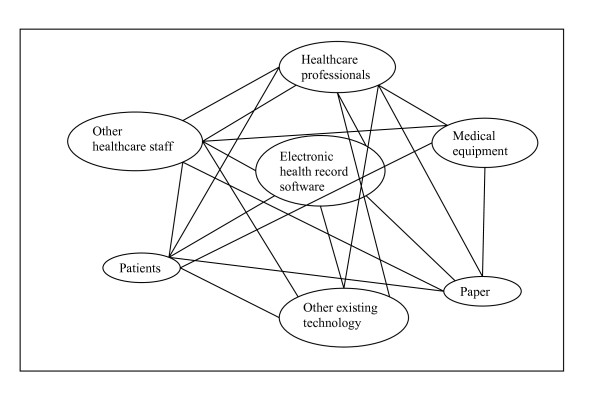
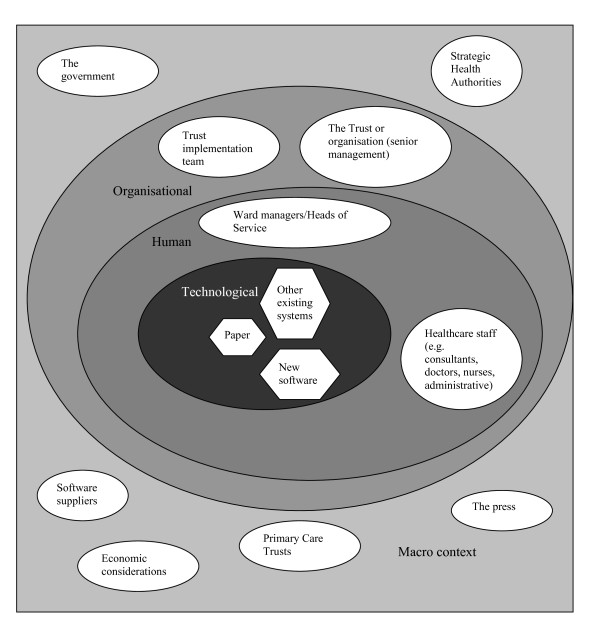
Despite some limitations, an Actor-Network Theory-based approach is conceptually useful in helping to appreciate the complexity of reality (including the complexity of organisations) and the active role of technology in this context. This can prove helpful in understanding how social effects are generated as a result of associations between different actors in a network. Of central importance in this respect is that Actor-Network Theory provides a lens through which to view the role of technology in shaping social processes. Attention to this shaping role can contribute to a more holistic appreciation of the complexity of technology introduction in healthcare settings. It can also prove practically useful in providing a theoretically informed approach to sampling (by drawing on informants that are related to the technology in question) and analysis (by providing a conceptual tool and vocabulary that can form the basis for interpretations). We draw on existing empirical work in this area and our ongoing work investigating the integration of electronic health record systems introduced as part of England's National Programme for Information Technology to illustrate salient points.
Actor-Network Theory needs to be used pragmatically with an appreciation of its shortcomings. Our experiences suggest it can be helpful in investigating technology implementations in healthcare settings.
行动者网络理论(ANT)是一种越来越有影响力但仍存在争议的方法,用于理解人类及其与无生命物体的相互作用。我们认为,健康服务研究,特别是对卫生服务组织中复杂的 IT 系统的评估,可以从行动者网络理论的角度得到启发。
尽管存在一些局限性,但基于行动者网络理论的方法在帮助理解现实的复杂性(包括组织的复杂性)以及技术在这种情况下的积极作用方面具有概念上的有用性。这有助于理解如何由于网络中不同行动者之间的关联而产生社会影响。在这方面,至关重要的是,行动者网络理论提供了一个视角,可以观察技术在塑造社会过程中的作用。关注这一塑造作用有助于更全面地理解医疗保健环境中技术引入的复杂性。它还可以通过提供一种理论上的方法来进行抽样(通过与相关技术的信息提供者联系)和分析(通过提供可以作为解释基础的概念工具和词汇),从而在实践中证明是有用的。我们借鉴了该领域的现有实证工作以及我们正在进行的研究,以说明电子健康记录系统整合的情况,这些系统是作为英格兰国家信息技术计划的一部分引入的。
行动者网络理论需要在理解其缺点的情况下务实使用。我们的经验表明,它在调查医疗保健环境中的技术实施情况方面可能会有所帮助。