Department of Clinical Science, Intervention and Technology, Karolinska Institute, Stockholm, Sweden.
PLoS One. 2010 Oct 22;5(10):e13582. doi: 10.1371/journal.pone.0013582.
Sub-Saharan Africa is facing rapidly increasing prevalences of cardiovascular disease, obesity, diabetes and hypertension. Previous and ongoing undernutrition among pregnant women may contribute to this development as suggested by epidemiological studies from high income countries linking undernutrition in fetal life with increased burden of non-communicable diseases in later life. We undertook to study the risks for hypertension, glucose intolerance and overweight forty years after fetal exposure to famine afflicted Biafra during the Nigerian civil war (1967-1970).
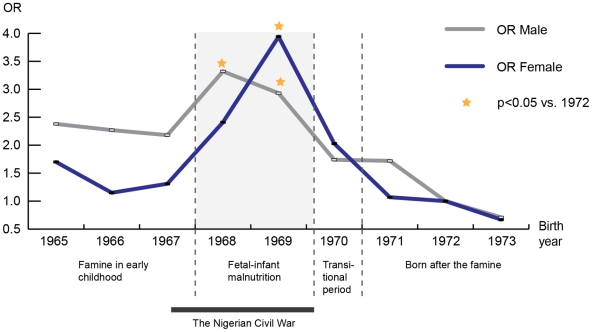
Cohort study performed in June 27-July 31, 2009 in Enugu, Nigeria. Adults (n = 1,339) born before (1965-67), during (1968-January 1970), or after (1971-73) the years of famine were included. Blood pressure (BP), random plasma glucose (p-glucose) and anthropometrics, as well as prevalence of hypertension (BP>140/90 mmHg), impaired glucose tolerance (IGT; p-glucose 7.8-11.0 mmol/l), diabetes (DM; p-glucose ≥11.1 mmol/l), or overweight (BMI>25 kg/m(2)) were compared between the three groups. Fetal-infant exposure to famine was associated with elevated systolic (+7 mmHg; p<0.001) and diastolic (+5 mmHg; p<0.001) BP, increased p-glucose (+0.3 mmol/L; p<0.05) and waist circumference (+3 cm, p<0.001), increased risk of systolic hypertension (adjusted OR 2.87; 95% CI 1.90-4.34), IGT (OR 1.65; 95% CI 1.02-2.69) and overweight (OR 1.41; 95% CI 1.03-1.93) as compared to people born after the famine. Limitations of this study include the lack of birth weight data and the inability to separate effects of fetal and infant famine.
Fetal and infant undernutrition is associated with significantly increased risk of hypertension and impaired glucose tolerance in 40-year-old Nigerians. Prevention of undernutrition during pregnancy and in infancy should therefore be given high priority in health, education, and economic agendas.
撒哈拉以南非洲地区心血管疾病、肥胖、糖尿病和高血压的患病率正在迅速上升。来自高收入国家的流行病学研究表明,孕妇先前和持续的营养不足可能导致这种情况的发生,这些研究表明胎儿期的营养不足与以后生活中非传染性疾病负担的增加有关。我们着手研究在尼日利亚内战(1967-1970 年)期间,胎儿暴露于比夫拉饥荒后 40 年时,高血压、葡萄糖耐量受损和超重的风险。
2009 年 6 月 27 日至 7 月 31 日在尼日利亚埃努古进行的队列研究。纳入了 1965-1967 年之前、1968-1970 年期间或 1971-1973 年之后出生的成年人(n=1339)。比较了三组之间的血压(BP)、随机血浆葡萄糖(p-葡萄糖)和人体测量学,以及高血压(BP>140/90 mmHg)、葡萄糖耐量受损(IGT;p-葡萄糖 7.8-11.0 mmol/L)、糖尿病(DM;p-葡萄糖≥11.1 mmol/L)或超重(BMI>25 kg/m(2))的患病率。胎儿-婴儿期暴露于饥荒与收缩压升高(+7 mmHg;p<0.001)和舒张压升高(+5 mmHg;p<0.001)、p-葡萄糖升高(+0.3 mmol/L;p<0.05)和腰围增加(+3 cm,p<0.001)、收缩期高血压的风险增加(调整后的 OR 2.87;95% CI 1.90-4.34)、IGT(OR 1.65;95% CI 1.02-2.69)和超重(OR 1.41;95% CI 1.03-1.93)有关。本研究的局限性包括缺乏出生体重数据和无法区分胎儿和婴儿期饥荒的影响。
胎儿和婴儿期营养不良与 40 岁尼日利亚人的高血压和葡萄糖耐量受损风险显著增加有关。因此,应在卫生、教育和经济议程中高度重视孕妇和婴儿期的营养不足预防。