Goldacre Michael J, Laxton Louise, Harrison Ewen M, Richards Jennifer M J, Lambert Trevor W, Parks Rowan W
UK Medical Careers Research Group, Department of Public Health, Oxford University, Oxford, UK.
BMC Surg. 2010 Nov 2;10:32. doi: 10.1186/1471-2482-10-32.
Changes to the structure of medical training worldwide require doctors to decide on their career specialty at an increasingly early stage after graduation. We studied trends in career choices for surgery, and the eventual career destinations, of UK graduates who declared an early preference for surgery.
Postal questionnaires were sent, at regular time intervals after qualification, to all medical qualifiers from all UK medical schools in selected qualification years between 1974 and 2005. They were sent in the first year after qualification, at year three and five years after qualification, and at longer time intervals thereafter.
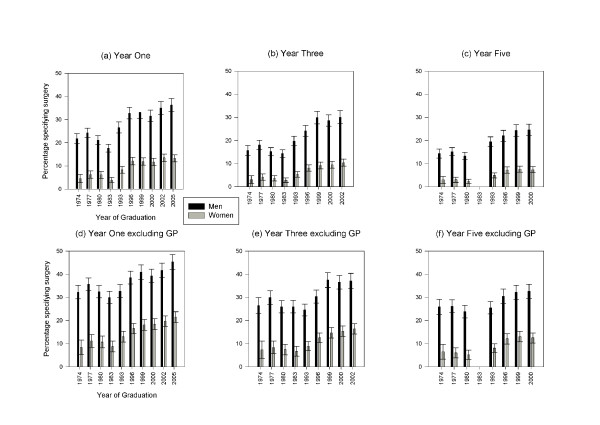
Responses were received from 27,749 of 38,280 doctors (73%) at year one, 23,468 of 33,151 (71%) at year three, and 17,689 of 24,870 (71%) at year five. Early career preferences showed that surgery has become more popular over the past two decades. Looking forward from early career choice, 60% of respondents (64% of men, 48% of women) with a first preference for a surgical specialty at year one eventually worked in surgery (p < 0.001 for the male-female comparison). Looking backward from eventual career destinations, 90% of responders working in surgery had originally specified a first choice for a surgical specialty at year one. 'Match' rates between eventual destinations and early choices were much higher for surgery than for other specialties. Considering factors that influenced early specialty choice 'a great deal', comparing aspiring surgeons and aspiring general practitioners (GPs), a significantly higher percentage who chose surgery than general practice specified enthusiasm for the specialty (73% vs. 53%), a particular teacher or department (34% vs. 12%), inclinations before medical school (20% vs. 11%), and future financial prospects (24% vs. 13%); and a lower percentage specified that hours and working conditions had influenced their choice (21% vs. 71%). Women choosing surgery were influenced less than men by their inclinations before medical school or by their future financial prospects.
Surgery is a popular specialty choice in the UK. The great majority of doctors who progressed in a surgical career made an early and definitive decision to do so.
全球医学培训结构的变化要求医生在毕业后越来越早的阶段就决定自己的职业专科方向。我们研究了英国那些早期表明倾向于外科手术的毕业生的外科职业选择趋势以及最终的职业去向。
在1974年至2005年选定的毕业年份中,对所有英国医学院校的医学毕业生在其毕业后的定期时间间隔通过邮寄问卷进行调查。问卷在毕业后第一年、第三年和第五年发放,之后间隔更长时间发放。
第一年,38280名医生中有27749人(73%)回复;第三年,33151名中有23468人(71%)回复;第五年,24870名中有17689人(71%)回复。早期职业倾向表明,在过去二十年里外科手术更受欢迎。从早期职业选择往后看,第一年首选外科专科的受访者中,60%(男性为64%,女性为48%)最终从事外科工作(男女比较p<0.001)。从最终职业去向往前看,从事外科工作的受访者中,90%在第一年最初就指定外科专科为首选。外科手术最终去向与早期选择之间的“匹配”率比其他专科高得多。在那些“很大程度上”影响早期专科选择的因素方面,将有抱负的外科医生和有抱负的全科医生进行比较,选择外科手术的人中明确表示对该专科有热情的比例(73%对53%)、受特定教师或科室影响的比例(34%对12%)、医学院之前就有的倾向比例(20%对11%)以及未来经济前景比例(24%对13%)显著高于选择全科医疗的人;而表示工作时长和工作条件影响了其选择的比例较低(21%对71%)。选择外科手术的女性受医学院之前的倾向或未来经济前景的影响小于男性。
在英国外科手术是一个受欢迎的专科选择。绝大多数在外科领域发展的医生早期就做出了明确的决定。