Piel Frédéric B, Patil Anand P, Howes Rosalind E, Nyangiri Oscar A, Gething Peter W, Williams Thomas N, Weatherall David J, Hay Simon I
Spatial Ecology and Epidemiology Group, Tinbergen Building, Department of Zoology, University of Oxford, South Parks Road, Oxford OX1 3PS, UK.
Nat Commun. 2010 Nov 2;1:104. doi: 10.1038/ncomms1104.
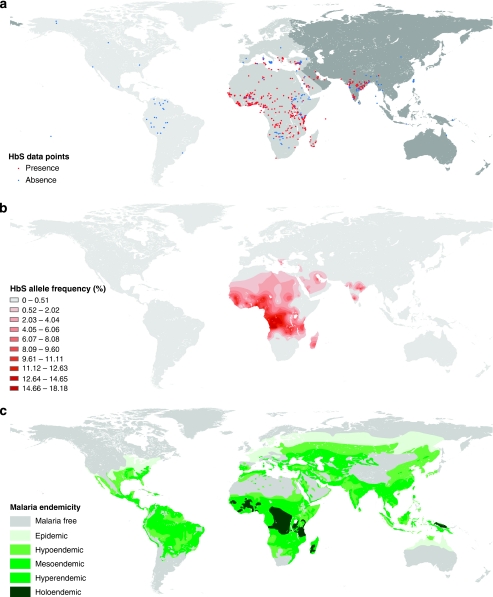
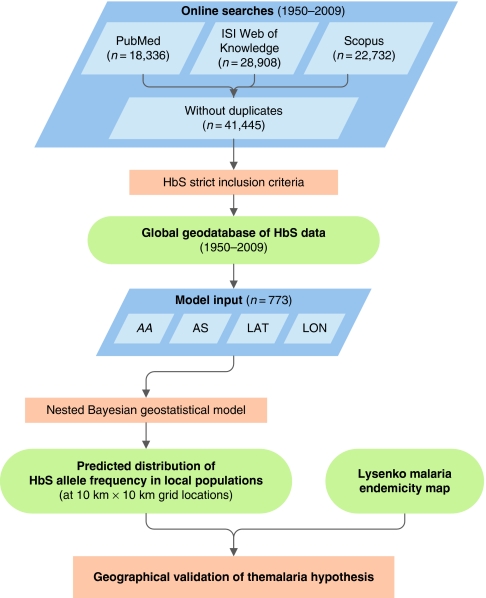
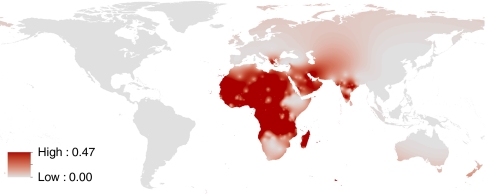
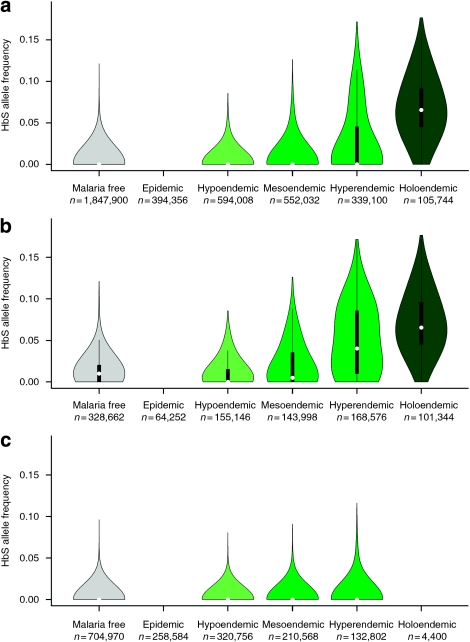
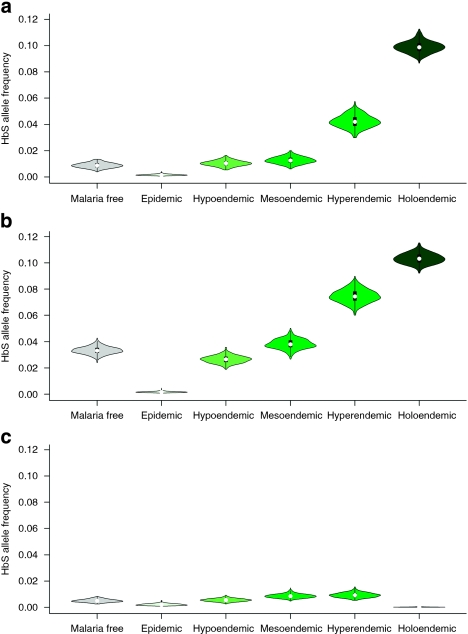
It has been 100 years since the first report of sickle haemoglobin (HbS). More than 50 years ago, it was suggested that the gene responsible for this disorder could reach high frequencies because of resistance conferred against malaria by the heterozygous carrier state. This traditional example of balancing selection is known as the 'malaria hypothesis'. However, the geographical relationship between the transmission intensity of malaria and associated HbS burden has never been formally investigated on a global scale. Here, we use a comprehensive data assembly of HbS allele frequencies to generate the first evidence-based map of the worldwide distribution of the gene in a Bayesian geostatistical framework. We compare this map with the pre-intervention distribution of malaria endemicity, using a novel geostatistical area-mean comparison. We find geographical support for the malaria hypothesis globally; the relationship is relatively strong in Africa but cannot be resolved in the Americas or in Asia.
自首次报道镰状血红蛋白(HbS)以来已有100年。50多年前,有人提出,由于杂合子携带者状态赋予了对疟疾的抗性,导致这种疾病的基因可能达到高频率。这种平衡选择的传统例子被称为“疟疾假说”。然而,疟疾传播强度与相关的镰状血红蛋白负担之间的地理关系从未在全球范围内进行过正式研究。在这里,我们使用镰状血红蛋白等位基因频率的综合数据集,在贝叶斯地理统计框架下生成了该基因全球分布的首张基于证据的地图。我们使用一种新颖的地理统计区域均值比较方法,将这张地图与疟疾流行程度的干预前分布进行比较。我们在全球范围内发现了对疟疾假说的地理支持;这种关系在非洲相对较强,但在美洲或亚洲无法确定。