Department of Anesthesiology and Critical Care, University of Pennsylvania School of Medicine, Philadelphia, PA, USA.
J Control Release. 2011 Feb 28;150(1):37-44. doi: 10.1016/j.jconrel.2010.10.025. Epub 2010 Nov 1.
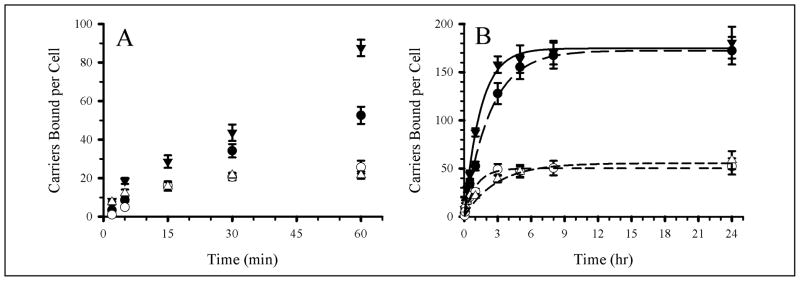
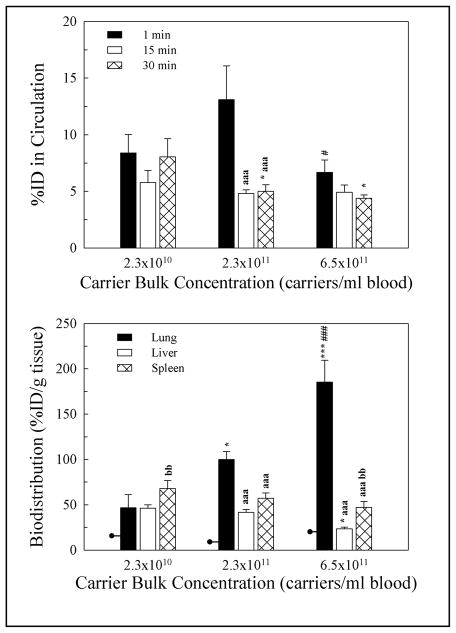
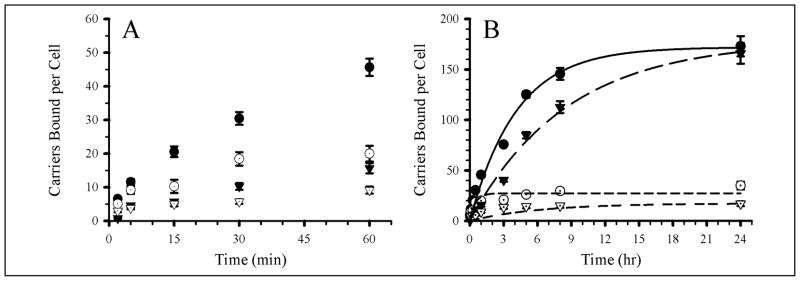
Targeting of drug carriers to cell adhesion molecules expressed on endothelial cells (ECs) may improve treatment of diseases involving the vascular endothelium. This is the case for carriers targeted to intercellular adhesion molecule 1 (ICAM-1), an endothelial surface protein overexpressed in many pathologies. In order to optimize our design of anti-ICAM carriers, we have explored in this study the influence of two carrier design parameters on specific and efficient endothelial targeting in vitro and in vivo: carrier dose and density of targeting molecules (antibodies-Ab) on the carrier surface. Using radioisotope tracing we assessed the role of these parameters on the biodistribution of model polymer carriers targeted to ICAM-1 ((125)I-anti-ICAM carriers) in mice. Increasing the carrier dose enhanced specific accumulation in the lung vasculature (a preferential endothelial target) and decreased non-specific hepatic and splenic uptake. Increasing the Ab density enhanced lung accumulation with minimally reduced liver and spleen uptake. These studies account for the influence of blood hydrodynamic forces on carrier binding to endothelium, relevant to arterioles, venules and larger vessels. Yet, carriers may rather bind to the extensive capillary bed where shear stress is minimal. We used fluorescence microscopy to determine binding kinetics of FITC-labeled anti-ICAM carriers in static conditions, at the threshold found in vivo and conditions mimicking low vs high ICAM-1 expression on quiescent vs activated ECs. Binding to activated ECs reached similar saturation with all tested Ab densities and carrier concentrations. In quiescent cells, carriers reached ~3-fold lower binding saturation, even at high carrier concentration and Ab density, and carriers with low Ab density did not reach saturation, reflecting avidity below threshold. Binding kinetics was positively regulated by anti-ICAM carrier concentration and Ab density. Counterintuitively, binding was faster in quiescent ECs (except for carriers with high Ab density and concentration), likely due to fast saturation of fewer binding sites on these cells. These results will guide optimization of ICAM-1-targeted carriers, e.g., in the context of targeting healthy vs diseased endothelium for prophylactic vs therapeutic interventions.
靶向细胞黏附分子(CAMs)表达于内皮细胞(ECs)可能改善涉及血管内皮的疾病治疗。这在针对细胞间黏附分子 1(ICAM-1)的载体中得到体现,ICAM-1 是许多病理情况下过度表达的内皮表面蛋白。为了优化我们针对 ICAM 的载体设计,我们在本研究中探索了两个载体设计参数对体外和体内靶向特定和有效内皮的影响:载体剂量和载体表面靶向分子(抗体-Ab)的密度。我们使用放射性同位素示踪法评估了这些参数对模型聚合物载体((125)I-抗-ICAM 载体)在小鼠体内生物分布的作用。增加载体剂量增强了肺血管系统(优先的内皮靶向)的特异性积累,同时减少了非特异性肝脏和脾脏摄取。增加 Ab 密度增强了肺的积累,同时最小化了对肝脏和脾脏的摄取。这些研究解释了血流动力学对载体与内皮结合的影响,这与小动脉、小静脉和较大血管有关。然而,载体可能更倾向于结合在剪切力最小的广泛毛细血管床。我们使用荧光显微镜在静态条件下确定 FITC 标记的抗-ICAM 载体的结合动力学,在体内检测到的阈值以及模拟静息和激活的 ECs 中低 vs 高 ICAM-1 表达的条件下进行检测。在所有测试的 Ab 密度和载体浓度下,与激活的 ECs 的结合均达到相似的饱和。在静息细胞中,即使在高载体浓度和 Ab 密度下,载体的结合也达到约 3 倍的较低饱和,并且低 Ab 密度的载体未达到饱和,反映出亲和力低于阈值。结合动力学受抗-ICAM 载体浓度和 Ab 密度的正调节。反直觉的是,在静息 ECs 中结合更快(高 Ab 密度和浓度的载体除外),可能是由于这些细胞上较少的结合位点快速饱和所致。这些结果将指导针对 ICAM-1 的载体的优化,例如,在针对健康或患病内皮进行预防性或治疗性干预的情况下。