Laboratoire Évolution et Diversité Biologique, UMR 5174, Centre National de la Recherche Scientifique, Université Paul Sabatier, Toulouse, France.
PLoS One. 2010 Oct 27;5(10):e13555. doi: 10.1371/journal.pone.0013555.
As egg production and offspring care are costly, females should invest resources adaptively into their eggs to optimize current offspring quality and their own lifetime reproductive success. Parasite infections can influence maternal investment decisions due to their multiple negative physiological effects. The act of preening--applying oils with anti-microbial properties to feathers--is thought to be a means by which birds combat pathogens and parasites, but little is known of how preening during the reproductive period (and its expected disease-protecting effects) influences maternal investment decisions at the level of the egg.
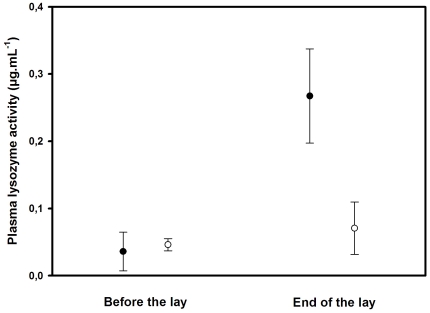
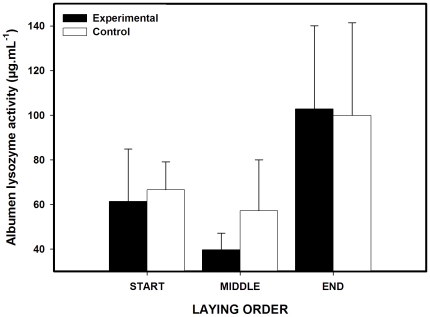
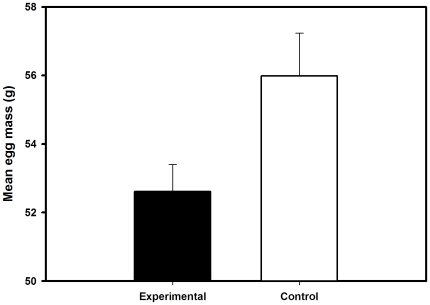
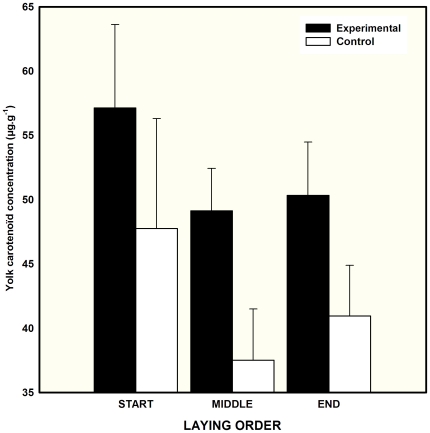
METHODOLOGY/PRINCIPAL FINDINGS: Here, we experimentally prevented female mallards (Anas platyrhynchos) from accessing their preen gland during breeding and monitored female immunoresponsiveness (e.g., plasma lysozyme concentration) as well as some egg traits linked to offspring quality (e.g., egg mass, yolk carotenoid content, and albumen lysozyme levels). Females with no access to their preen gland showed an increase in plasma lysozyme level compared to control, normally preening females. In addition, preen-gland-restricted females laid significantly lighter eggs and deposited higher carotenoid concentrations in the yolk compared to control females. Albumen lysozyme activity did not differ significantly between eggs laid by females with or without preen gland access.
CONCLUSION/SIGNIFICANCE: Our results establish a new link between an important avian self-maintenance behaviour and aspects of maternal health and reproduction. We suggest that higher yolk carotenoid levels in eggs laid by preen-gland-restricted females may serve to boost health of offspring that would hatch in a comparatively microbe-rich environment.
由于产卵和育雏成本高昂,雌性动物应该根据环境适应性将资源投入到卵子中,以优化当前后代的质量和自身的终生繁殖成功率。寄生虫感染会通过多种负面生理效应影响母体的投资决策。理羽行为(将具有抗菌特性的油脂涂抹到羽毛上)被认为是鸟类对抗病原体和寄生虫的一种方式,但人们对繁殖期理羽(及其预期的疾病保护作用)如何影响卵子层面的母体投资决策知之甚少。
方法/主要发现:在这里,我们通过实验阻止雌性绿头鸭(Anas platyrhynchos)在繁殖期间接触其尾脂腺,并监测了雌性免疫反应(例如,血浆溶菌酶浓度)以及一些与后代质量相关的卵子特征(例如,卵重、蛋黄类胡萝卜素含量和蛋清溶菌酶水平)。与对照组(正常理羽的雌性)相比,无法接触尾脂腺的雌性的血浆溶菌酶水平有所升高。此外,与对照组雌性相比,尾脂腺受限制的雌性所产的卵明显较轻,蛋黄中的类胡萝卜素浓度更高。蛋清溶菌酶活性在有或没有尾脂腺接触的雌性所产的卵之间没有显著差异。
结论/意义:我们的研究结果在重要的鸟类自我维护行为与母体健康和繁殖的某些方面之间建立了新的联系。我们认为,尾脂腺受限制的雌性所产的卵中蛋黄类胡萝卜素水平较高,可能有助于增强在微生物丰富环境中孵化的后代的健康。