Department of Neuroscience, Physiology and Pharmacology, University College London, London, United Kingdom.
PLoS One. 2010 Oct 26;5(10):e13611. doi: 10.1371/journal.pone.0013611.
The neuronal nicotinic receptors that mediate excitatory transmission in autonomic ganglia are thought to be formed mainly by the α3 and β4 subunits. Expressing this composition in oocytes fails to reproduce the properties of ganglionic receptors, which may also incorporate the α5 and/or β2 subunits. We compared the properties of human α3β4 neuronal nicotinic receptors expressed in Human embryonic kidney cells (HEK293) and in Xenopus oocytes, to examine the effect of the expression system and α:β subunit ratio.
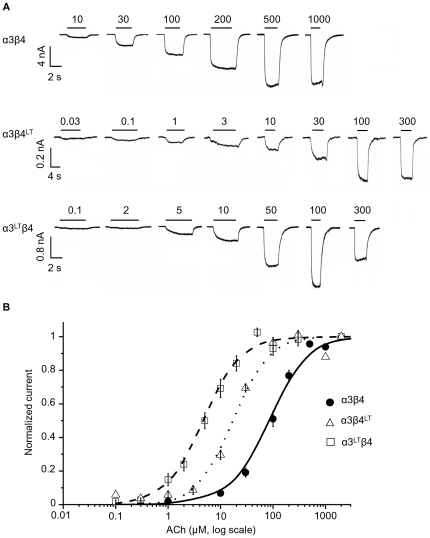
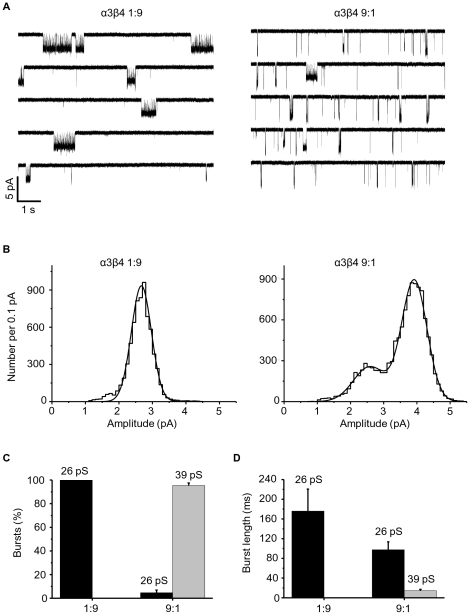
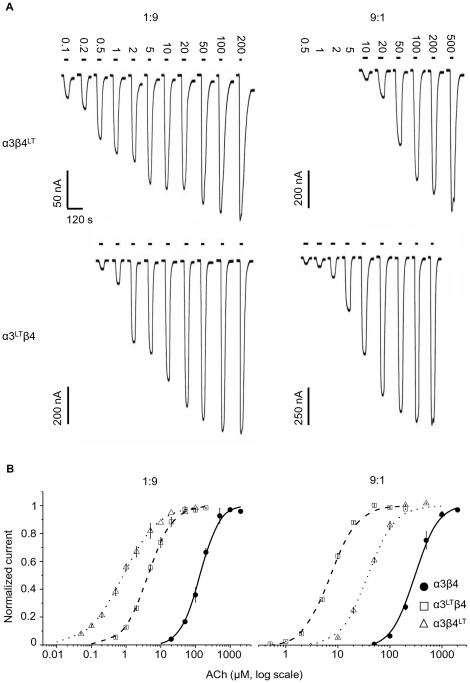
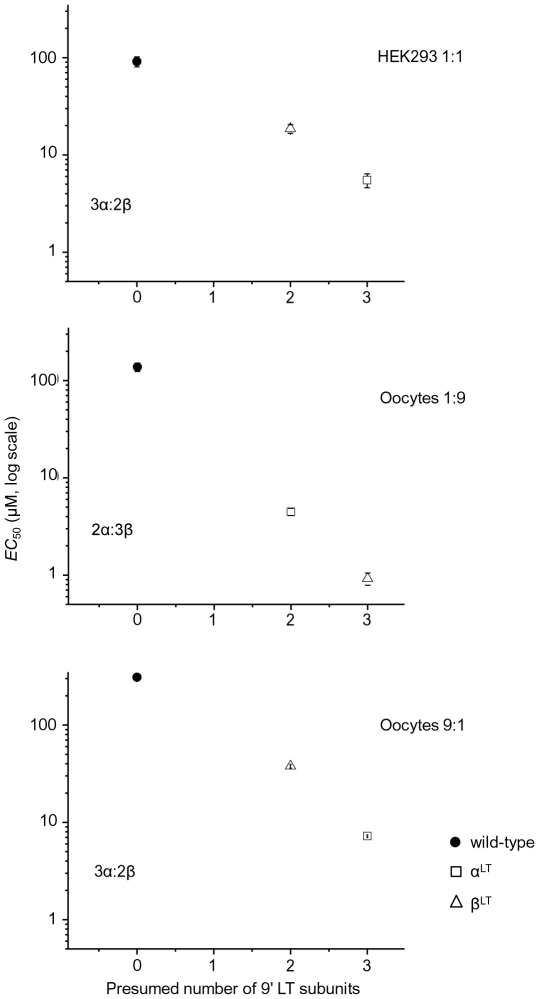
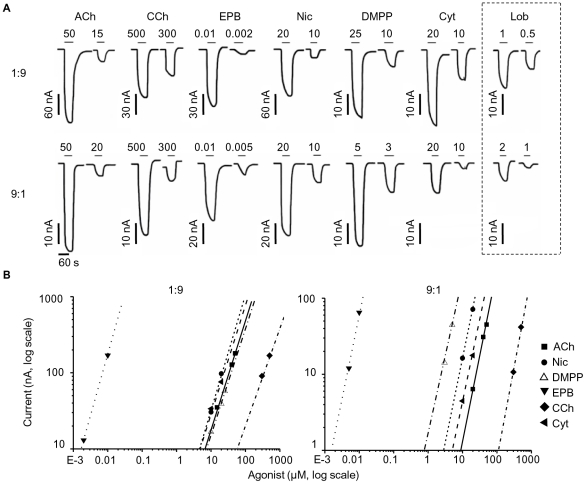
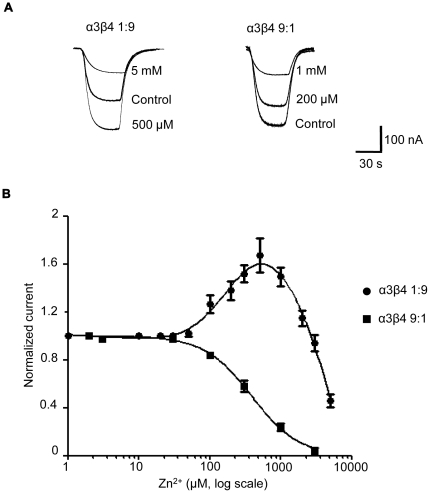
METHODOLOGY/PRINCIPAL FINDINGS: Two distinct channel forms were observed: these are likely to correspond to different stoichiometries of the receptor, with two or three copies of the α subunit, as reported for α4β2 channels. This interpretation is supported by the pattern of change in acetylcholine (ACh) sensitivity observed when a hydrophilic Leu to Thr mutation was inserted in position 9' of the second transmembrane domain, as the effect of mutating the more abundant subunit is greater. Unlike α4β2 channels, for α3β4 receptors the putative two-α form is the predominant one in oocytes (at 1:1 α:β cRNA ratio). This two-α form has a slightly higher ACh sensitivity (about 3-fold in oocytes), and displays potentiation by zinc. The putative three-α form is the predominant one in HEK cells transfected with a 1:1 α:β DNA ratio or in oocytes at 9:1 α:β RNA ratio, and is more sensitive to dimethylphenylpiperazinium (DMPP) than to ACh. In outside-out single-channel recordings, the putative two-α form opened to distinctive long bursts (100 ms or more) with low conductance (26 pS), whereas the three-α form gave rise to short bursts (14 ms) of high conductance (39 pS).
CONCLUSIONS/SIGNIFICANCE: Like other neuronal nicotinic receptors, the α3β4 receptor can exist in two different stoichiometries, depending on whether it is expressed in oocytes or in mammalian cell lines and on the ratio of subunits transfected.
介导自主神经节兴奋传递的神经元烟碱受体被认为主要由α3 和β4 亚基组成。在卵母细胞中表达这种组成不能再现神经节受体的特性,神经节受体可能还包含α5 和/或β2 亚基。我们比较了在人胚肾细胞(HEK293)和非洲爪蟾卵母细胞中表达的人α3β4 神经元烟碱受体的特性,以检查表达系统和α:β 亚基比例的影响。
方法/主要发现:观察到两种不同的通道形式:这些可能对应于受体的不同缔合状态,与α4β2 通道报道的一样,有两个或三个α 亚基的拷贝。这种解释得到了在第二个跨膜域的 9' 位置插入亲水亮氨酸到苏氨酸突变时观察到的乙酰胆碱(ACh)敏感性变化模式的支持,因为突变丰度更高的亚基的影响更大。与α4β2 通道不同,对于α3β4 受体,假定的双α形式在卵母细胞中占主导地位(在 1:1α:βcRNA 比)。这种双-α 形式具有稍高的 ACh 敏感性(在卵母细胞中约为 3 倍),并表现出锌增强作用。假定的三-α 形式在以 1:1α:βDNA 比转染的 HEK 细胞或在 9:1α:βRNA 比的卵母细胞中占主导地位,并且对二甲苯基哌嗪(DMPP)比 ACh 更敏感。在外面单通道记录中,假定的双-α 形式以低电导(26 pS)打开独特的长爆发(100 ms 或更长),而三-α 形式产生高电导(39 pS)的短爆发(14 ms)。
结论/意义:与其他神经元烟碱受体一样,α3β4 受体可以存在两种不同的缔合状态,这取决于它是在卵母细胞中表达还是在哺乳动物细胞系中表达,以及转染的亚基比例。