Department Neuropsychology and Psychopharmacology, Faculty of Psychology and Neuroscience, Maastricht University, Maastricht, The Netherlands.
Psychopharmacology (Berl). 2011 Mar;214(2):391-401. doi: 10.1007/s00213-010-2042-1. Epub 2010 Oct 30.
Previous research has shown that heavy cannabis users develop tolerance to the impairing effects of Δ9-tetrahydrocannabinol (THC) on neurocognitive functions. Animal studies suggest that chronic cannabis consumption may also produce cross-tolerance for the impairing effects of alcohol, but supportive data in humans is scarce.
The present study was designed to assess tolerance and cross-tolerance to the neurocognitive effects of THC and alcohol in heavy cannabis users.
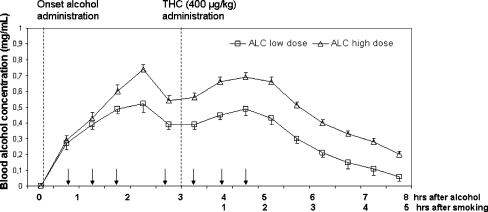
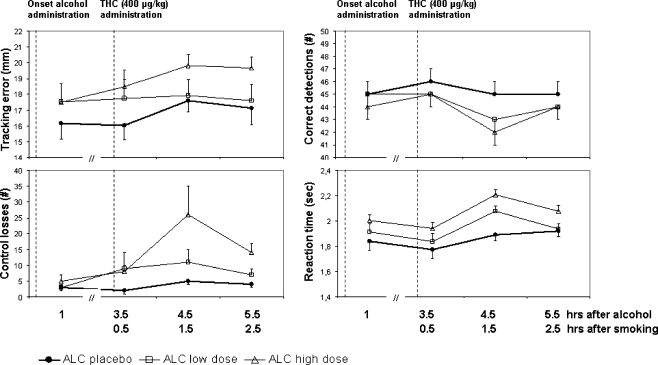
Twenty-one heavy cannabis users participated in a double-blind, placebo-controlled, three-way study. Subjects underwent three alcohol-dosing conditions that were designed to achieve a steady blood alcohol concentration of about 0, 0.5, and 0.7 mg/ml during a 5-h time window. In addition, subjects smoked a THC cigarette (400 μg/kg) at 3 h post-onset of alcohol dosing during every alcohol condition. Performance tests were conducted repeatedly between 0 and 7 h after onset of drinking and included measures of perceptual motor control (critical tracking task), dual task processing (divided-attention task), motor inhibition (stop-signal task), and cognition (Tower of London).
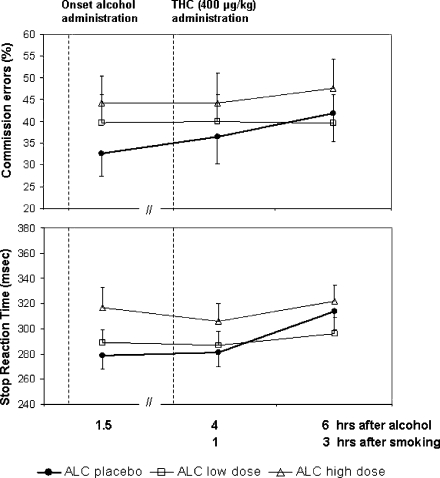
Alcohol significantly impaired critical tracking, divided attention, and stop-signal performance. THC generally did not affect task performance. However, combined effects of THC and alcohol on divided attention were bigger than those by alcohol alone.
In conclusion, the present study generally confirms that heavy cannabis users develop tolerance to the impairing effects of THC on neurocognitive task performance. Yet, heavy cannabis users did not develop cross-tolerance to the impairing effects of alcohol, and the presence of the latter even selectively potentiated THC effects on measures of divided attention.
先前的研究表明,重度大麻使用者对Δ9-四氢大麻酚(THC)对神经认知功能的损害作用产生了耐受性。动物研究表明,慢性大麻消费也可能对酒精的损害作用产生交叉耐受性,但在人类中支持这一数据的证据很少。
本研究旨在评估重度大麻使用者对 THC 和酒精的神经认知作用的耐受性和交叉耐受性。
21 名重度大麻使用者参与了一项双盲、安慰剂对照、三向研究。受试者接受了三种酒精给药条件,旨在在 5 小时的时间窗口内使血液酒精浓度稳定在约 0、0.5 和 0.7 mg/ml。此外,在每个酒精条件下,受试者在酒精给药开始后 3 小时吸烟一支含有 400 μg/kg THC 的香烟。在饮酒开始后 0 至 7 小时之间重复进行性能测试,包括感知运动控制(关键跟踪任务)、双重任务处理(分散注意任务)、运动抑制(停止信号任务)和认知(伦敦塔任务)的测量。
酒精显著损害了关键跟踪、分散注意力和停止信号的表现。THC 通常不会影响任务表现。然而,THC 和酒精联合作用对分散注意力的影响大于酒精单独作用。
总之,本研究一般证实了重度大麻使用者对 THC 对神经认知任务表现的损害作用产生了耐受性。然而,重度大麻使用者对酒精的损害作用没有产生交叉耐受性,后者的存在甚至选择性地增强了 THC 对分散注意力测量的作用。