Departamento de Ecología, Genética y Evolución, Facultad de Ciencias Exactas y Naturales, Universidad de Buenos Aires, 1428, Ciudad Autónoma de Buenos Aires, Provincia de Buenos Aires, Argentina.
BMC Evol Biol. 2010 Nov 4;10:340. doi: 10.1186/1471-2148-10-340.
Maternally inherited endosymbionts like Wolbachia pipientis are in linkage disequilibrium with the mtDNA of their hosts. Therefore, they can induce selective sweeps, decreasing genetic diversity over many generations. This sex ratio distorter, that is involved in the origin of parthenogenesis and other reproductive alterations, infects the parthenogenetic weevil Naupactus cervinus, a serious pest of ornamental and fruit plants.
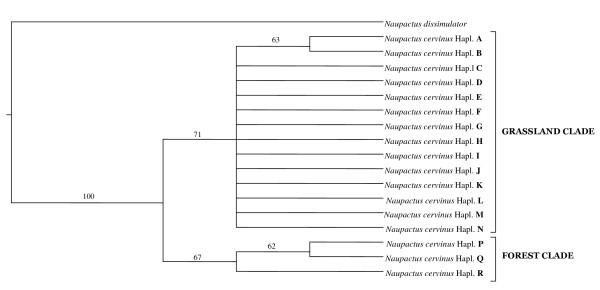
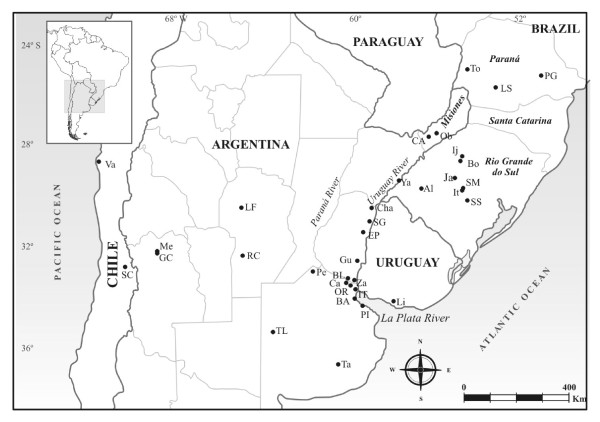
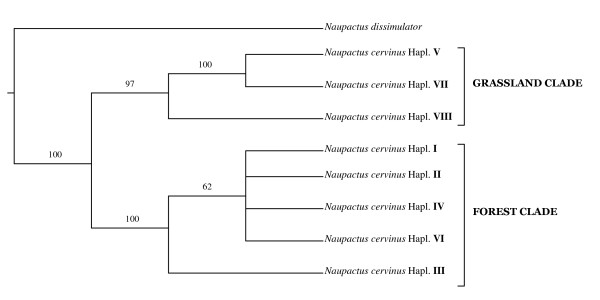
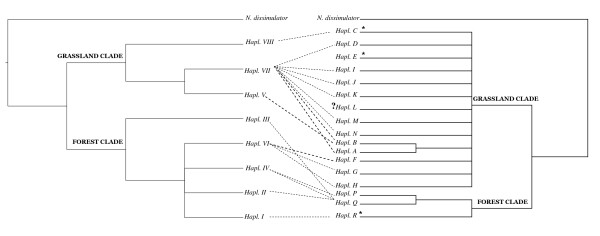
Molecular evolution analyses of mitochondrial (COI) and nuclear (ITS1) sequences from 309 individuals of Naupactus cervinus sampled over a broad range of its geographical distribution were carried out. Our results demonstrate lack of recombination in the nuclear fragment, non-random association between nuclear and mitochondrial genomes and the consequent coevolution of both genomes, being an indirect evidence of apomixis. This weevil is infected by a single Wolbachia strain, which could have caused a moderate bottleneck in the invaded population which survived the initial infection.
Clonal reproduction and Wolbachia infection induce the coevolution of bacterial, mitochondrial and nuclear genomes. The time elapsed since the Wolbachia invasion would have erased the traces of the demographic crash in the mtDNA, being the nuclear genome the only one that retained the signal of the bottleneck. The amount of genetic change accumulated in the mtDNA and the high prevalence of Wolbachia in all populations of N. cervinus agree with the hypothesis of an ancient infection. Wolbachia probably had great influence in shaping the genetic diversity of N. cervinus. However, it would have not caused the extinction of males, since sexual and asexual infected lineages coexisted until recent times.
像沃尔巴克氏体(Wolbachia pipientis)这样的母体遗传共生菌与宿主的 mtDNA 处于连锁不平衡状态。因此,它们可以诱导选择清除,导致许多代的遗传多样性降低。这种性别比例扭曲因子参与了孤雌生殖和其他生殖改变的起源,感染了孤雌生殖的象鼻虫 Naupactus cervinus,这是一种严重危害观赏和水果植物的害虫。
对来自 Naupactus cervinus 的 309 个个体的线粒体(COI)和核(ITS1)序列进行了分子进化分析,这些个体在其地理分布范围内广泛采样。我们的结果表明,核片段中不存在重组,核和线粒体基因组之间存在非随机关联,因此两个基因组共同进化,这是孤雌生殖的间接证据。这种象鼻虫感染了一种单一的沃尔巴克氏体菌株,该菌株可能导致入侵种群在最初感染时经历了适度的瓶颈。
克隆繁殖和沃尔巴克氏体感染诱导了细菌、线粒体和核基因组的共同进化。自从沃尔巴克氏体入侵以来,时间的流逝已经抹去了 mtDNA 中人口崩溃的痕迹,只有核基因组保留了瓶颈的信号。mtDNA 中积累的遗传变化量和沃尔巴克氏体在 N. cervinus 所有种群中的高流行率与古老感染的假设相符。沃尔巴克氏体可能对塑造 N. cervinus 的遗传多样性产生了巨大影响。然而,它并没有导致雄性的灭绝,因为有性和无性感染的谱系直到最近还共存。