Sleep and Chronobiology Laboratory, Department of Integrative Physiology, 1725 Pleasant Street, Clare Small 114, University of Colorado, Boulder, CO 80309-0354, USA.
J Physiol. 2011 Jan 1;589(Pt 1):235-44. doi: 10.1113/jphysiol.2010.197517. Epub 2010 Nov 8.
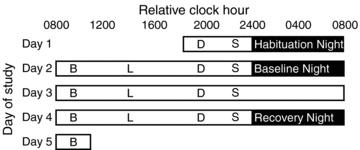
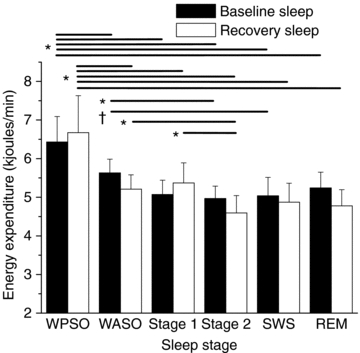
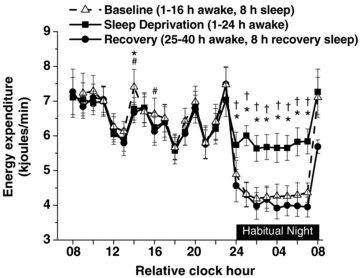
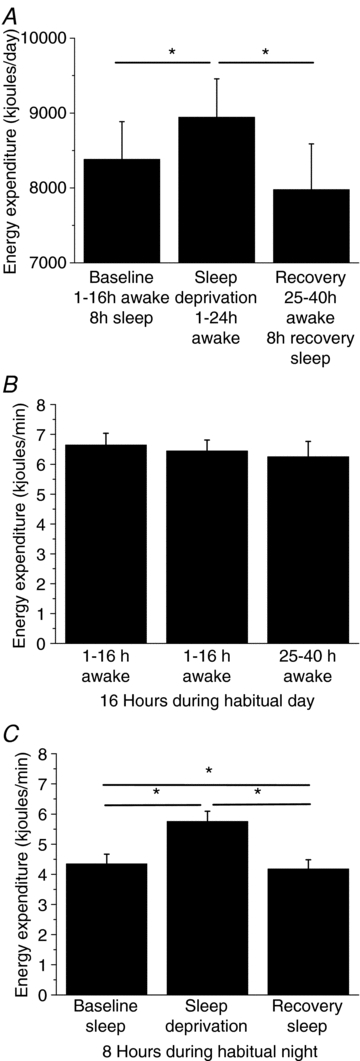
Sleep has been proposed to be a physiological adaptation to conserve energy, but little research has examined this proposed function of sleep in humans. We quantified effects of sleep, sleep deprivation and recovery sleep on whole-body total daily energy expenditure (EE) and on EE during the habitual day and nighttime. We also determined effects of sleep stage during baseline and recovery sleep on EE. Seven healthy participants aged 22 ± 5 years (mean ± s.d.) maintained ∼8 h per night sleep schedules for 1 week before the study and consumed a weight-maintenance diet for 3 days prior to and during the laboratory protocol. Following a habituation night, subjects lived in a whole-room indirect calorimeter for 3 days. The first 24 h served as baseline – 16 h wakefulness, 8 h scheduled sleep – and this was followed by 40 h sleep deprivation and 8 h scheduled recovery sleep. Findings show that, compared to baseline, 24 h EE was significantly increased by ∼7% during the first 24 h of sleep deprivation and was significantly decreased by ∼5% during recovery, which included hours awake 25-40 and 8 h recovery sleep. During the night time, EE was significantly increased by ∼32% on the sleep deprivation night and significantly decreased by ∼4% during recovery sleep compared to baseline. Small differences in EE were observed among sleep stages, but wakefulness during the sleep episode was associated with increased energy expenditure. These findings provide support for the hypothesis that sleep conserves energy and that sleep deprivation increases total daily EE in humans.
睡眠被认为是一种节约能量的生理适应,但很少有研究检验睡眠在人类中的这种潜在功能。我们量化了睡眠、睡眠剥夺和恢复性睡眠对人体总日常能量消耗(EE)以及日常白昼和夜间 EE 的影响。我们还确定了基线和恢复性睡眠期间的睡眠阶段对 EE 的影响。7 名年龄在 22 ± 5 岁(平均值 ± 标准差)的健康参与者在研究前一周保持每晚约 8 小时的睡眠时间表,并在实验室方案进行前和进行期间连续 3 天摄入维持体重的饮食。在适应夜间之后,受试者在整个房间间接测热计中生活了 3 天。前 24 小时作为基线——16 小时清醒,8 小时有规律的睡眠——随后是 40 小时的睡眠剥夺和 8 小时有规律的恢复性睡眠。研究结果表明,与基线相比,睡眠剥夺的前 24 小时内 24 小时 EE 显著增加了约 7%,而在恢复期间则显著减少了约 5%,其中包括 25-40 小时清醒和 8 小时恢复性睡眠。在夜间,睡眠剥夺夜的 EE 显著增加了约 32%,而与基线相比,恢复性睡眠期间的 EE 则显著减少了约 4%。在睡眠阶段之间观察到 EE 存在微小差异,但睡眠期间的清醒与能量消耗增加有关。这些发现为睡眠可以节约能量以及睡眠剥夺会增加人类总日常 EE 的假说提供了支持。