Program in Cell Biology, Hospital for Sick Children, Toronto, Ontario M5G 1X8, Canada.
J Cell Biol. 2010 Nov 15;191(4):741-9. doi: 10.1083/jcb.201006031. Epub 2010 Nov 8.
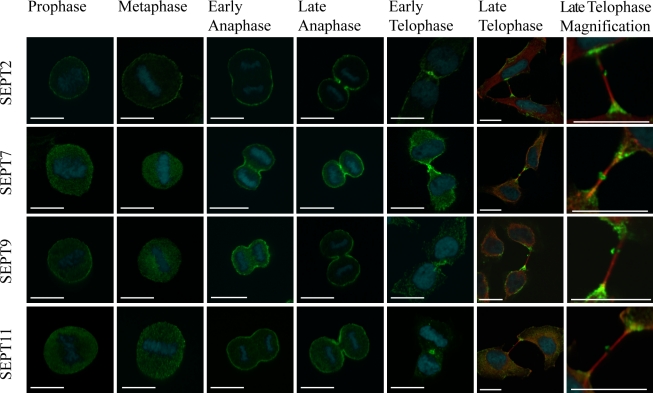
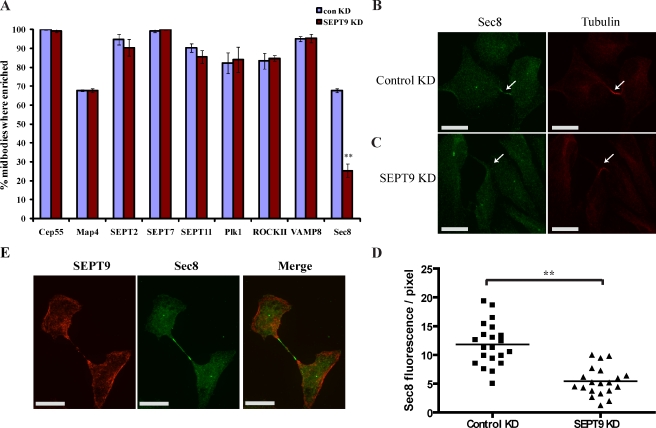
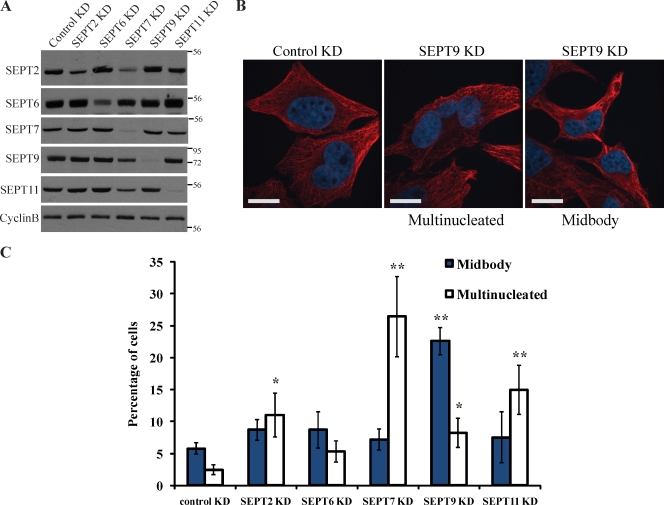
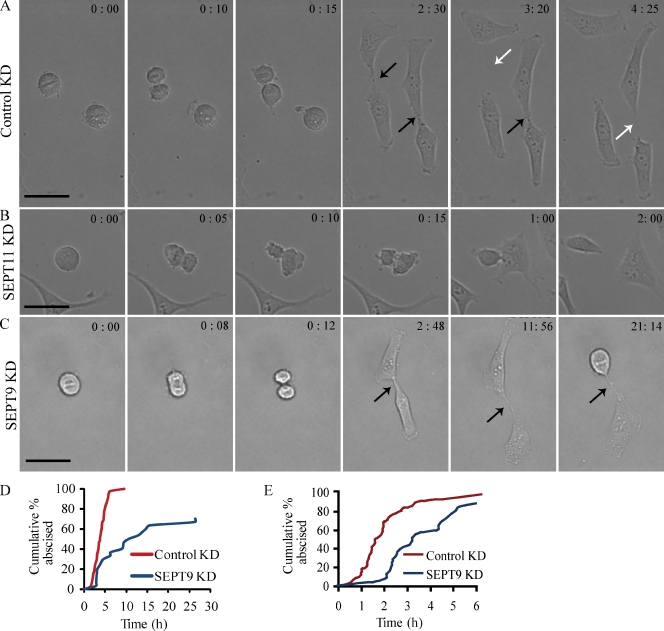
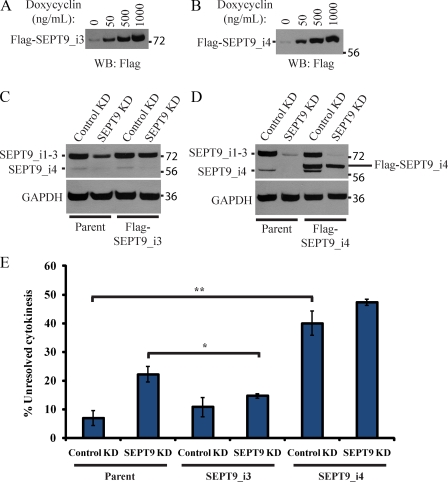
Septins are a family of GTP-binding proteins implicated in mammalian cell division. Most studies examining the role of septins in this process have treated the family as a whole, thus neglecting the possibility that individual members may have diverse functions. To address this, we individually depleted each septin family member expressed in HeLa cells by siRNA and assayed for defects in cell division by immunofluorescence and time-lapse microscopy. Depletion of SEPT2, SEPT7, and SEPT11 causes defects in the early stages of cytokinesis, ultimately resulting in binucleation. In sharp contrast, SEPT9 is dispensable for the early stages of cell division, but is critical for the final separation of daughter cells. Rescue experiments indicate that SEPT9 isoforms containing the N-terminal region are sufficient to drive cytokinesis. We demonstrate that SEPT9 mediates the localization of the vesicle-tethering exocyst complex to the midbody, providing mechanistic insight into the role of SEPT9 during abscission.
septins 是一类 GTP 结合蛋白,参与哺乳动物细胞分裂。大多数研究细胞分裂过程中 septins 的作用时,都将整个 septin 家族作为一个整体进行研究,因此忽略了个别成员可能具有不同功能的可能性。为了解决这个问题,我们通过 siRNA 分别耗尽了 HeLa 细胞中表达的每个 septin 家族成员,并通过免疫荧光和延时显微镜检测细胞分裂缺陷。SEPT2、SEPT7 和 SEPT11 的缺失导致胞质分裂的早期阶段出现缺陷,最终导致双核化。相比之下,SEPT9 对于细胞分裂的早期阶段是可有可无的,但对于子细胞的最终分离却是至关重要的。挽救实验表明,含有 N 端区域的 SEPT9 异构体足以驱动胞质分裂。我们证明 SEPT9 将囊泡连接的外泌体复合物定位到中体,为 SEPT9 在胞质分裂过程中的作用提供了机制上的见解。