Department of Psychology, Center for Behavioral Teratology, San Diego State University, California 92120, USA.
Alcohol Clin Exp Res. 2011 Feb;35(2):355-64. doi: 10.1111/j.1530-0277.2010.01351.x. Epub 2010 Nov 10.
Alcohol consumption during pregnancy can damage the developing fetus, illustrated by central nervous system dysfunction and deficits in motor and cognitive abilities. Binge drinking has been associated with an increased risk of fetal alcohol spectrum disorders, likely due to increased episodes of ethanol withdrawal. We hypothesized that overactivity of the N-methyl-D-aspartate (NMDA) receptor during ethanol withdrawal leads to excitotoxic cell death in the developing brain. Consistent with this, administration of NMDA receptor antagonists (e.g., MK-801) during withdrawal can attenuate ethanol's teratogenic effects. The aim of this study was to determine whether administration of memantine, an NMDA receptor antagonist, during ethanol withdrawal could effectively attenuate ethanol-related deficits, without the adverse side effects associated with other NMDA receptor antagonists.
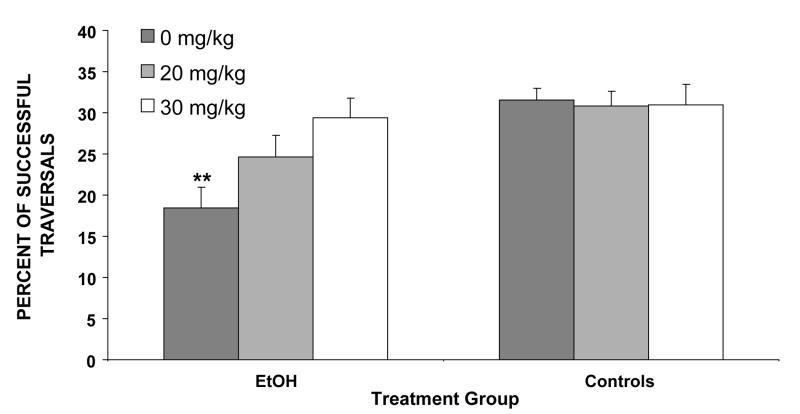
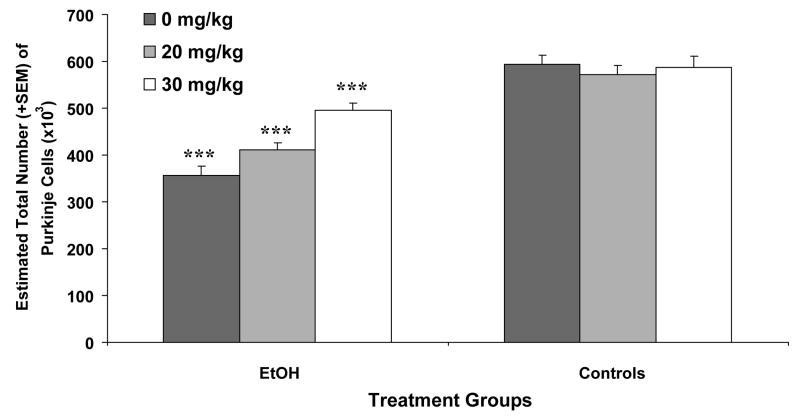
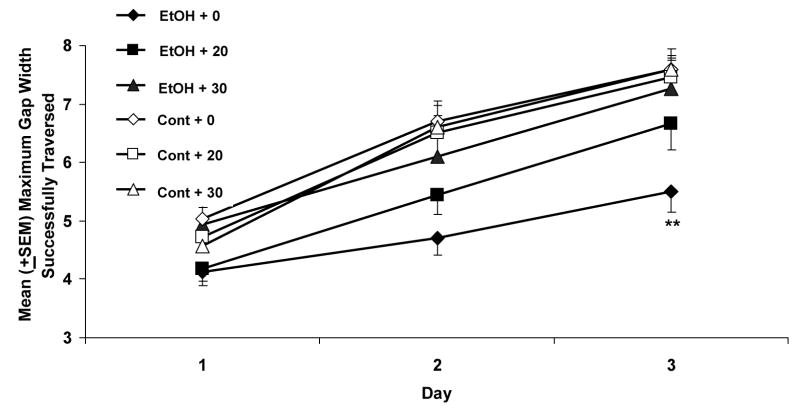
Sprague-Dawley pups were exposed to 6.0 g/kg ethanol or isocaloric maltose solution via intubation on postnatal day 6, a period of brain development equivalent to a portion of the 3rd trimester. Twenty-four and 36 hours after ethanol, subjects were injected with 0, 10, or 15 mg/kg memantine, totaling doses of 0, 20, or 30 mg/kg. Motor coordination was tested on a parallel bar task and the total number of cerebellar Purkinje cells was estimated using unbiased stereology.
Alcohol exposure induced significant parallel bar motor incoordination and reduced Purkinje cell number. Memantine administration significantly attenuated both ethanol-associated motor deficits and cerebellar cell loss in a dose-dependent manner.
Memantine was neuroprotective when administered during ethanol withdrawal. These data provide further support that ethanol withdrawal contributes to fetal alcohol spectrum disorders.
怀孕期间饮酒会损害发育中的胎儿,表现为中枢神经系统功能障碍以及运动和认知能力缺陷。狂饮与胎儿酒精谱系障碍的风险增加有关,这可能是由于乙醇戒断发作次数增加所致。我们假设,乙醇戒断期间 N-甲基-D-天冬氨酸(NMDA)受体的过度活跃会导致发育中大脑的兴奋性细胞死亡。NMDA 受体拮抗剂(例如,MK-801)在戒断期间的给药与这种情况一致,可以减轻乙醇的致畸作用。本研究的目的是确定在乙醇戒断期间给予 NMDA 受体拮抗剂美金刚是否可以有效减轻与乙醇相关的缺陷,而不会产生与其他 NMDA 受体拮抗剂相关的不良反应。
在出生后第 6 天通过插管向 Sprague-Dawley 幼仔给予 6.0 g/kg 乙醇或等热量麦芽糖溶液,这是大脑发育相当于第三个三个月的一部分。在乙醇后 24 和 36 小时,给动物注射 0、10 或 15 mg/kg 美金刚,总剂量为 0、20 或 30 mg/kg。通过平行棒任务测试运动协调性,并使用无偏立体学估计小脑浦肯野细胞的总数。
酒精暴露会引起明显的平行棒运动不协调,并减少浦肯野细胞数量。美金刚给药以剂量依赖性方式显著减轻了与乙醇相关的运动缺陷和小脑细胞丢失。
美金刚在乙醇戒断期间给药具有神经保护作用。这些数据进一步支持乙醇戒断导致胎儿酒精谱系障碍的假说。