Division of Craniofacial and Molecular Genetics, Tufts University, 136 Harrison Ave, Boston MA 02111, USA.
BMC Genet. 2010 Nov 11;11:102. doi: 10.1186/1471-2156-11-102.
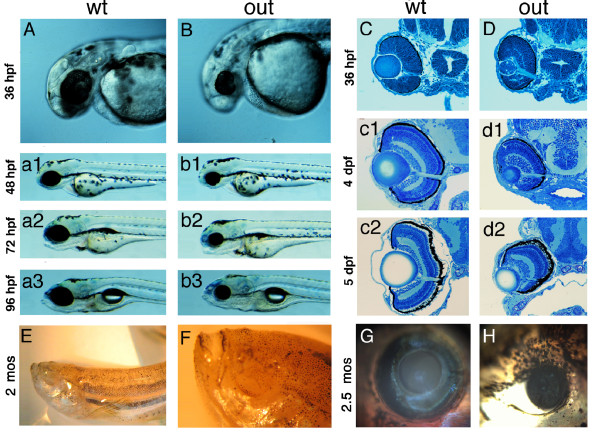
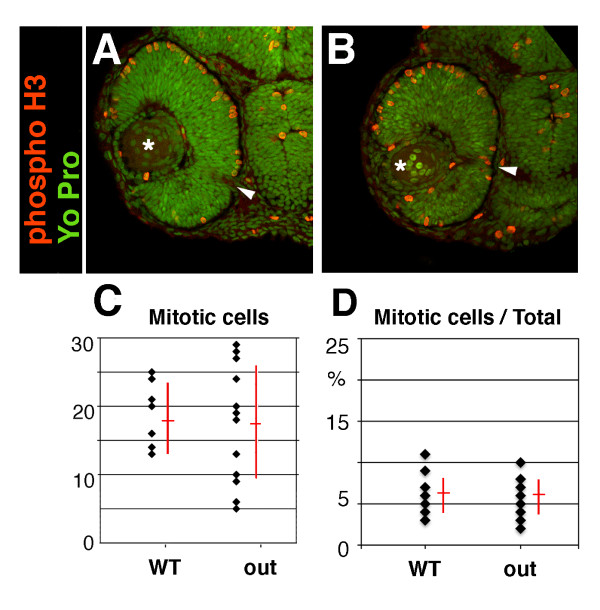
The size of the vertebrate eye and the retina is likely to be controlled at several stages of embryogenesis by mechanisms that affect cell cycle length as well as cell survival. A mutation in the zebrafish out of sight (out) locus results in a particularly severe reduction of eye size. The goal of this study is to characterize the outm233 mutant, and to determine whether mutations in the out gene cause microphthalmia in humans.
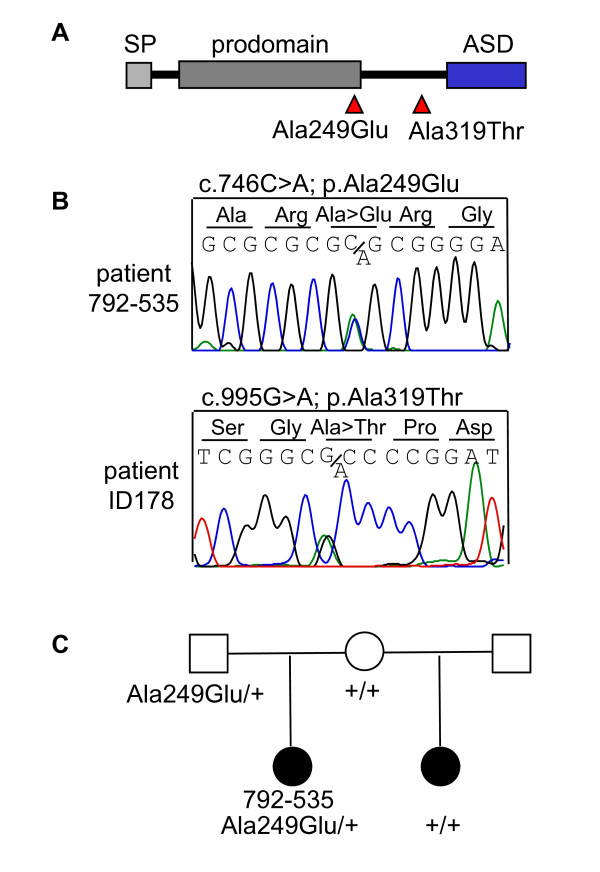
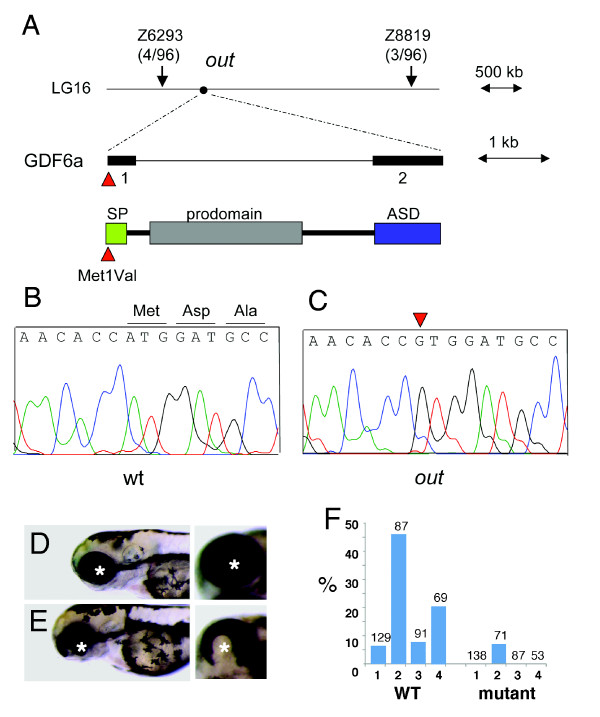
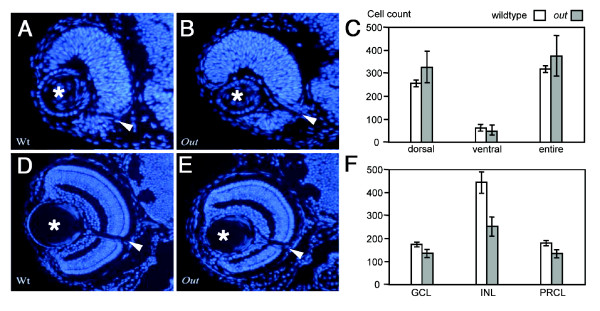
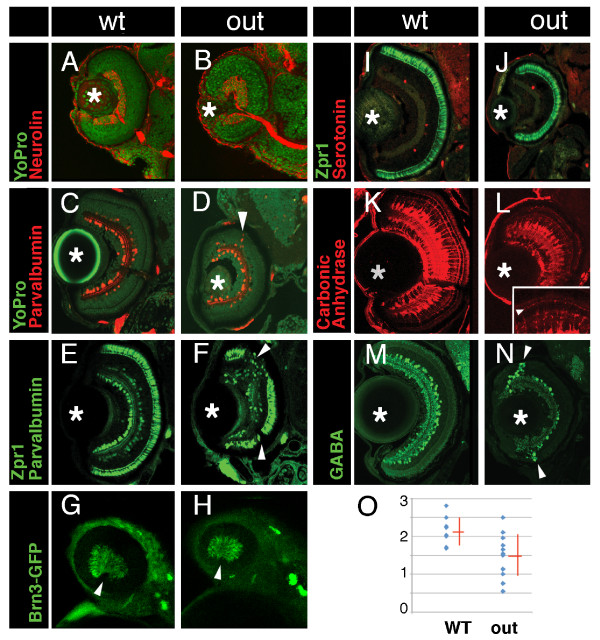
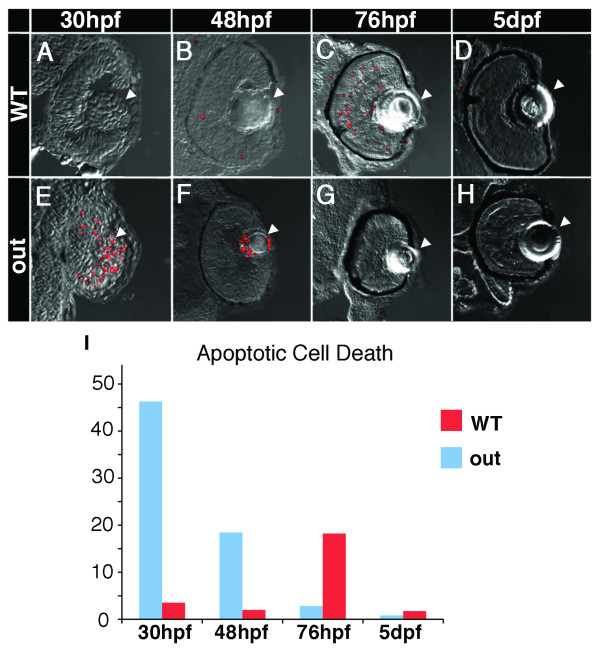
In this study, we show that the severe reduction of eye size in the outm233 mutant is caused by a mutation in the zebrafish gdf6a gene. Despite the small eye size, the overall retinal architecture appears largely intact, and immunohistochemical studies confirm that all major cell types are present in outm233 retinae. Subtle cell fate and patterning changes are present predominantly in amacrine interneurons. Acridine orange and TUNEL staining reveal that the levels of apoptosis are abnormally high in outm233 mutant eyes during early neurogenesis. Mutation analysis of the GDF6 gene in 200 patients with microphthalmia revealed amino acid substitutions in four of them. In two patients additional skeletal defects were observed.
This study confirms the essential role of GDF6 in the regulation of vertebrate eye size. The reduced eye size in the zebrafish outm233 mutant is likely to be caused by a transient wave of apoptosis at the onset of neurogenesis. Amino acid substitutions in GDF6 were detected in 4 (2%) of 200 patients with microphthalmia. In two patients different skeletal defects were also observed, suggesting pleitrophic effects of GDF6 variants. Parents carrying these variants are asymptomatic, suggesting that GDF6 sequence alterations are likely to contribute to the phenotype, but are not the sole cause of the disease. Variable expressivity and penetrance suggest a complex non-Mendelian inheritance pattern where other genetic factors may influence the outcome of the phenotype.
脊椎动物眼睛和视网膜的大小可能在胚胎发生的几个阶段受到影响细胞周期长度和细胞存活的机制的控制。斑马鱼看不见(out)基因座的突变导致眼睛大小特别严重的减小。本研究的目的是描述 outm233 突变体,并确定 out 基因的突变是否导致人类小眼症。
在这项研究中,我们表明,outm233 突变体眼睛大小的严重减小是由斑马鱼 gdf6a 基因突变引起的。尽管眼睛尺寸很小,但整个视网膜结构看起来基本完整,免疫组织化学研究证实所有主要细胞类型都存在于 outm233 视网膜中。在amacrine 中间神经元中存在微妙的细胞命运和模式变化。吖啶橙和 TUNEL 染色显示,在早期神经发生过程中,outm233 突变体眼睛中的凋亡水平异常升高。对 200 名小眼症患者的 GDF6 基因突变分析显示其中 4 人存在氨基酸取代。在 2 名患者中还观察到额外的骨骼缺陷。
本研究证实了 GDF6 在调节脊椎动物眼睛大小中的重要作用。斑马鱼 outm233 突变体眼睛变小可能是由于神经发生开始时短暂的凋亡波引起的。在 200 名小眼症患者中的 4 名(2%)检测到 GDF6 中的氨基酸取代。在 2 名患者中还观察到不同的骨骼缺陷,这表明 GDF6 变体具有多效性效应。携带这些变体的父母无症状,这表明 GDF6 序列改变可能导致表型,但不是疾病的唯一原因。可变的表现度和外显率表明存在复杂的非孟德尔遗传模式,其中其他遗传因素可能影响表型的结果。