Department of General Practice, Université Catholique de Louvain, Avenue Mounier 53, bte 5360, 1200 Brussels, Belgium.
BMC Geriatr. 2010 Nov 11;10:85. doi: 10.1186/1471-2318-10-85.
In the elderly the diagnosis of chronic heart failure is often challenging and the availability of echocardiography can be limited. Plasma levels of NT-proBNP are valuable tools to diagnose patients with heart failure. However, the performance of this biomarker to detect cardiac abnormalities in the very elderly remains unclear. The aims of this study were to investigate the relation between NT-proBNP and cardiac abnormalities and to evaluate the use of NT-proBNP to exclude structural and functional cardiac abnormalities in a community-based sample of "well-functioning" nonagenarians.
A diagnostic cross-sectional study embedded within the Leiden 85-plus Study in the municipality of Leiden, the Netherlands. Plasma NT-proBNP levels were measured and 2-dimensional echocardiography was performed in a subgroup of 80 well-functioning nonagenarians. Linear regression analysis was used to explore the relation between NT-proBNP and cardiac abnormalities and ROC curve analysis was used to assess the performance of NT-proBNP to exclude cardiac abnormalities. The upper limit of the lowest tertile of NT-proBNP was used as a cut-off value.
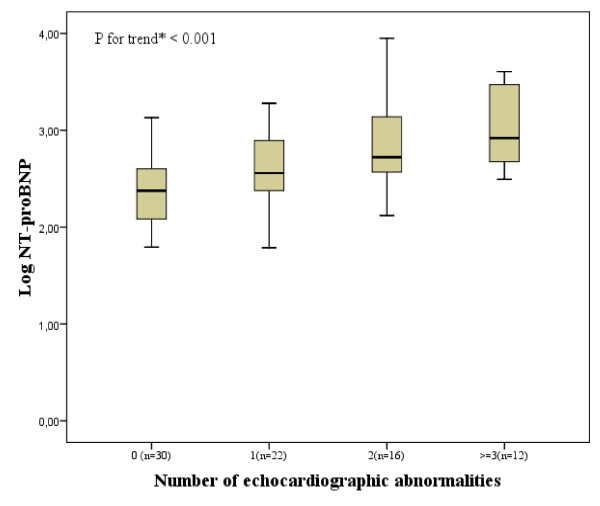
NT-proBNP levels were associated with abnormal left ventricular (LV) dimensions, LV systolic and diastolic function, left atrial enlargement and valvular heart disease. LV mass, E/A ratio and degree of aortic regurgitation were identified as independent predictors of NT-proBNP. NT-proBNP levels were higher with greater number of echocardiographic abnormalities (P < 0.001). A cut-off level of 269.5 pg/mL identified patients with abnormal LV dimensions or depressed LV systolic function (sensitivity 85%, negative predictive value (NPV) 77%, area under the curve 0.75 (95% CI 0.64-0.85)). In addition, high NPV were found for LV systolic dysfunction, left atrial enlargement, severe valvular heart disease and pulmonary hypertension. The test performance of NT-proBNP to exclude any echocardiographic abnormality showed a sensitivity of 82% and a NPV of 65%.
In this convenience sample of well-functioning nonagenarians NT-proBNP was related to a wide variety of functional and structural echocardiographic abnormalities. Moreover, NT-proBNP could be used to exclude echocardiographic abnormalities in well-functioning nonagenarians and might be used to indicate who needs to be referred for further cardiovascular examination.
在老年人中,慢性心力衰竭的诊断常常具有挑战性,且超声心动图的应用可能受到限制。血浆 NT-proBNP 水平是诊断心力衰竭患者的有价值的工具。然而,该生物标志物用于检测非常高龄老年人心脏异常的性能仍不清楚。本研究的目的是探讨 NT-proBNP 与心脏异常之间的关系,并评估 NT-proBNP 用于排除基于社区的“功能良好”90 岁以上老年人样本中心脏结构和功能异常的作用。
这是一项荷兰莱顿市莱顿 85 岁以上研究中的诊断性横断面研究,将其作为嵌入研究。对 80 名功能良好的 90 岁以上老年人进行了 2 维超声心动图和血浆 NT-proBNP 水平检测。线性回归分析用于探讨 NT-proBNP 与心脏异常之间的关系,ROC 曲线分析用于评估 NT-proBNP 排除心脏异常的性能。将 NT-proBNP 最低三分位的上限用作截断值。
NT-proBNP 水平与左心室(LV)异常的大小、LV 收缩和舒张功能、左心房增大和瓣膜性心脏病相关。LV 质量、E/A 比值和主动脉瓣反流程度被确定为 NT-proBNP 的独立预测因子。随着超声心动图异常数量的增加,NT-proBNP 水平也升高(P<0.001)。截断值为 269.5pg/mL 可识别出 LV 尺寸异常或 LV 收缩功能降低的患者(敏感性 85%,阴性预测值(NPV)77%,曲线下面积为 0.75(95%CI 0.64-0.85))。此外,LV 收缩功能障碍、左心房增大、严重瓣膜性心脏病和肺动脉高压的 NPV 较高。NT-proBNP 用于排除任何超声心动图异常的检测性能显示敏感性为 82%,NPV 为 65%。
在这项功能良好的 90 岁以上老年人的便利样本中,NT-proBNP 与广泛的功能性和结构性超声心动图异常相关。此外,NT-proBNP 可用于排除功能良好的 90 岁以上老年人的超声心动图异常,并且可能用于指示需要进行进一步心血管检查的患者。