Department of Chemistry, Center for Research at Bio/Nano Interface, University of Florida, Gainesville, Florida, United States of America.
PLoS One. 2010 Nov 1;5(11):e13770. doi: 10.1371/journal.pone.0013770.
Ovarian cancer is the most lethal gynecological malignancy, and the ovarian clear cell carcinoma subtype (OCCA) demonstrates a particularly poor response to standard treatment. Improvements in ovarian cancer outcomes, especially for OCCA, could be expected from a clearer understanding of the molecular pathology that might guide strategies for earlier diagnosis and more effective treatment.
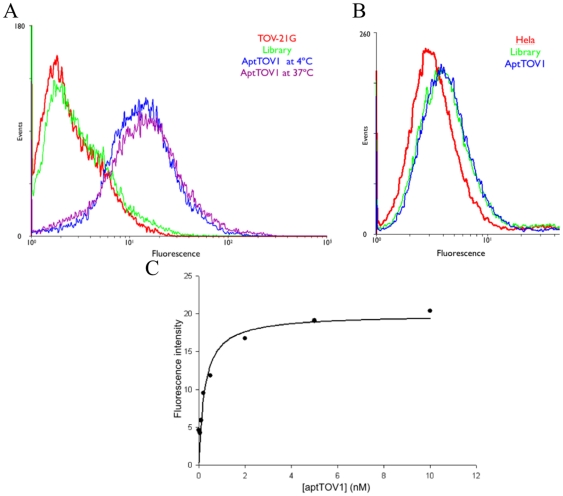
METHODOLOGY/PRINCIPAL FINDINGS: Cell-SELEX technology was employed to develop new molecular probes for ovarian cancer cell surface markers. A total of thirteen aptamers with K(d)'s to ovarian cancer cells in the pico- to nanomolar range were obtained. Preliminary investigation of the targets of these aptamers and their binding characteristics was also performed.
CONCLUSIONS/SIGNIFICANCE: We have selected a series of aptamers that bind to different types of ovarian cancer, but not cervical cancer. Though binding to other cancer cell lines was observed, these aptamers could lead to identification of biomarkers that are related to cancer.
卵巢癌是最致命的妇科恶性肿瘤,卵巢透明细胞癌亚型(OCCA)对标准治疗的反应特别差。如果能更清楚地了解可能指导早期诊断和更有效治疗策略的分子病理学,有望改善卵巢癌的预后,特别是对 OCCA。
方法/主要发现:细胞 SELEX 技术被用于开发卵巢癌细胞表面标志物的新型分子探针。总共获得了 13 种对卵巢癌细胞具有皮摩尔到纳摩尔范围内 K(d)的适体。还初步研究了这些适体的靶标及其结合特性。
结论/意义:我们已经选择了一系列与不同类型的卵巢癌而不是宫颈癌结合的适体。尽管观察到与其他癌细胞系结合,但这些适体可能会鉴定出与癌症相关的生物标志物。