Department of Biostatistics and Epidemiology, University of Oklahoma Health Sciences Center, Oklahoma City, Oklahoma, United States of America.
PLoS Negl Trop Dis. 2010 Nov 2;4(11):e870. doi: 10.1371/journal.pntd.0000870.
The objective of this study is to conduct a systematic review of studies reporting the frequency of neurocysticercosis (NCC) worldwide.
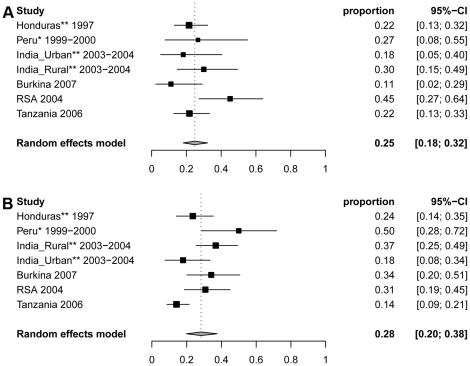
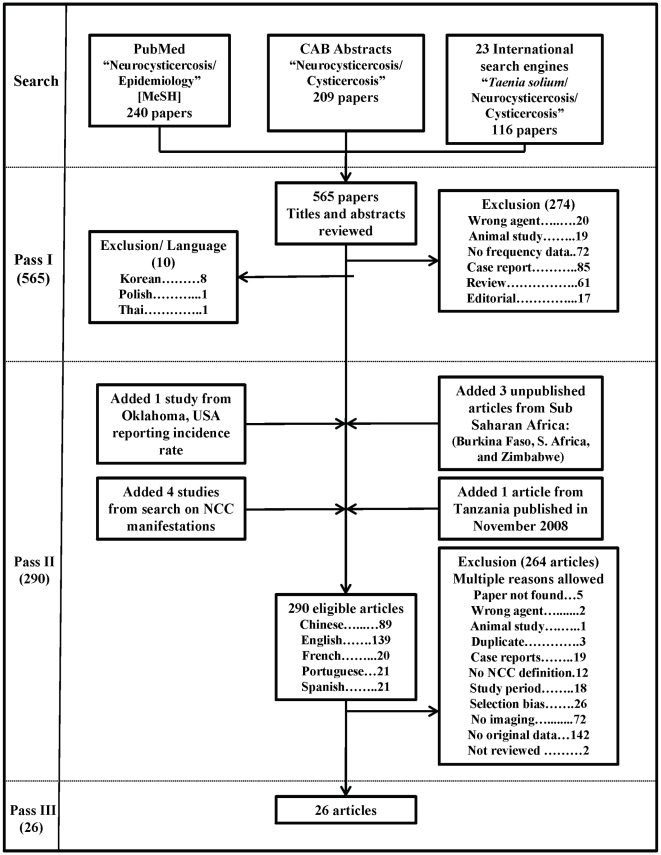
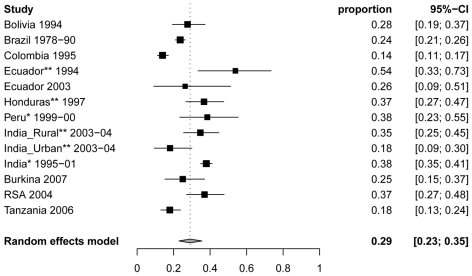
METHODS/PRINCIPAL FINDINGS: PubMed, Commonwealth Agricultural Bureau (CAB) abstracts and 23 international databases were systematically searched for articles published from January 1, 1990 to June 1, 2008. Articles were evaluated for inclusion by at least two researchers focusing on study design and methods. Data were extracted independently using standardized forms. A random-effects binomial model was used to estimate the proportion of NCC among people with epilepsy (PWE). Overall, 565 articles were retrieved and 290 (51%) selected for further analysis. After a second analytic phase, only 4.5% of articles, all of which used neuroimaging for the diagnosis of NCC, were reviewed. Only two studies, both from the US, estimated an incidence rate of NCC using hospital discharge data. The prevalence of NCC in a random sample of village residents was reported from one study where 9.1% of the population harboured brain lesions of NCC. The proportion of NCC among different study populations varied widely. However, the proportion of NCC in PWE was a lot more consistent. The pooled estimate for this population was 29.0% (95%CI: 22.9%-35.5%). These results were not sensitive to the inclusion or exclusion of any particular study.
CONCLUSION/SIGNIFICANCE: Only one study has estimated the prevalence of NCC in a random sample of all residents. Hence, the prevalence of NCC worldwide remains unknown. However, the pooled estimate for the proportion of NCC among PWE was very robust and could be used, in conjunction with estimates of the prevalence and incidence of epilepsy, to estimate this component of the burden of NCC in endemic areas. The previously recommended guidelines for the diagnostic process and for declaring NCC an international reportable disease would improve the knowledge on the global frequency of NCC.
本研究旨在对全球报道神经囊虫病(NCC)频率的研究进行系统综述。
方法/主要发现:系统检索了 1990 年 1 月 1 日至 2008 年 6 月 1 日期间发表的文章,包括 PubMed、英联邦农业局(CAB)摘要和 23 个国际数据库。至少有两名研究人员专注于研究设计和方法,对文章进行评估是否符合纳入标准。使用标准化表格独立提取数据。采用随机效应二项模型估计癫痫患者(PWE)中 NCC 的比例。共检索到 565 篇文章,其中 290 篇(51%)被进一步分析。经过第二轮分析,仅有 4.5%的文章,全部为使用神经影像学诊断 NCC 的文章,被审查。仅有两项研究,均来自美国,使用医院出院数据估计 NCC 的发病率。从一项研究中报告了在随机抽取的农村居民样本中 NCC 的患病率,其中 9.1%的人群存在 NCC 的脑部病变。不同研究人群中 NCC 的比例差异很大。然而,PWE 中 NCC 的比例更为一致。该人群的汇总估计值为 29.0%(95%CI:22.9%-35.5%)。这些结果不受任何特定研究的纳入或排除的影响。
结论/意义:仅有一项研究估计了所有居民中 NCC 的患病率。因此,全球范围内 NCC 的患病率仍然未知。然而,PWE 中 NCC 比例的汇总估计值非常稳健,可以与癫痫的患病率和发病率估计值结合使用,以估计流行地区 NCC 负担的这一部分。先前建议的诊断过程和宣布 NCC 为国际报告疾病的指南将提高对全球 NCC 频率的认识。