Schwede Angela, Jones Nicola, Engstler Markus, Carrington Mark
Department of Biochemistry, Cambridge, UK.
Mol Biochem Parasitol. 2011 Feb;175(2):201-4. doi: 10.1016/j.molbiopara.2010.11.004. Epub 2010 Nov 11.
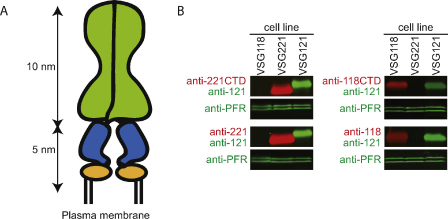
In the mammalian host, the Trypanosoma brucei cell surface is covered with a densely packed protein coat of a single protein, the variant surface glycoprotein (VSG). The VSG is believed to shield invariant surface proteins from host antibodies but there is limited information on how far antibodies can penetrate into the VSG monolayer. Here, the VSG surface coat was probed to determine whether it acts as a barrier to binding of antibodies to the membrane proximal VSG C-terminal domain. The binding of C-terminal domain antibodies to VSG221 or VSG118 was compared with antibodies recognising the cognate whole VSGs. The C-terminal VSG domain was inaccessible to antibodies on live cells but not on fixed cells. This provides further evidence that the VSG coat acts as a barrier and protects the cell from antibodies that would otherwise bind to some of the other externally disposed proteins.
在哺乳动物宿主体内,布氏锥虫的细胞表面覆盖着一层由单一蛋白质——可变表面糖蛋白(VSG)构成的紧密堆积的蛋白质外衣。VSG被认为可保护不变表面蛋白不被宿主抗体识别,但关于抗体能够穿透VSG单层的程度,目前的信息有限。在此,我们对VSG表面外衣进行了探究,以确定其是否会对抗体与膜近端VSG C末端结构域的结合形成阻碍。将C末端结构域抗体与识别同源完整VSG的抗体对VSG221或VSG118的结合情况进行了比较。活细胞上的抗体无法接触到C末端VSG结构域,但固定细胞上的抗体可以。这进一步证明了VSG外衣起到了屏障作用,并保护细胞免受原本会与其他一些外部暴露蛋白结合的抗体的侵害。