School of Medicine, The University of Queensland, Queensland, Australia.
Neuroscientist. 2011 Aug;17(4):351-67. doi: 10.1177/1073858410381531. Epub 2010 Nov 12.
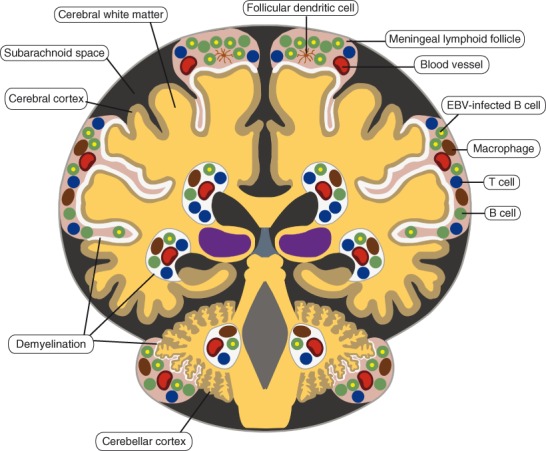
There is increasing evidence that infection with the Epstein-Barr virus (EBV) plays a role in the development of multiple sclerosis (MS), a chronic inflammatory demyelinating disease of the CNS. This article provides a four-tier hypothesis proposing (1) EBV infection is essential for the development of MS; (2) EBV causes MS in genetically susceptible individuals by infecting autoreactive B cells, which seed the CNS where they produce pathogenic autoantibodies and provide costimulatory survival signals to autoreactive T cells that would otherwise die in the CNS by apoptosis; (3) the susceptibility to develop MS after EBV infection is dependent on a genetically determined quantitative deficiency of the cytotoxic CD8+ T cells that normally keep EBV infection under tight control; and (4) sunlight and vitamin D protect against MS by increasing the number of CD8+ T cells available to control EBV infection. The hypothesis makes predictions that can be tested, including the prevention and successful treatment of MS by controlling EBV infection.
越来越多的证据表明,感染爱泼斯坦-巴尔病毒(EBV)在多发性硬化症(MS)的发展中起作用,MS 是一种中枢神经系统的慢性炎症性脱髓鞘疾病。本文提出了一个四层次假设,提出(1) EBV 感染是 MS 发展的必要条件;(2) EBV 通过感染自身反应性 B 细胞导致 MS,这些细胞在中枢神经系统中播种,在那里产生致病性自身抗体,并为自身反应性 T 细胞提供共刺激存活信号,否则这些 T 细胞会在中枢神经系统中通过细胞凋亡而死亡;(3) EBV 感染后发展为 MS 的易感性取决于细胞毒性 CD8+T 细胞的遗传决定的定量缺乏,这些细胞通常可严密控制 EBV 感染;以及(4)阳光和维生素 D 通过增加可用于控制 EBV 感染的 CD8+T 细胞数量来预防和成功治疗 MS。该假设提出了可以进行测试的预测,包括通过控制 EBV 感染来预防和成功治疗 MS。