Julius Center for Health Sciences and Primary Care, University Medical Center Utrecht, Str 6.131, PO Box 85500, 3508 GA Utrecht, The Netherlands.
Diabetologia. 2011 Feb;54(2):264-70. doi: 10.1007/s00125-010-1960-0. Epub 2010 Nov 14.
AIMS/HYPOTHESIS: Treatment guidelines recommend the UK Prospective Diabetes Study (UKPDS) risk engine for predicting cardiovascular risk in patients with type 2 diabetes, although validation studies showed moderate performance. The methods used in these validation studies were diverse, however, and sometimes insufficient. Hence, we assessed the discrimination and calibration of the UKPDS risk engine to predict 4, 5, 6 and 8 year cardiovascular risk in patients with type 2 diabetes.
The cohort included 1,622 patients with type 2 diabetes. During a mean follow-up of 8 years, patients were followed for incidence of CHD and cardiovascular disease (CVD). Discrimination and calibration were assessed for 4, 5, 6 and 8 year risk. Discrimination was examined using the c-statistic and calibration by visually inspecting calibration plots and calculating the Hosmer-Lemeshow χ(2) statistic.
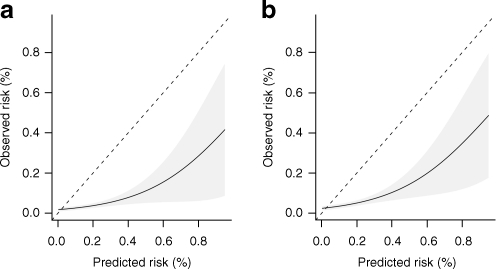
The UKPDS risk engine showed moderate to poor discrimination for both CHD and CVD (c-statistic of 0.66 for both 5 year CHD and CVD risks), and an overestimation of the risk (224% and 112%). The calibration of the UKPDS risk engine was slightly better for patients with type 2 diabetes who had been diagnosed with diabetes more than 10 years ago compared with patients diagnosed more recently, particularly for 4 and 5 year predicted CVD and CHD risks. Discrimination for these periods was still moderate to poor.
CONCLUSIONS/INTERPRETATION: We observed that the UKPDS risk engine overestimates CHD and CVD risk. The discriminative ability of this model is moderate, irrespective of various subgroup analyses. To enhance the prediction of CVD in patients with type 2 diabetes, this model should be updated.
目的/假设:治疗指南推荐 UKPDS 风险引擎来预测 2 型糖尿病患者的心血管风险,尽管验证研究表明其性能中等。然而,这些验证研究使用的方法多种多样,有时还不够充分。因此,我们评估了 UKPDS 风险引擎预测 2 型糖尿病患者 4、5、6 和 8 年心血管风险的区分度和校准度。
该队列包括 1622 名 2 型糖尿病患者。在平均 8 年的随访期间,患者因冠心病和心血管疾病(CVD)的发生而被随访。使用 c 统计量评估 4、5、6 和 8 年风险的区分度,通过视觉检查校准图和计算 Hosmer-Lemeshow χ(2)统计量评估校准度。
UKPDS 风险引擎对冠心病和心血管疾病的区分度均为中等至较差(5 年冠心病和心血管疾病风险的 c 统计量分别为 0.66),并且风险高估(224%和 112%)。对于诊断时间超过 10 年的 2 型糖尿病患者,UKPDS 风险引擎的校准情况略好于最近诊断的患者,尤其是对于 4 年和 5 年预测的心血管疾病和冠心病风险。这些时期的区分度仍然是中等至较差。
结论/解释:我们观察到 UKPDS 风险引擎高估了冠心病和心血管疾病的风险。该模型的判别能力中等,无论进行何种亚组分析都是如此。为了提高 2 型糖尿病患者心血管疾病的预测能力,应更新该模型。