Department of Pathology, The University of Texas M. D. Anderson Cancer Center, Houston, TX 77030, USA.
Hum Pathol. 2010 Dec;41(12):1788-93. doi: 10.1016/j.humpath.2010.06.008.
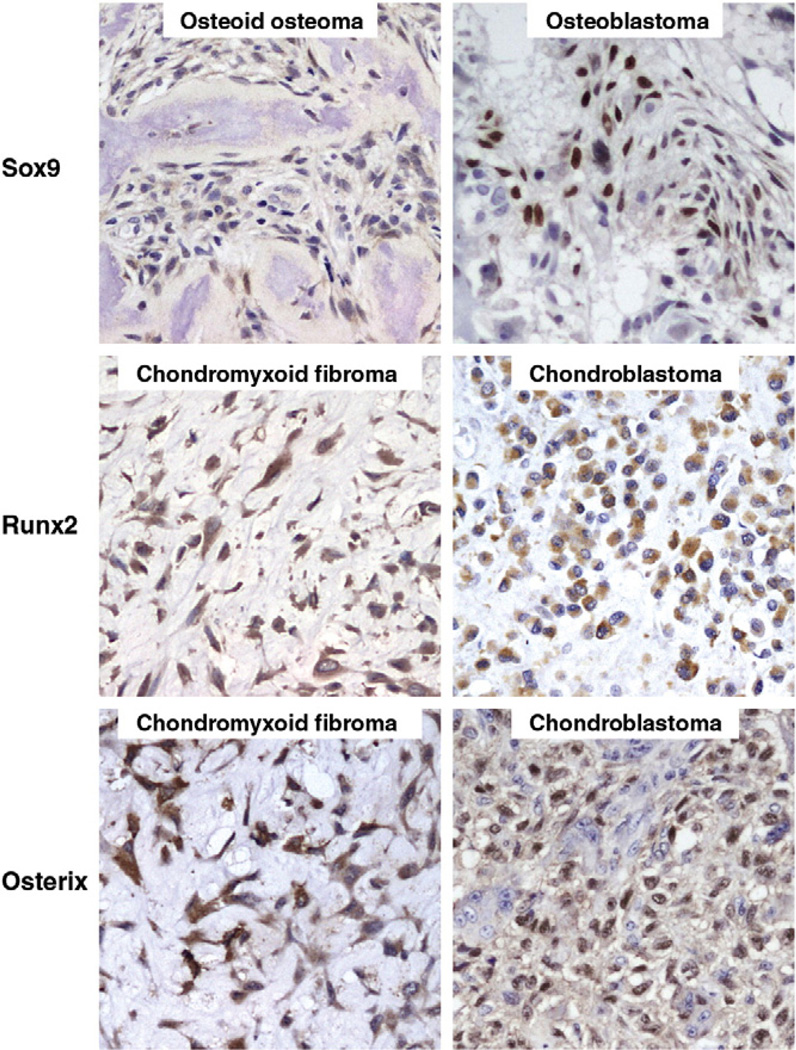
Recent progress in skeletal molecular biology has led to the clarification of the transcriptional mechanisms of chondroblastic and osteoblastic lineage differentiation. Three master transcription factors-Sox9, Runx2, and Osterix-were shown to play an essential role in determining the skeletal progenitor cells' fate. The present study evaluates the expression of these factors in 4 types of benign bone tumors-chondromyxoid fibroma, chondroblastoma, osteoid osteoma, and osteoblastoma-using immunohistochemistry and tissue microarrays. Osteoid osteoma and osteoblastoma showed strong nuclear expression of Osterix and Runx2. In contrast, only a few chondroblastomas showed positive nuclear expression of Osterix. Strong nuclear expression of Sox9 was detected in all chondroblastomas, whereas nearly half of the osteoblastomas showed focal weak cytoplasmic expression of Sox9.
最近在骨骼分子生物学方面的进展使得软骨细胞和成骨细胞谱系分化的转录机制得到了阐明。三个主要的转录因子——Sox9、Runx2 和 Osterix——被证明在决定骨骼祖细胞命运方面发挥着重要作用。本研究使用免疫组织化学和组织微阵列技术评估了这些因子在 4 种良性骨肿瘤中的表达:软骨黏液样纤维瘤、软骨母细胞瘤、骨样骨瘤和骨母细胞瘤。骨样骨瘤和骨母细胞瘤表现出 Osterix 和 Runx2 的强核表达。相比之下,只有少数软骨母细胞瘤表现出 Osterix 的核阳性表达。所有软骨母细胞瘤均检测到 Sox9 的强核表达,而近一半的骨母细胞瘤则表现出 Sox9 的局灶性弱细胞质表达。