University of Washington School of Medicine, Seattle, Washington 98105, USA.
Ann Intern Med. 2010 Nov 16;153(10):661-5. doi: 10.7326/0003-4819-153-10-201011160-00010.
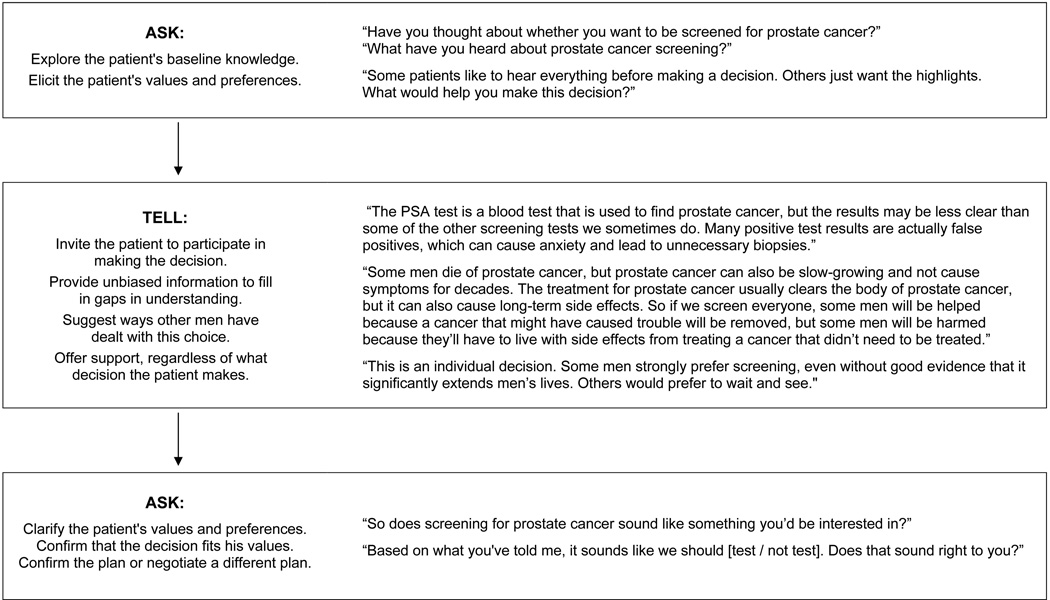
National guidelines recommend that primary care providers discuss the risks and benefits of prostate cancer screening with their patients but give little guidance on how to fit such a complex discussion into a busy clinic encounter. The authors propose a process-oriented approach (Ask-Tell-Ask) that promotes tailored conversations and value-based recommendations. The Ask-Tell-Ask approach includes diagnosing a patient's informational needs, providing targeted education based on those needs, and making a shared decision about testing. This time-efficient model emphasizes the provider's role as an interactive guide rather than a one-way supplier of information. Although there is no way to make these discussions simple, this streamlined strategy can help patients and providers efficiently negotiate the complex and important decision of screening for prostate cancer.
国家指南建议初级保健医生与患者讨论前列腺癌筛查的风险和益处,但对如何将如此复杂的讨论融入繁忙的诊所就诊提供的指导很少。作者提出了一种面向流程的方法(询问-告知-询问),该方法促进了针对性的对话和基于价值的建议。Ask-Tell-Ask 方法包括诊断患者的信息需求,根据这些需求提供有针对性的教育,并就检测做出共同决定。这种高效的模型强调了提供者作为互动指南的作用,而不是信息的单向提供者。虽然没有办法使这些讨论简单化,但这种简化的策略可以帮助患者和提供者有效地协商前列腺癌筛查这一复杂而重要的决策。