Infectious Diseases Unit, Hospital de la Santa Creu I Sant Pau, Barcelona, Spain.
PLoS One. 2010 Nov 15;5(11):e13896. doi: 10.1371/journal.pone.0013896.
Uridine has been advocated for the treatment of HIV-1/HAART-associated lipodystrophy (HALS), although its metabolism in HIV-1-infected patients is poorly understood.
Plasma uridine concentrations were measured in 35 controls and 221 HIV-1-infected patients and fat uridine in 15 controls and 19 patients. The diagnosis of HALS was performed following the criteria of the Lipodystrophy Severity Grading Scale. Uridine was measured by a binary gradient-elution HPLC method. Analysis of genes encoding uridine metabolizing enzymes in fat was performed with TaqMan RT-PCR.
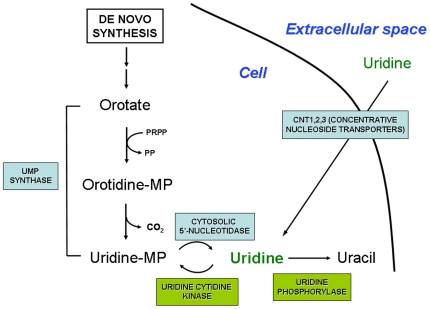
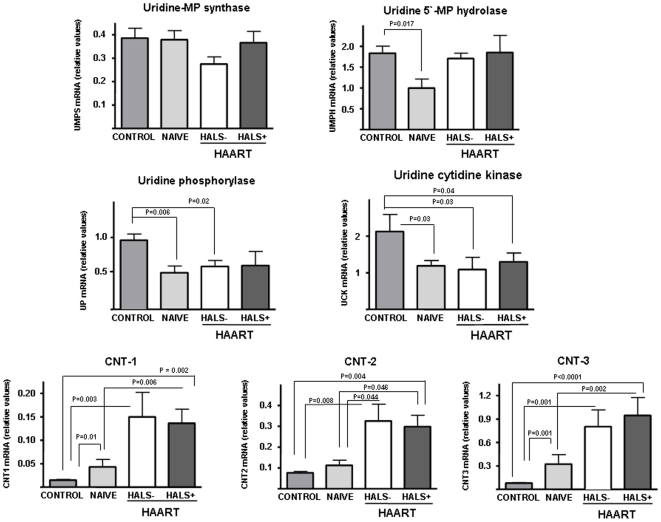
Median plasma uridine concentrations for HIV-1-infected patients were 3.80 µmol/l (interquartile range: 1.60), and for controls 4.60 µmol/l (IQR: 1.8) (P = 0.0009). In fat, they were of 6.0 (3.67), and 2.8 (4.65) nmol/mg of protein, respectively (P = 0.0118). Patients with a mixed HALS form had a median plasma uridine level of 4.0 (IC95%: 3.40-4.80) whereas in those with isolated lipoatrophy it was 3.25 (2.55-4.15) µmol/l/l (P = 0.0066). The expression of uridine cytidine kinase and uridine phosphorylase genes was significantly decreased in all groups of patients with respect to controls. A higher expression of the mRNAs for concentrative nucleoside transporters was found in HIV-1-infected patients with respect to healthy controls.
HIV-1 infection is associated with a decrease in plasma uridine and a shift of uridine to the adipose tissue compartment. Antiretroviral therapy was not associated with plasma uridine concentrations, but pure lipoatrophic HALS was associated with significantly lower plasma uridine concentrations.
尿苷已被提倡用于治疗 HIV-1/HAART 相关脂肪营养不良(HALS),尽管 HIV-1 感染患者的尿苷代谢情况了解甚少。
在 35 名对照者和 221 名 HIV-1 感染者中测量血浆尿苷浓度,在 15 名对照者和 19 名患者中测量脂肪尿苷浓度。根据脂肪营养不良严重程度分级量表的标准诊断 HALS。采用二元梯度洗脱 HPLC 法测量尿苷。采用 TaqMan RT-PCR 分析脂肪中编码尿苷代谢酶的基因。
HIV-1 感染者的中位血浆尿苷浓度为 3.80 µmol/l(四分位距:1.60),对照者为 4.60 µmol/l(IQR:1.8)(P = 0.0009)。脂肪中的浓度分别为 6.0(3.67)和 2.8(4.65)nmol/mg 蛋白(P = 0.0118)。混合 HALS 形式的患者的中位血浆尿苷水平为 4.0(IC95%:3.40-4.80),而单纯脂肪萎缩患者的水平为 3.25(2.55-4.15)µmol/l/l(P = 0.0066)。与对照组相比,所有组的 HIV-1 感染者的尿苷胞嘧啶激酶和尿苷磷酸化酶基因的表达均显著降低。与健康对照组相比,HIV-1 感染者的高浓度核苷转运体 mRNA 表达增加。
HIV-1 感染与血浆尿苷减少和尿苷向脂肪组织转移有关。抗逆转录病毒治疗与血浆尿苷浓度无关,但单纯的脂肪萎缩性 HALS 与显著较低的血浆尿苷浓度有关。