Department of Epidemiology and Population Health, London School of Hygiene and Tropical Medicine, London, United Kingdom.
PLoS One. 2010 Nov 9;5(11):e15431. doi: 10.1371/journal.pone.0015431.
Poverty and blindness are believed to be intimately linked, but empirical data supporting this purported relationship are sparse. The objective of this study is to assess whether there is a reduction in poverty after cataract surgery among visually impaired cases.
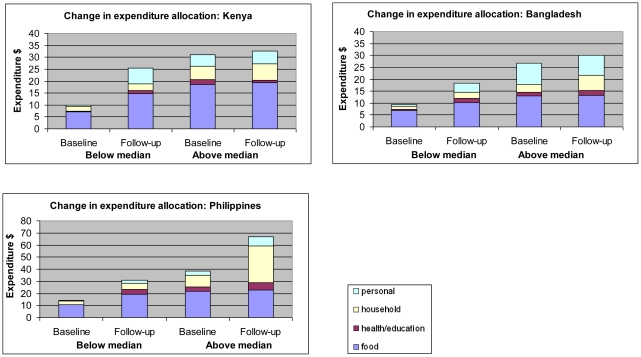
METHODOLOGY/PRINCIPAL FINDINGS: A multi-centre intervention study was conducted in three countries (Kenya, Philippines, Bangladesh). Poverty data (household per capita expenditure--PCE, asset ownership and self-rated wealth) were collected from cases aged ≥50 years who were visually impaired due to cataract (visual acuity<6/24 in the better eye) and age-sex matched controls with normal vision. Cases were offered free/subsidised cataract surgery. Approximately one year later participants were re-interviewed about poverty. 466 cases and 436 controls were examined at both baseline and follow-up (Follow up rate: 78% for cases, 81% for controls), of which 263 cases had undergone cataract surgery ("operated cases"). At baseline, operated cases were poorer compared to controls in terms of PCE (Kenya: $22 versus £35 p = 0.02, Bangladesh: $16 vs $24 p = 0.004, Philippines: $24 vs 32 p = 0.0007), assets and self-rated wealth. By follow-up PCE had increased significantly among operated cases in each of the three settings to the level of controls (Kenya: $30 versus £36 p = 0.49, Bangladesh: $23 vs $23 p = 0.20, Philippines: $45 vs $36 p = 0.68). There were smaller increases in self-rated wealth and no changes in assets. Changes in PCE were apparent in different socio-demographic and ocular groups. The largest PCE increases were apparent among the cases that were poorest at baseline.
CONCLUSIONS/SIGNIFICANCE: This study showed that cataract surgery can contribute to poverty alleviation, particularly among the most vulnerable members of society. This study highlights the need for increased provision of cataract surgery to poor people and shows that a focus on blindness may help to alleviate poverty and achieve the Millennium Development Goals.
贫困与失明被认为存在密切关联,但支持这一关联的经验数据却十分有限。本研究旨在评估白内障手术后视力障碍患者的贫困状况是否有所改善。
方法/主要发现:本项多中心干预研究在三个国家(肯尼亚、菲律宾、孟加拉国)开展。纳入年龄≥50 岁、因白内障(较好眼视力<6/24)而致盲且与视力正常的年龄性别相匹配的对照者,收集其贫困数据(家庭人均支出、资产拥有情况和自我评估财富)。为病例提供免费/补贴白内障手术。大约一年后,再次对参与者进行贫困情况访谈。共纳入 466 例病例和 436 例对照者,分别于基线和随访时进行检查(病例随访率:78%,对照者随访率:81%),其中 263 例病例接受了白内障手术(“手术病例”)。基线时,与对照者相比,手术病例的家庭人均支出(肯尼亚:$22 比 £35,p = 0.02;孟加拉国:$16 比 $24,p = 0.004;菲律宾:$24 比 32,p = 0.0007)、资产和自我评估财富均更差。随访时,在三个国家中,手术病例的家庭人均支出均显著增加,达到对照者水平(肯尼亚:$30 比 £36,p = 0.49;孟加拉国:$23 比 $23,p = 0.20;菲律宾:$45 比 $36,p = 0.68)。自我评估财富略有增加,资产无变化。不同社会人口学和眼部亚组的家庭人均支出均有明显增加。基线时最贫困的病例家庭人均支出增加幅度最大。
结论/意义:本研究表明白内障手术有助于减轻贫困,尤其是对社会最弱势群体。本研究强调为贫困人口提供更多白内障手术的必要性,并表明关注失明问题有助于减轻贫困,实现千年发展目标。