Center for Research and Innovation in Laser, Nove de Julho University (UNINOVE), Rua Vergueiro, 235, 01504-001, São Paulo, SP, Brazil.
Lasers Med Sci. 2011 Jul;26(4):493-501. doi: 10.1007/s10103-010-0866-x. Epub 2010 Nov 19.
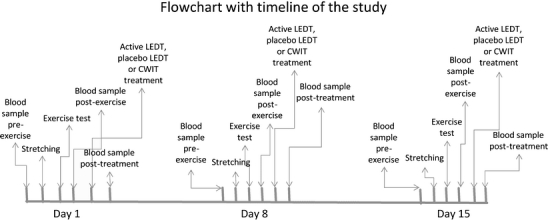
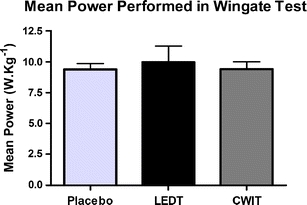
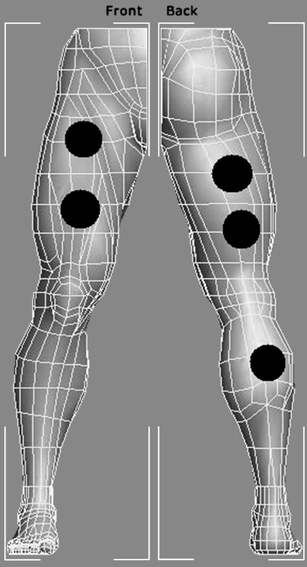
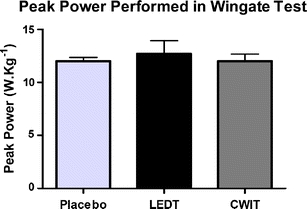
In the last years, phototherapy has becoming a promising tool to improve skeletal muscle recovery after exercise, however, it was not compared with other modalities commonly used with this aim. In the present study we compared the short-term effects of cold water immersion therapy (CWIT) and light emitting diode therapy (LEDT) with placebo LEDT on biochemical markers related to skeletal muscle recovery after high-intensity exercise. A randomized double-blind placebo-controlled crossover trial was performed with six male young futsal athletes. They were treated with CWIT (5°C of temperature [SD ±1°]), active LEDT (69 LEDs with wavelengths 660/850 nm, 10/30 mW of output power, 30 s of irradiation time per point, and 41.7 J of total energy irradiated per point, total of ten points irradiated) or an identical placebo LEDT 5 min after each of three Wingate cycle tests. Pre-exercise, post-exercise, and post-treatment measurements were taken of blood lactate levels, creatine kinase (CK) activity, and C-reactive protein (CRP) levels. There were no significant differences in the work performed during the three Wingate tests (p > 0.05). All biochemical parameters increased from baseline values (p < 0.05) after the three exercise tests, but only active LEDT decreased blood lactate levels (p = 0.0065) and CK activity (p = 0.0044) significantly after treatment. There were no significant differences in CRP values after treatments. We concluded that treating the leg muscles with LEDT 5 min after the Wingate cycle test seemed to inhibit the expected post-exercise increase in blood lactate levels and CK activity. This suggests that LEDT has better potential than 5 min of CWIT for improving short-term post-exercise recovery.
在过去几年中,光疗法已成为改善运动后骨骼肌恢复的一种有前景的工具,然而,它尚未与为此目的常用的其他方式进行比较。在本研究中,我们比较了冷水浸泡疗法(CWIT)和发光二极管疗法(LEDT)与安慰剂LEDT对高强度运动后骨骼肌恢复相关生化标志物的短期影响。对六名男性青年五人制足球运动员进行了一项随机双盲安慰剂对照交叉试验。在三次温盖特自行车测试中的每次测试后5分钟,他们接受了CWIT(温度为5°C [标准差±1°])、活性LEDT(69个发光二极管,波长为660/850 nm,输出功率为10/30 mW,每点照射时间为30秒,每点总照射能量为41.7 J,共照射十点)或相同的安慰剂LEDT。在运动前、运动后和治疗后测量血乳酸水平、肌酸激酶(CK)活性和C反应蛋白(CRP)水平。三次温盖特测试期间的做功没有显著差异(p>0.05)。在三次运动测试后,所有生化参数均从基线值升高(p<0.05),但只有活性LEDT在治疗后显著降低了血乳酸水平(p = 0.0065)和CK活性(p = 0.0044)。治疗后CRP值没有显著差异。我们得出结论,在温盖特自行车测试后5分钟用LEDT治疗腿部肌肉似乎能抑制运动后血乳酸水平和CK活性的预期升高。这表明LEDT在改善运动后短期恢复方面比5分钟的CWIT具有更好的潜力。