Cavalieri Duccio, Rivero Damariz, Beltrame Luca, Buschow Sonja I, Calura Enrica, Rizzetto Lisa, Gessani Sandra, Gauzzi Maria C, Reith Walter, Baur Andreas, Bonaiuti Roberto, Brandizi Marco, De Filippo Carlotta, D'Oro Ugo, Draghici Sorin, Dunand-Sauthier Isabelle, Gatti Evelina, Granucci Francesca, Gündel Michaela, Kramer Matthijs, Kuka Mirela, Lanyi Arpad, Melief Cornelis Jm, van Montfoort Nadine, Ostuni Renato, Pierre Philippe, Popovici Razvan, Rajnavolgyi Eva, Schierer Stephan, Schuler Gerold, Soumelis Vassili, Splendiani Andrea, Stefanini Irene, Torcia Maria G, Zanoni Ivan, Zollinger Raphael, Figdor Carl G, Austyn Jonathan M
Department of Pharmacology, University of Firenze, Firenze, Italy.
Immunome Res. 2010 Nov 19;6:10. doi: 10.1186/1745-7580-6-10.
The advent of Systems Biology has been accompanied by the blooming of pathway databases. Currently pathways are defined generically with respect to the organ or cell type where a reaction takes place. The cell type specificity of the reactions is the foundation of immunological research, and capturing this specificity is of paramount importance when using pathway-based analyses to decipher complex immunological datasets. Here, we present DC-ATLAS, a novel and versatile resource for the interpretation of high-throughput data generated perturbing the signaling network of dendritic cells (DCs).
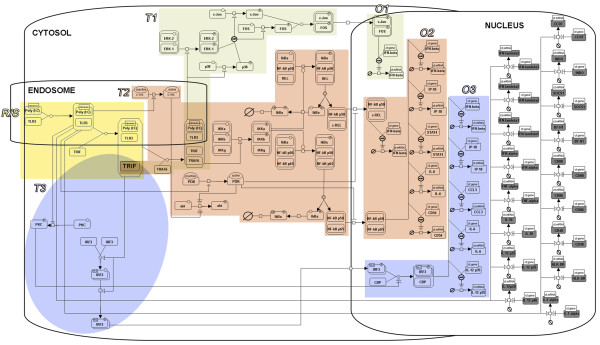
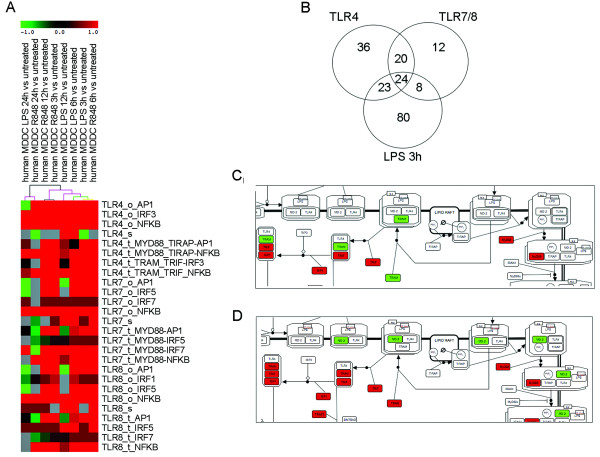
Pathways are annotated using a novel data model, the Biological Connection Markup Language (BCML), a SBGN-compliant data format developed to store the large amount of information collected. The application of DC-ATLAS to pathway-based analysis of the transcriptional program of DCs stimulated with agonists of the toll-like receptor family allows an integrated description of the flow of information from the cellular sensors to the functional outcome, capturing the temporal series of activation events by grouping sets of reactions that occur at different time points in well-defined functional modules.
The initiative significantly improves our understanding of DC biology and regulatory networks. Developing a systems biology approach for immune system holds the promise of translating knowledge on the immune system into more successful immunotherapy strategies.
系统生物学的出现伴随着通路数据库的蓬勃发展。目前,通路是根据反应发生的器官或细胞类型进行一般性定义的。反应的细胞类型特异性是免疫学研究的基础,在使用基于通路的分析来解读复杂的免疫数据集时,捕捉这种特异性至关重要。在此,我们展示了DC-ATLAS,这是一种新颖且通用的资源,用于解释通过干扰树突状细胞(DC)信号网络产生的高通量数据。
通路使用一种新颖的数据模型——生物连接标记语言(BCML)进行注释,BCML是一种符合SBGN的数据格式,专为存储收集到的大量信息而开发。将DC-ATLAS应用于基于通路的对用Toll样受体家族激动剂刺激的DC转录程序的分析,能够对从细胞传感器到功能结果的信息流进行综合描述,通过将在明确的功能模块中不同时间点发生的反应集分组,捕捉激活事件的时间序列。
该计划显著增进了我们对DC生物学和调控网络的理解。开发针对免疫系统的系统生物学方法有望将关于免疫系统的知识转化为更成功的免疫治疗策略。