Feijó Daniel, Tibúrcio Rafael, Ampuero Mariana, Brodskyn Cláudia, Tavares Natalia
Centro de Pesquisas Gonçalo Moniz (CPqGM), 40296-710 Salvador, BA, Brazil.
Centro de Pesquisas Gonçalo Moniz (CPqGM), 40296-710 Salvador, BA, Brazil; Universidade Federal da Bahia (UFBA), 40170-115 Salvador, BA, Brazil.
J Immunol Res. 2016;2016:3967436. doi: 10.1155/2016/3967436. Epub 2016 Jan 19.
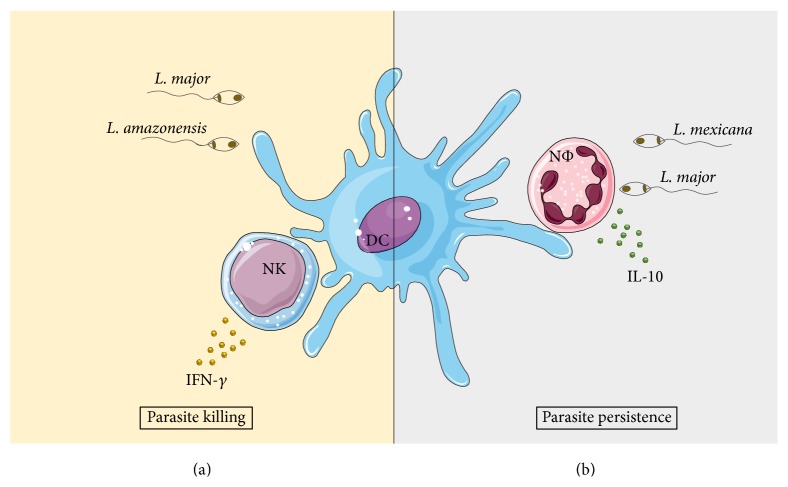
Leishmaniasis is a group of neglected diseases whose clinical manifestations depend on factors from the host and the pathogen. It is an important public health problem worldwide caused by the protozoan parasite from the Leishmania genus. Cutaneous Leishmaniasis (CL) is the most frequent form of this disease transmitted by the bite of an infected sandfly into the host skin. The parasites can be uptook and/or recognized by macrophages, neutrophils, and/or dendritic cells (DCs). Initially, DCs were described to play a protective role in activating the immune response against Leishmania parasites. However, several reports showed a dichotomic role of DCs in modulating the host immune response to susceptibility or resistance in CL. In this review, we discuss (1) the interactions between DCs and parasites from different species of Leishmania and (2) the crosstalk of DCs and other cells during CL infection. The complexity of these interactions profoundly affects the adaptive immune response and, consequently, the disease outcome, especially from Leishmania species of the New World.
利什曼病是一组被忽视的疾病,其临床表现取决于宿主和病原体的因素。它是由利什曼原虫属的原生动物寄生虫引起的全球重要公共卫生问题。皮肤利什曼病(CL)是该疾病最常见的形式,通过受感染的白蛉叮咬传播到宿主皮肤。寄生虫可被巨噬细胞、中性粒细胞和/或树突状细胞(DC)摄取和/或识别。最初,DC被描述为在激活针对利什曼原虫寄生虫的免疫反应中发挥保护作用。然而,一些报告显示DC在调节宿主对CL易感性或抗性的免疫反应中具有双重作用。在本综述中,我们讨论了(1)DC与不同利什曼原虫物种的寄生虫之间的相互作用,以及(2)CL感染期间DC与其他细胞的相互作用。这些相互作用的复杂性深刻影响适应性免疫反应,进而影响疾病结局,尤其是来自新大陆的利什曼原虫物种。