Gradwohl G, Ménissier de Murcia J M, Molinete M, Simonin F, Koken M, Hoeijmakers J H, de Murcia G
Institut de Biologie Moléculaire et Cellulaire, Centre National de la Recherche Scientifique, Laboratoire de Biochimie II, Strasbourg, France.
Proc Natl Acad Sci U S A. 1990 Apr;87(8):2990-4. doi: 10.1073/pnas.87.8.2990.
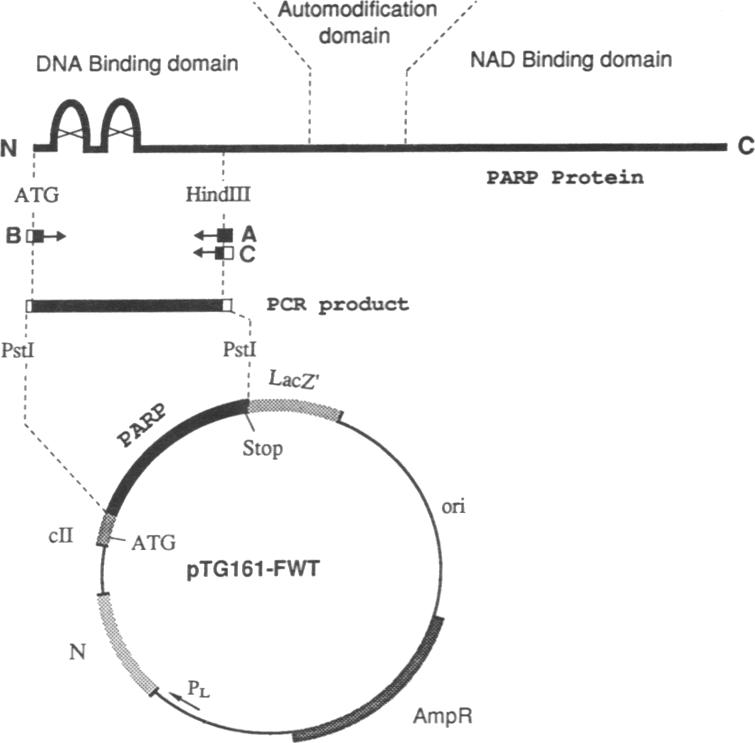
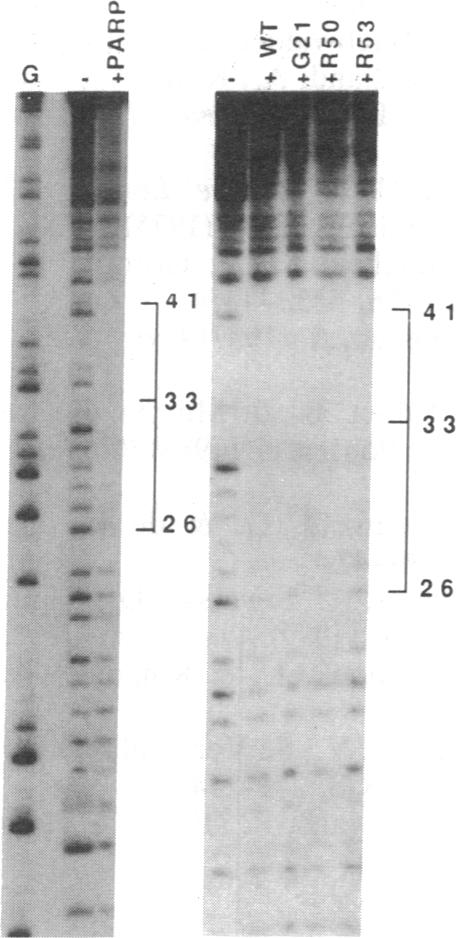
Poly(ADP-ribose) polymerase (EC 2.4.2.30) is a zinc-binding protein that specifically binds to a DNA strand break in a zinc-dependent manner. We describe here the cloning and expression in Escherichia coli of a cDNA fragment encoding the two putative zinc fingers (FI and FII) domain of the human poly(ADP-ribose) polymerase. Using site-directed mutagenesis, we identified the amino acids involved in metal coordination and analyzed the consequence of altering the proposed zinc-finger structures on DNA binding. Disruption of the metal binding ability of the second zinc finger, FII, dramatically reduced target DNA binding. In contrast, when the postulated Zn(II) ligands of FI were mutated, the DNA binding activity was only slightly affected. DNase I protection studies showed that the FII is involved in the specific recognition of a DNA strand break. These results demonstrate that poly(ADP-ribose) polymerase contains a type of zinc finger that differs from previously recognized classes in terms of both structure and function.
聚(ADP - 核糖)聚合酶(EC 2.4.2.30)是一种锌结合蛋白,它以锌依赖的方式特异性结合DNA链断裂处。我们在此描述编码人聚(ADP - 核糖)聚合酶两个假定锌指(FI和FII)结构域的cDNA片段在大肠杆菌中的克隆与表达。利用定点诱变,我们确定了参与金属配位的氨基酸,并分析了改变所提出的锌指结构对DNA结合的影响。第二个锌指FII的金属结合能力的破坏显著降低了对靶DNA的结合。相比之下,当FI的假定锌(II)配体发生突变时,DNA结合活性仅受到轻微影响。DNase I保护研究表明,FII参与了对DNA链断裂的特异性识别。这些结果表明,聚(ADP - 核糖)聚合酶含有一种在结构和功能上均不同于先前公认类型的锌指。