College of Life and Environmental Sciences, University of Exeter, Washington Singer Laboratories, Exeter, UK.
Inj Prev. 2011 Apr;17(2):119-26. doi: 10.1136/ip.2010.026989. Epub 2010 Nov 21.
This review considers barriers to, and facilitators of, success for interventions to reduce unintentional injury to children in the home through supply and/or installation of home safety equipment, and looks at risk assessments.
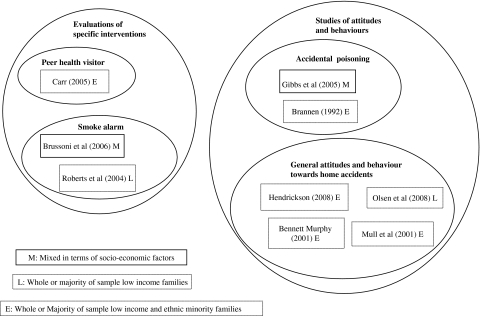
A systematic review of qualitative research. Bibliographic databases were searched for studies on interventions to reduce unintentional child injury in the home, or on related attitudes and behaviours. Studies were quality appraised, findings extracted, and a conceptual framework was developed to assess factors affecting the success of interventions.
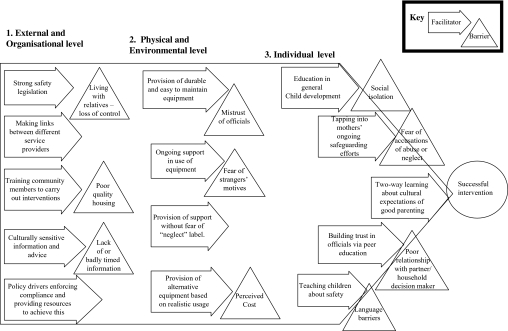
Nine peer-reviewed journal articles were included. Barriers and facilitators were highlighted at organisational, environmental and personal levels. Effective provision of safety equipment involves ongoing support with installation and maintenance. Take up and success of interventions depends on adjusting interventions according to practical limitations and parents' cultural expectations. A particular barrier was parents' inability to modify rented or shared accommodation.
The review highlights ways in which health inequalities affect the take up and success of home safety interventions, and how health workers can use this knowledge to facilitate future interventions.
本综述考虑了通过供应和/或安装家庭安全设备来减少儿童在家中意外伤害的干预措施的成功障碍和促进因素,并着眼于风险评估。
对定性研究进行系统综述。检索了有关减少家庭中意外伤害的干预措施或相关态度和行为的研究。对研究进行了质量评估,提取了研究结果,并制定了一个概念框架,以评估影响干预措施成功的因素。
纳入了 9 篇同行评审的期刊文章。在组织、环境和个人层面上强调了障碍和促进因素。有效提供安全设备需要持续的安装和维护支持。干预措施的采用和成功取决于根据实际限制和父母的文化期望来调整干预措施。一个特别的障碍是父母无法修改租用或共享的住宿。
该综述强调了健康不平等如何影响家庭安全干预措施的采用和成功,以及卫生工作者如何利用这一知识来促进未来的干预措施。