Department of Anesthesiology and Critical Care Medicine, The Johns Hopkins School of Medicine, 600 North Wolfe Street, Baltimore, MD, 21287, USA.
Crit Care. 2010;14(6):R218. doi: 10.1186/cc9346. Epub 2010 Nov 29.
Intensive care unit (ICU) patients and family members repeatedly note accurate and timely communication from health care providers to be crucial to high-quality ICU care. Practice guidelines recommend improving communication. However, few data, particularly in surgical ICUs, exist on health care provider opinions regarding whether communication is effective.
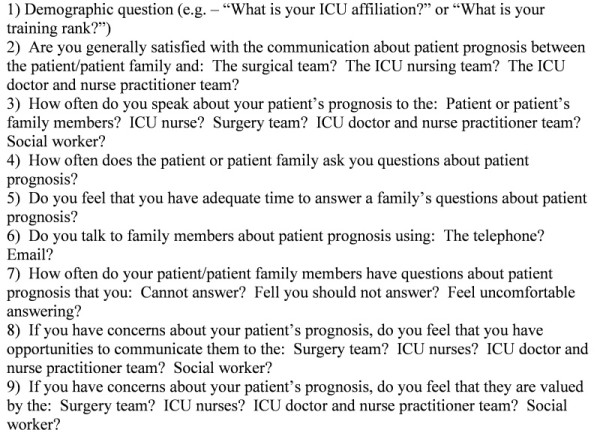
To evaluate ICU clinician perceptions regarding adequacy of communication regarding prognosis, we developed a survey and administered it to a cross section of surgical ICU nurses, surgical ICU physicians, nurse practitioners (NPs), and surgeons.
Surgeons had a high satisfaction with communication regarding prognosis for themselves (90%), ICU nurses (85%), and ICU physicians and NPs (85%). ICU nurses noted high satisfaction with personal (82%) and ICU physician and NP (71%) communication, but low (2%) satisfaction with that provided by surgeons. ICU physicians and NPs noted high satisfaction with personal (74%) and ICU nurse (88%) communication, but lower (23%) satisfaction with that provided by surgeons. ICU nurses were the most likely (75%) to report speaking to patients and patient families regarding prognosis, followed by surgeons (40%), and then ICU physicians and NPs (33%). Surgeons noted many opportunities to speak to ICU nurses and ICU physicians and NPs about patient prognosis and noted that comments were often valued. ICU physicians and NPs and ICU nurses noted many opportunities to speak to each other but fewer opportunities to communicate with surgeons. ICU physicians and NPs thought that their comments were valued by ICU nurses but less valued by surgeons. ICU nurses thought that their comments were less valued by ICU physicians and NPs and surgeons.
ICU nurses, surgeons, and ICU intensivists and NPs varied widely in their satisfaction with communication relating to prognosis. Clinician groups also varied in whether they thought that they had opportunities to communicate prognosis and whether their concerns were valued by other provider groups. These results hint at the nuanced and complicated relationships present in surgical ICUs. Further validation studies and further evaluations of patient and family member perspectives are needed.
重症监护病房(ICU)的患者和家属反复指出,医护人员提供准确、及时的沟通对于高质量的 ICU 护理至关重要。实践指南建议改善沟通。然而,在外科 ICU 中,很少有数据存在于医护人员对沟通是否有效的看法。
为了评估 ICU 临床医生对预后沟通是否充分的看法,我们开发了一项调查,并将其分发给外科 ICU 护士、外科 ICU 医生、执业护士(NP)和外科医生。
外科医生对自己(90%)、ICU 护士(85%)和 ICU 医生和 NP(85%)预后沟通的满意度很高。ICU 护士对个人(82%)和 ICU 医生和 NP(71%)的沟通满意度很高,但对外科医生提供的沟通满意度较低(2%)。ICU 医生和 NP 对个人(74%)和 ICU 护士(88%)的沟通满意度很高,但对外科医生提供的沟通满意度较低(23%)。ICU 护士最有可能(75%)与患者及其家属就预后进行沟通,其次是外科医生(40%),然后是 ICU 医生和 NP(33%)。外科医生注意到有很多机会与 ICU 护士和 ICU 医生和 NP 讨论患者的预后,并指出这些意见经常受到重视。ICU 医生和 NP 以及 ICU 护士注意到有很多机会相互沟通,但与外科医生沟通的机会较少。ICU 医生和 NP 认为他们的意见受到 ICU 护士的重视,但受到外科医生的重视程度较低。ICU 护士认为他们的意见受到 ICU 医生和 NP 以及外科医生的重视程度较低。
ICU 护士、外科医生以及 ICU 医生和 NP 在与预后相关的沟通满意度方面存在很大差异。临床医生群体在他们是否认为有机会沟通预后以及他们的担忧是否被其他医疗服务提供者群体重视方面也存在差异。这些结果暗示了外科 ICU 中存在的微妙而复杂的关系。需要进一步的验证研究和对患者和家属观点的进一步评估。