Department of Anesthesiology, University Medical Center Groningen, Hanzeplein 1, Groningen, 9700 RB, The Netherlands.
Crit Care. 2010;14(6):R219. doi: 10.1186/cc9348. Epub 2010 Nov 29.
Controversy remains regarding the relationship between central venous saturation (ScvO(2)) and mixed venous saturation (SvO(2)) and their use and interchangeability in patients with sepsis or septic shock. We tested the hypothesis that ScvO(2) does not reliably predict SvO(2) in sepsis. Additionally we looked at the influence of the source (splanchnic or non-splanchnic) of sepsis on this relationship.
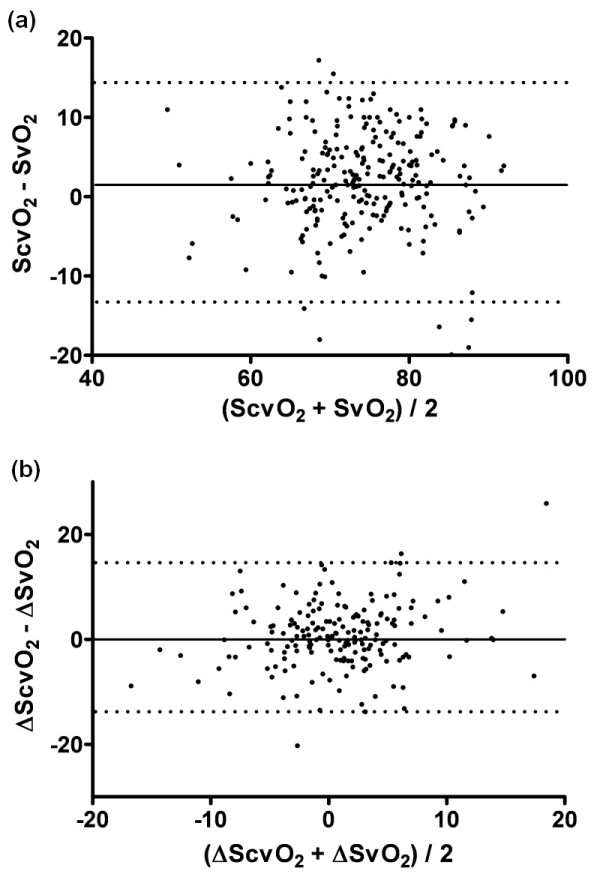
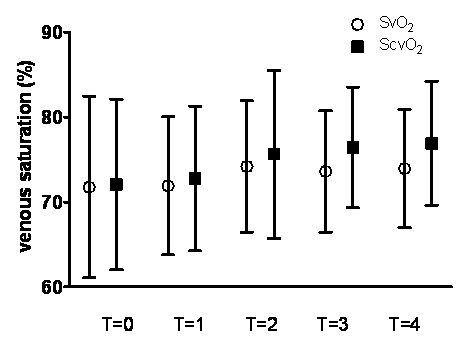
In this prospective observational two-center study we concurrently determined ScvO(2) and SvO(2) in a group of 53 patients with severe sepsis during the first 24 hours after admission to the intensive care units in 2 Dutch hospitals. We assessed correlation and agreement of ScvO(2) and SvO(2), including the difference, i.e. the gradient, between ScvO(2) and SvO(2) (ScvO(2) - SvO(2)). Additionally, we compared the mean differences between ScvO(2) and SvO(2) of both splanchnic and non-splanchnic group.
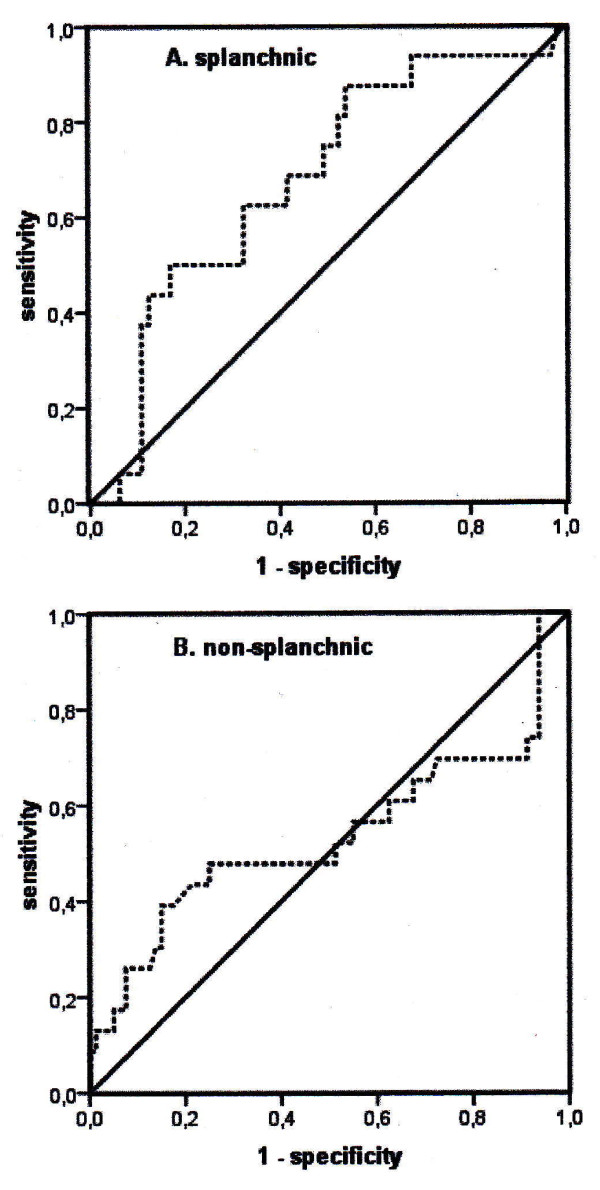
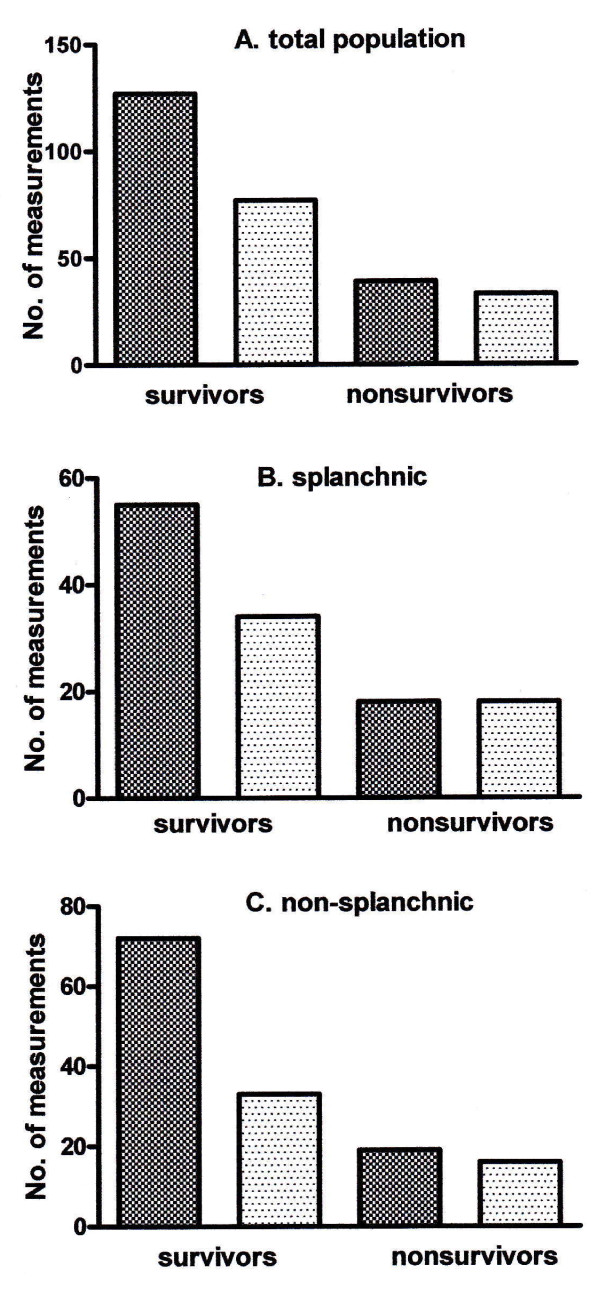
A total of 265 paired blood samples were obtained. ScvO(2) overestimated SvO(2) by less than 5% with wide limits of agreement. For changes in ScvO(2) and SvO(2) results were similar. The distribution of the (ScvO(2) - SvO(2)) (< 0 or ≥ 0) was similar in survivors and nonsurvivors. The mean (ScvO(2) - SvO(2)) in the splanchnic group was similar to the mean (ScvO(2) - SvO(2)) in the non-splanchnic group (0.8 ± 3.9% vs. 2.5 ± 6.2%; P = 0.30). O(2)ER (P = 0.23) and its predictive value for outcome (P = 0.20) were similar in both groups.
ScvO(2) does not reliably predict SvO(2) in patients with severe sepsis. The trend of ScvO(2) is not superior to the absolute value in this context. A positive difference (ScvO(2) - SvO(2)) is not associated with improved outcome.
中心静脉血氧饱和度(ScvO2)与混合静脉血氧饱和度(SvO2)之间的关系及其在脓毒症或感染性休克患者中的应用和可互换性仍存在争议。我们检验了 ScvO2 不能可靠预测脓毒症患者 SvO2 的假设。此外,我们还观察了脓毒症的来源(内脏或非内脏)对这种关系的影响。
在这项前瞻性观察性的 2 中心研究中,我们同时在荷兰 2 家医院的重症监护病房中,在 53 名严重脓毒症患者入院后的前 24 小时内,同时确定 ScvO2 和 SvO2。我们评估了 ScvO2 和 SvO2 的相关性和一致性,包括 ScvO2 和 SvO2 之间的差异(ScvO2-SvO2)。此外,我们比较了内脏和非内脏组的 ScvO2 和 SvO2 之间的平均差值。
共获得 265 对血样。ScvO2 对 SvO2 的高估值小于 5%,一致性界限较宽。对于 ScvO2 和 SvO2 的变化,结果相似。存活者和非存活者的(ScvO2-SvO2)(<0 或≥0)分布相似。内脏组的平均(ScvO2-SvO2)与非内脏组相似(0.8±3.9%比 2.5±6.2%;P=0.30)。O2ER(P=0.23)及其对结局的预测价值(P=0.20)在两组中相似。
ScvO2 不能可靠地预测严重脓毒症患者的 SvO2。在这种情况下,ScvO2 的趋势并不优于绝对值。阳性差异(ScvO2-SvO2)与改善结局无关。