Lee Jae-Wook, Bang Kyong-Won, Jang Pil-Sang, Chung Nak-Gyun, Cho Bin, Jeong Dae-Chul, Kim Hack-Ki, Im Soo-Ah, Lim Gye-Yeon
Department of Pediatrics, College of Medicine, The Catholic University of Korea, Seoul, Korea.
Korean J Hematol. 2010 Mar;45(1):62-5. doi: 10.5045/kjh.2010.45.1.62. Epub 2010 Mar 31.
Acute colonic pseudo-obstruction (ACPO) refers to dilatation of the colon and decreased bowel motility without evidence of mechanical obstruction. Neostigmine, an acetylcholinesterase inhibitor, has been used in patients in whom supportive therapy failed to resolve ACPO. Here, we report the results of administering neostigmine to treat ACPO in children with hematologic malignancies.
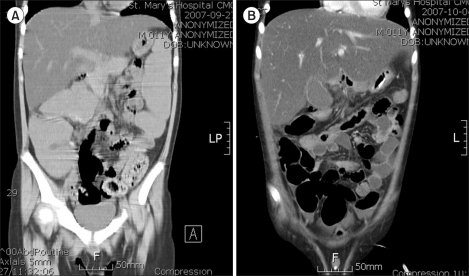
Between September 2005 and December 2009, 10 patients (8 male and 2 female) were diagnosed with ACPO at the Department of Pediatrics, Catholic University of Korea. Diagnosis of ACPO was based on typical clinical features as well as colonic dilatation found on abdominal CT imaging. Neostigmine was administered subcutaneously at a dosage of 0.01 mg/kg/dose (maximum 0.5 mg) twice daily for a maximum of 5 total doses. ACPO was determined to be responsive to neostigmine if the patient showed both stool passage and improvement of clinical symptoms.
The study group included 8 acute lymphoblastic leukemia patients, 1 patient with malignant lymphoma, and 1 patient with juvenile myelomonocytic leukemia. The median age at ACPO diagnosis was 8.5 years (range, 3-14). Overall, 8 patients (80%) showed therapeutic response to neostigmine at a median of 29 hours after the initial administration (range, 1-70). Two patients (20%) showed side effects of grade 2 or above, but none complained of cardiovascular symptoms that required treatment.
In this study, ACPO was diagnosed most often in late-childhood ALL patients. Subcutaneous neostigmine can be used to effectively treat ACPO diagnosed in children with hematologic malignancies without major cardiovascular complications.
急性结肠假性梗阻(ACPO)是指结肠扩张且肠动力下降,但无机械性梗阻证据。新斯的明是一种乙酰胆碱酯酶抑制剂,已用于支持治疗未能缓解ACPO的患者。在此,我们报告给予新斯的明治疗血液系统恶性肿瘤患儿ACPO的结果。
2005年9月至2009年12月,韩国天主教大学儿科诊断出10例ACPO患者(8例男性,2例女性)。ACPO的诊断基于典型临床特征以及腹部CT成像发现的结肠扩张。新斯的明以0.01mg/kg/剂量(最大0.5mg)皮下注射,每日两次,最多共5剂。如果患者出现排便且临床症状改善,则判定ACPO对新斯的明有反应。
研究组包括8例急性淋巴细胞白血病患者、1例恶性淋巴瘤患者和1例青少年粒单核细胞白血病患者。ACPO诊断时的中位年龄为8.5岁(范围3 - 14岁)。总体而言,8例患者(80%)在首次给药后的中位29小时(范围1 - 70小时)显示对新斯的明有治疗反应。2例患者(20%)出现2级或以上副作用,但无人抱怨需要治疗的心血管症状。
在本研究中,ACPO最常诊断于儿童晚期ALL患者。皮下注射新斯的明可有效治疗血液系统恶性肿瘤患儿诊断出的ACPO,且无重大心血管并发症。