Department of Gynecology and Obstetrics, Botucatu Medical School, Sao Paulo State University Botucatu, Brazil.
Reprod Biol Endocrinol. 2010 Dec 3;8:149. doi: 10.1186/1477-7827-8-149.
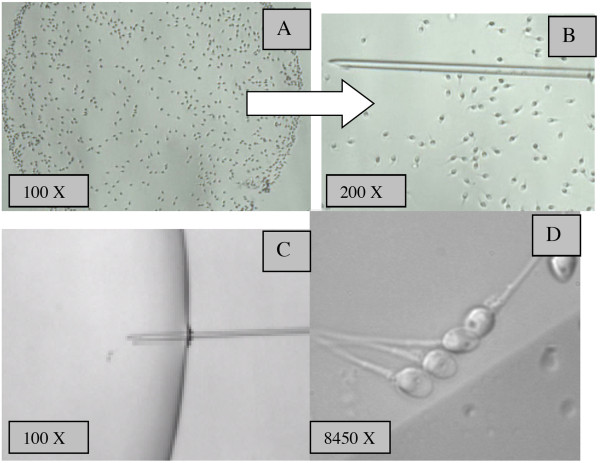
The present study aimed to evaluate the efficacy of the hyaluronic acid (HA) binding assay in the selection of motile spermatozoa with normal morphology at high magnification (8400x).
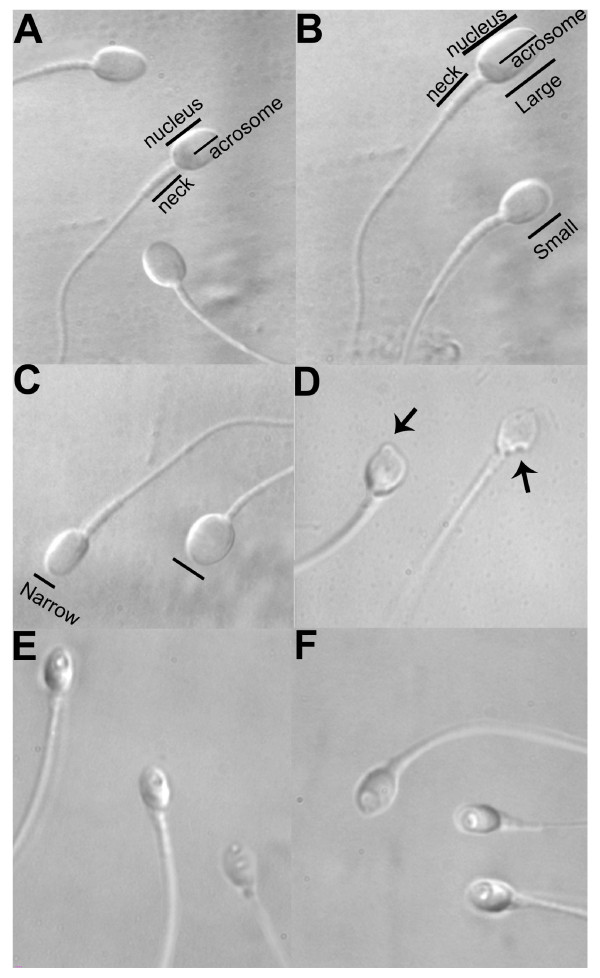
A total of 16592 prepared spermatozoa were selected and classified into two groups: Group I, spermatozoa which presented their head attached to an HA substance (HA-bound sperm), and Group II, those spermatozoa that did not attach to the HA substance (HA-unbound sperm). HA-bound and HA-unbound spermatozoa were evaluated according to the following sperm forms: 1-Normal morphology: normal nucleus (smooth, symmetric and oval configuration, length: 4.75+/-2.8 μm and width: 3.28+/-0.20 μm, no extrusion or invagination and no vacuoles occupied more than 4% of the nuclear area) as well as acrosome, post-acrosomal lamina, neck, tail, besides not presenting a cytoplasmic droplet or cytoplasm around the head; 2-Abnormalities of nuclear form (a-Large/small; b-Wide/narrow; c-Regional disorder); 3-Abnormalities of nuclear chromatin content (a-Vacuoles: occupy >4% to 50% of the nuclear area and b-Large vacuoles: occupy >50% of the nuclear area) using a high magnification (8400x) microscopy system.
No significant differences were obtained with respect to sperm morphological forms and the groups HA-bound and HA-unbound. 1-Normal morphology: HA-bound 2.7% and HA-unbound 2.5% (P = 0.56). 2-Abnormalities of nuclear form: a-Large/small: HA-bound 1.6% vs. HA-unbound 1.6% (P = 0.63); b-Wide/narrow: HA-bound 3.1% vs. HA-unbound 2.7% (P = 0.13); c-Regional disorders: HA-bound 4.7% vs. HA-unbound 4.4% (P = 0.34). 3. Abnormalities of nuclear chromatin content: a-Vacuoles >4% to 50%: HA-bound 72.2% vs. HA-unbound 72.5% (P = 0.74); b-Large vacuoles: HA-bound 15.7% vs. HA-unbound 16.3% (P = 0.36).
The findings suggest that HA binding assay has limited efficacy in selecting motile spermatozoa with normal morphology at high magnification.
本研究旨在评估高倍镜(8400x)下使用透明质酸(HA)结合试验选择具有正常形态的活动精子的效果。
共选择 16592 个准备好的精子并将其分为两组:I 组,精子头部附着在 HA 物质上(HA 结合精子);II 组,精子头部不附着在 HA 物质上(HA 未结合精子)。HA 结合和 HA 未结合的精子根据以下精子形态进行评估:1-正常形态:正常核(光滑、对称、椭圆形,长度:4.75+/-2.8μm,宽度:3.28+/-0.20μm,无挤压或内陷,无空泡占据核面积的 4%以上)以及顶体、顶体后板、颈部、尾部,同时头部没有细胞质滴或头部周围的细胞质;2-核形态异常(a-大/小;b-宽/窄;c-区域紊乱);3-核染色质含量异常(a-空泡:占据核面积的>4%至 50%,b-大空泡:占据核面积的>50%)使用高倍镜(8400x)显微镜系统。
HA 结合和 HA 未结合组在精子形态和形态学方面没有显著差异。1-正常形态:HA 结合组为 2.7%,HA 未结合组为 2.5%(P=0.56)。2-核形态异常:a-大/小:HA 结合组 1.6%,HA 未结合组 1.6%(P=0.63);b-宽/窄:HA 结合组 3.1%,HA 未结合组 2.7%(P=0.13);c-区域紊乱:HA 结合组 4.7%,HA 未结合组 4.4%(P=0.34)。3.核染色质含量异常:a-空泡>4%至 50%:HA 结合组 72.2%,HA 未结合组 72.5%(P=0.74);b-大空泡:HA 结合组 15.7%,HA 未结合组 16.3%(P=0.36)。
研究结果表明,HA 结合试验在选择高倍镜下具有正常形态的活动精子方面效果有限。