The Roslin Institute and Royal (Dick) School of Veterinary Studies, University of Edinburgh, Roslin Biocentre, Roslin, Midlothian, EH25 9PS, UK.
BMC Genet. 2010 Dec 7;11:107. doi: 10.1186/1471-2156-11-107.
Infectious disease of livestock continues to be a cause of substantial economic loss and has adverse welfare consequences in both the developing and developed world. New solutions to control disease are needed and research focused on the genetic loci determining variation in immune-related traits has the potential to deliver solutions. However, identifying selectable markers and the causal genes involved in disease resistance and vaccine response is not straightforward. The aims of this study were to locate regions of the bovine genome that control the immune response post immunisation. 195 F2 and backcross Holstein Charolais cattle were immunised with a 40-mer peptide derived from foot-and-mouth disease virus (FMDV). T cell and antibody (IgG1 and IgG2) responses were measured at several time points post immunisation. All experimental animals (F0, F1 and F2, n = 982) were genotyped with 165 microsatellite markers for the genome scan.
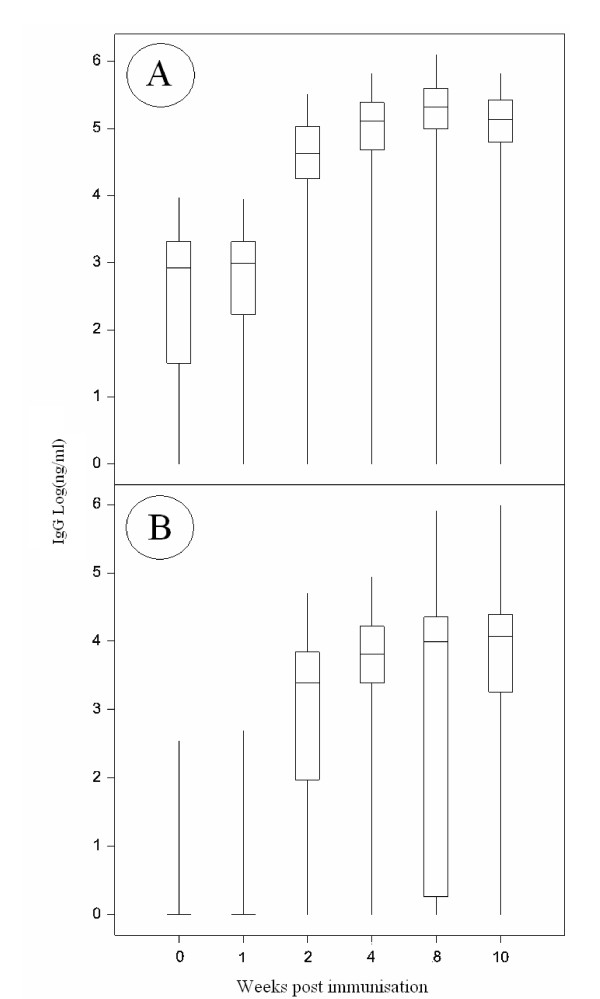
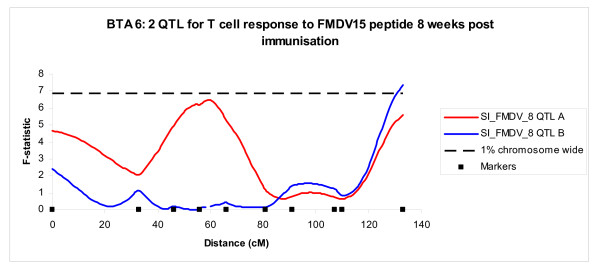
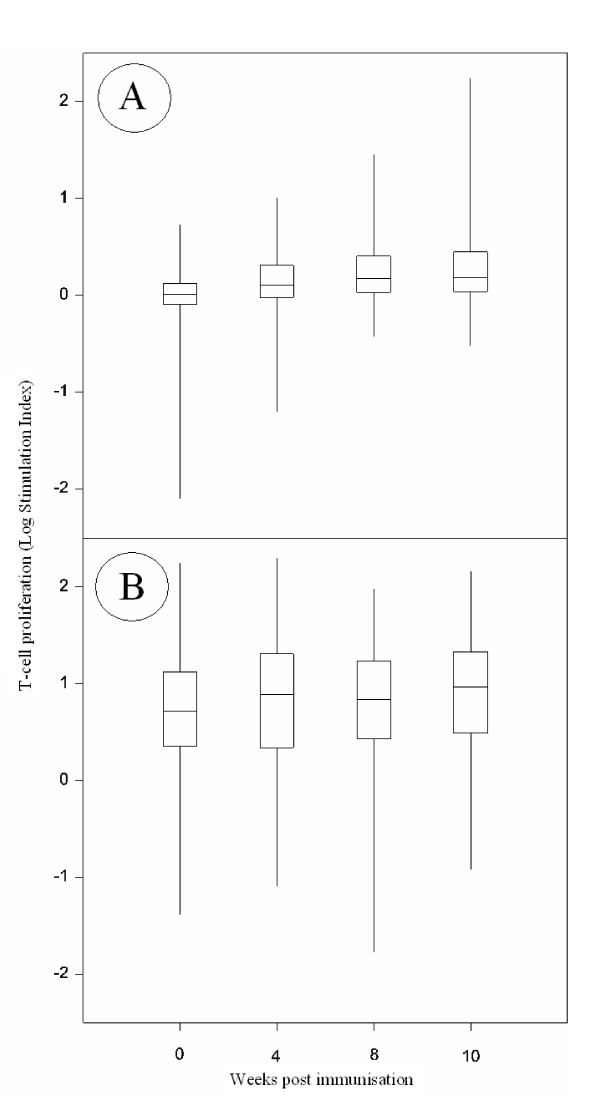
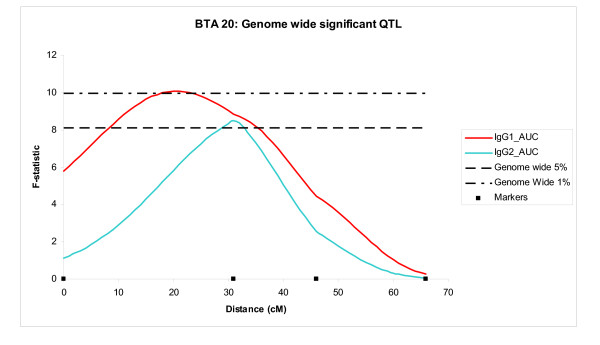
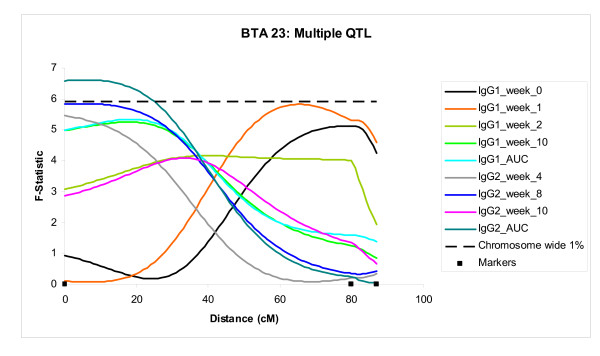
Considerable variability in the immune responses across time was observed and sire, dam and age had significant effects on responses at specific time points. There were significant correlations within traits across time, and between IgG1 and IgG2 traits, also some weak correlations were detected between T cell and IgG2 responses. The whole genome scan detected 77 quantitative trait loci (QTL), on 22 chromosomes, including clusters of QTL on BTA 4, 5, 6, 20, 23 and 25. Two QTL reached 5% genome wide significance (on BTA 6 and 24) and one on BTA 20 reached 1% genome wide significance.
A proportion of the variance in the T cell and antibody response post immunisation with an FDMV peptide has a genetic component. Even though the antigen was relatively simple, the humoral and cell mediated responses were clearly under complex genetic control, with the majority of QTL located outside the MHC locus. The results suggest that there may be specific genes or loci that impact on variation in both the primary and secondary immune responses, whereas other loci may be specifically important for early or later phases of the immune response. Future fine mapping of the QTL clusters identified has the potential to reveal the causal variations underlying the variation in immune response observed.
传染病继续对牲畜造成严重的经济损失,并对发展中国家和发达国家的福利产生不利影响。需要新的解决方案来控制疾病,而专注于决定免疫相关特征变异的遗传基因座的研究有可能提供解决方案。然而,确定与疾病抗性和疫苗反应相关的可选择标记和因果基因并不简单。本研究的目的是定位控制免疫后免疫反应的牛基因组区域。195 头 F2 和回交荷斯坦-夏洛来牛用来自口蹄疫病毒(FMDV)的 40 肽进行免疫接种。在免疫接种后几个时间点测量 T 细胞和抗体(IgG1 和 IgG2)反应。所有实验动物(F0、F1 和 F2,n=982)均用 165 个微卫星标记进行基因组扫描进行基因型分析。
在整个时间内观察到免疫反应的变化相当大,并且 sire、dam 和年龄对特定时间点的反应有显著影响。在性状内的性状之间以及在 IgG1 和 IgG2 性状之间存在显著相关性,也检测到 T 细胞和 IgG2 反应之间的一些弱相关性。全基因组扫描检测到 77 个数量性状基因座(QTL),位于 22 条染色体上,包括 BTA 4、5、6、20、23 和 25 上的 QTL 簇。两个 QTL 达到 5%全基因组显著水平(在 BTA 6 和 24 上),一个在 BTA 20 上达到 1%全基因组显著水平。
用 FMDV 肽免疫接种后的 T 细胞和抗体反应的变异有一部分具有遗传成分。尽管抗原相对简单,但体液和细胞介导的反应显然受到复杂的遗传控制,大多数 QTL 位于 MHC 基因座之外。结果表明,可能存在影响原发性和继发性免疫反应变异的特定基因或基因座,而其他基因座可能对免疫反应的早期或晚期阶段特别重要。未来对鉴定的 QTL 簇的精细定位有可能揭示观察到的免疫反应变异的因果变化。