Department of Hepatology, Wright-Fleming Institute, Faculty of Medicine, Imperial College London, London, UK.
Gut. 2011 Jun;60(6):837-45. doi: 10.1136/gut.2010.217166. Epub 2010 Dec 7.
An epidemic of acute hepatitis C virus (HCV) infection in HIV-positive men-who-have-sex-with-men (MSM) is emerging in Europe, Australia and the USA. The aim of this study was to characterise the natural history of primary HCV in this setting and to assess host and viral factors which predict spontaneous clearance.
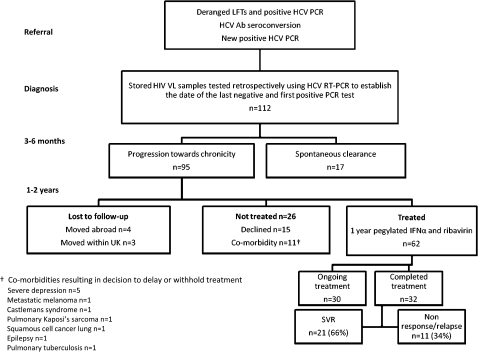
This prospective longitudinal cohort study was carried out in 112 HIV-positive patients who were followed in a single centre (the St Mary's Acute HCV Cohort). Plasma and peripheral blood mononuclear cells (PBMCs) were obtained at monthly intervals for 3 months and at 3-monthly intervals thereafter for a median of 45 months (IQR = 29-69 months). The primary end point was spontaneous clearance of HCV. Cox regression was used to assess the impact of clinical and virological variables on outcome, including liver function, CD4 count, rate of HCV RNA decline, T cell response and clonal sequence evolution within the HCV E2 envelope gene.
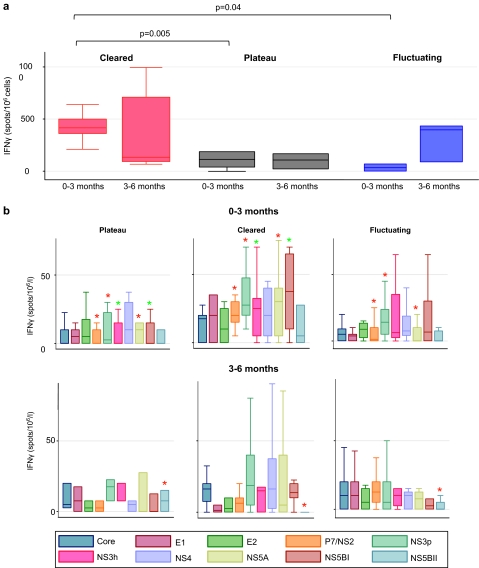
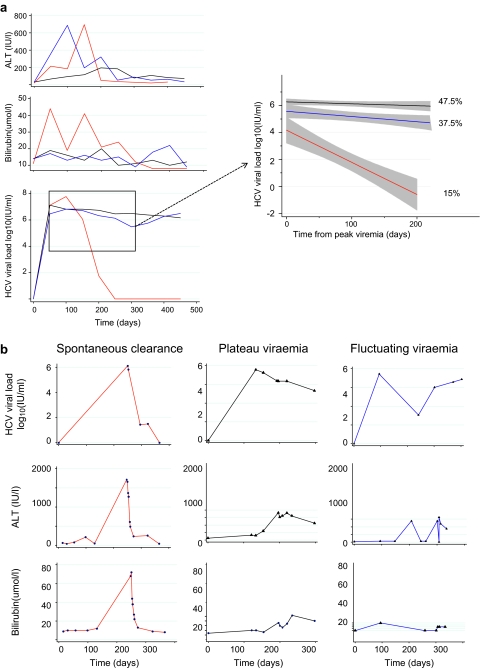
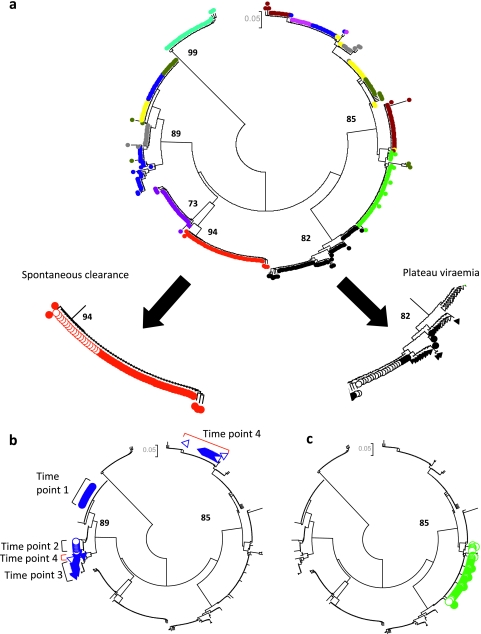
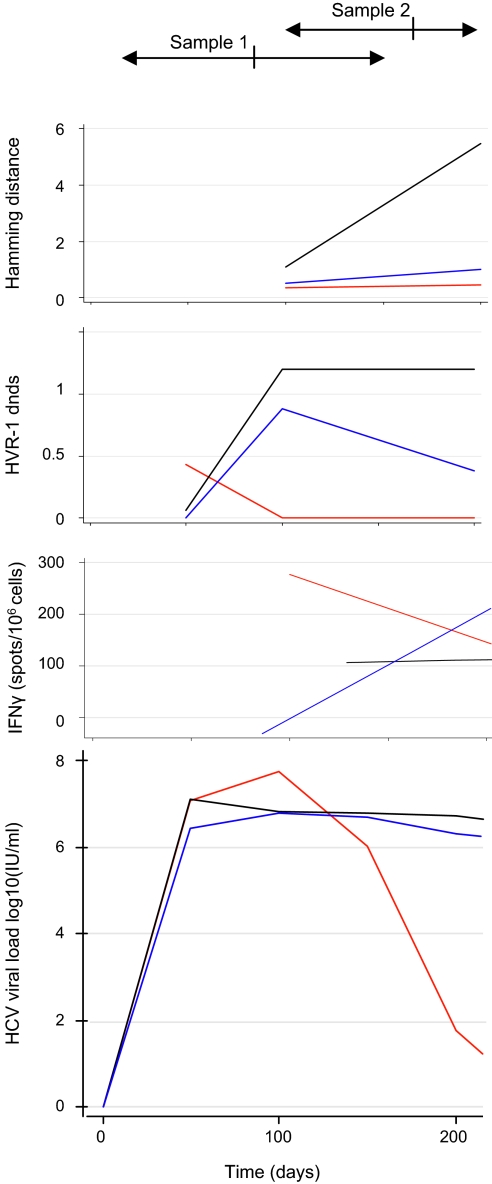
15% of patients cleared HCV spontaneously, while 85% progressed towards chronicity. The latter group included a significant proportion of 'fluctuating' progressors (37.5%), in whom a fall followed by a rise (>1 log₁₀) in viraemia was observed. This was associated with superinfection with new HCV strains and partially effective T cell responses. Spontaneous clearance was strongly associated with a 2.2 log₁₀ viral load drop within 100 days of infection (HR = 1.78; p < 0.0001), elevated bilirubin (≥ 40 μmol/l; HR = 5.04; p = 0.006), elevated alanine aminotransferase (ALT; ≥ 1000 IU/ml; HR = 2.62; p = 0.048) and baseline CD4 count ≥ 650 × 10⁶/l (HR = 2.66; p = 0.045), and only occurred in patients with genotype 1 infection. Evolution to spontaneous clearance occurred in patients with low viral diversity in the presence of an early multispecific T cell response.
Spontaneous clearance of acute HCV in HIV-positive men can be predicted by a rapid decline in viral load, high CD4 count, elevated bilirubin and ALT, and is associated with low viral diversity and strong T cell responses.
在欧洲、澳大利亚和美国,艾滋病毒阳性男男性行为者(MSM)中丙型肝炎病毒(HCV)感染呈爆发性流行。本研究旨在描述该人群中 HCV 感染的自然史,并评估预测自发清除的宿主和病毒因素。
这项前瞻性纵向队列研究在 112 名在一个中心(圣玛丽急性 HCV 队列)接受随访的 HIV 阳性患者中进行。在最初的 3 个月中,每月采集血浆和外周血单个核细胞(PBMC),此后每 3 个月采集一次,中位时间为 45 个月(IQR = 29-69 个月)。主要终点是 HCV 的自发清除。Cox 回归用于评估临床和病毒学变量对结局的影响,包括肝功能、CD4 计数、HCV RNA 下降率、T 细胞反应和 HCV E2 包膜基因内的克隆序列演变。
15%的患者自发清除 HCV,而 85%的患者进展为慢性感染。后者包括相当一部分“波动”进展者(37.5%),他们的病毒血症先下降后上升(>1 log₁₀)。这与新 HCV 株的重叠感染和部分有效的 T 细胞反应有关。自发清除与感染后 100 天内病毒载量下降 2.2 log₁₀(HR = 1.78;p < 0.0001)、胆红素升高(≥ 40 μmol/L;HR = 5.04;p = 0.006)、丙氨酸氨基转移酶(ALT;≥ 1000 IU/ml;HR = 2.62;p = 0.048)升高以及基线 CD4 计数≥650 × 10⁶/L(HR = 2.66;p = 0.045)强烈相关,仅发生在基因型 1 感染患者中。在早期多特异性 T 细胞反应存在的情况下,病毒多样性低的患者会自发向清除方向演变。
HIV 阳性男性中急性 HCV 的自发清除可通过病毒载量快速下降、CD4 计数高、胆红素和 ALT 升高来预测,与病毒多样性低和强烈的 T 细胞反应有关。