Department of Terrestrial Ecology, Netherlands Institute of Ecology, Wageningen, The Netherlands.
Oecologia. 2011 Jun;166(2):421-31. doi: 10.1007/s00442-010-1861-4. Epub 2010 Dec 8.
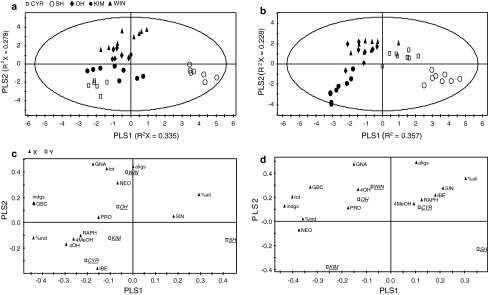
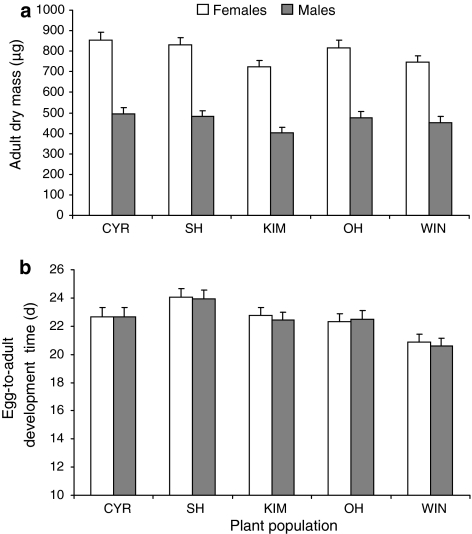
The effect of direct chemical defences in plants on the performance of insect herbivores and their natural enemies has received increasing attention over the past 10 years. However, much less is known about the scale at which this variation is generated and maintained, both within and across populations of the same plant species. This study compares growth and development of the large cabbage butterfly, Pieris brassicae, and its gregarious pupal parasitoid, Pteromalus puparum, on three wild populations [Kimmeridge (KIM), Old Harry (OH) and Winspit (WIN)] and two cultivars [Stonehead (ST), and Cyrus (CYR)] of cabbage, Brassica oleracea. The wild populations originate from the coast of Dorset, UK, but grow in close proximity with one another. Insect performance and chemical profiles were made from every plant used in the experiment. Foliar glucosinolates (GS) concentrations were highest in the wild plants in rank order WIN > OH > KIM, with lower levels found in the cultivars. Caterpillar-damaged leaves in the wild cabbages also had higher GS levels than undamaged leaves. Pupal mass in P. brassicae varied significantly among populations of B. oleracea. Moreover, development time in the host and parasitoid were correlated, even though these stages are temporally separated. Parasitoid adult dry mass closely approximated the development of its host. Multivariate statistics revealed a correlation between pupal mass and development time of P. brassicae and foliar GS chemistry, of which levels of neoglucobrassicin appeared to be the most important. Our results show that there is considerable variation in quantitative aspects of defensive chemistry in wild cabbage plants that is maintained at very small spatial scales in nature. Moreover, the performance of the herbivore and its parasitoid were both affected by differences in plant quality.
过去 10 年来,植物中直接化学防御对昆虫食草动物及其天敌表现的影响受到了越来越多的关注。然而,人们对这种变异在同一植物物种的种群内和种群间产生和维持的规模知之甚少。本研究比较了三种野生种群(Kimmeridge(KIM)、Old Harry(OH)和 Winspit(WIN))和两种甘蓝品种(Stonehead(ST)和 Cyrus(CYR))的甘蓝上大菜粉蝶 Pieris brassicae 及其群居蛹寄生蜂 Pteromalus puparum 的生长和发育。野生种群起源于英国多塞特海岸,但彼此生长非常接近。实验中使用的每一株植物的昆虫表现和化学特征都进行了分析。叶中硫代葡萄糖苷(GS)浓度以 WIN>KIM>OH 的顺序在野生植物中最高,在品种中浓度较低。野生甘蓝受损叶片中的 GS 水平也高于未受损叶片。B. oleracea 中 P. brassicae 的蛹质量存在显著差异。此外,即使这些阶段在时间上是分开的,寄主和寄生蜂的发育时间也存在相关性。寄生蜂成虫的干质量与宿主的发育非常接近。多元统计分析显示,P. brassicae 的蛹质量和发育时间与叶片 GS 化学之间存在相关性,其中新葡糖异硫氰酸盐的水平似乎最为重要。我们的研究结果表明,野生甘蓝植物在防御化学的定量方面存在相当大的变异,这种变异在自然状态下以非常小的空间尺度维持。此外,食草动物及其寄生蜂的表现都受到植物质量差异的影响。