Department of Radiology, University of Southern California, Childrens Hospital Los Angeles, Los Angeles, USA.
BMC Genomics. 2010 Dec 1;11 Suppl 3(Suppl 3):S9. doi: 10.1186/1471-2164-11-S3-S9.
Small animal MRI at 7 Tesla (T) provides a useful tool for adiposity research. For adiposity researchers, separation of fat from surrounding tissues and its subsequent quantitative or semi- quantitative analysis is a key task. This is a relatively new field and a priori it cannot be known which specific biological questions related to fat deposition will be relevant in a specific study. Thus it is impossible to predict what accuracy and what spatial resolution will be required in all cases and even difficult what accuracy and resolution will be useful in most cases. However the pragmatic time constraints and the practical resolution ranges are known for small animal imaging at 7T. Thus we have used known practical constraints to develop a method for fat volume analysis based on an optimized image acquisition and image post processing pair.
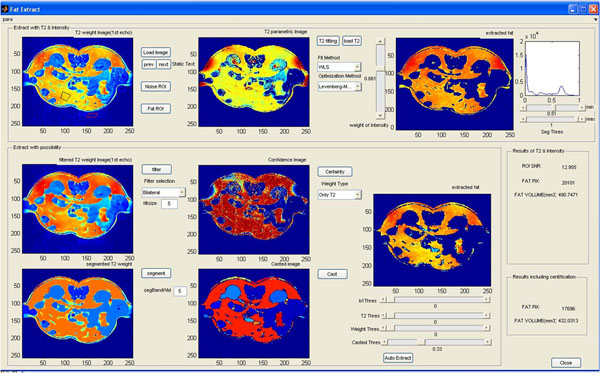
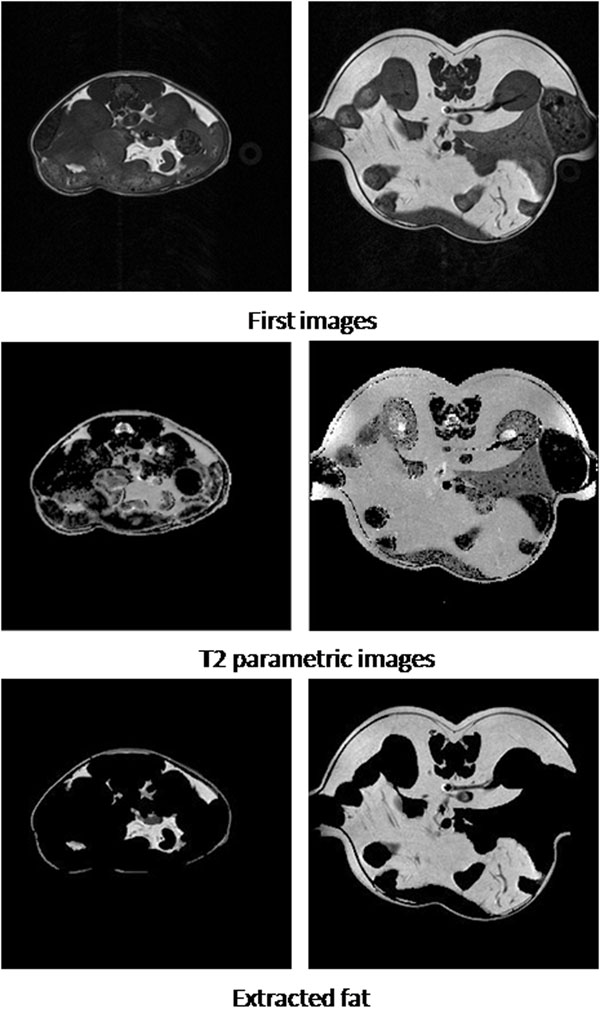
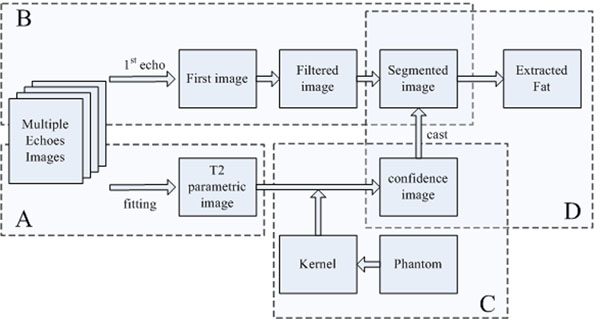
We designed a fat segmentation method based on optimizing a variety of factors relevant to small animal imaging at 7T. In contrast to most previously described MRI methods based on signal intensity of T1 weighted image alone, we chose to use parametric images based on Multi-spin multi-echo (MSME) Bruker pulse sequence which has proven to be particularly robust in our laboratory over the last several years. The sequence was optimized on a T1 basis to emphasize the signal. T2 relaxation times can be calculated from the multi echo data and we have done so on a pixel by pixel basis for the initial step in the post processing methodology. The post processing consists of parallel paths. On one hand, the weighted image is precisely divided into different regions with optimized smoothing and segmentation methods; and on the other hand, a confidence image is deduced from the parametric image according to the distribution of relaxation time relationship of typical adipose. With the assistance of the confidence image, a useful software feature was implemented to which enhances the data and in the end results in a more reliable and flexible method for adipose evaluation.
In this paper, we describe how we arrived at our recommended procedures and key aspects of the post-processing steps. The feasibility of the proposed method is tested on both simulated and real data in this preliminary research. A research tool was created to help researchers segment out fat even when the anatomical information is of low quality making it difficult to distinguish between fat and non-fat. In addition, tool is designed to allow the operator to make adjustments to many of the key steps for comparison purposes and to quantitatively assess the difference these changes make. Ultimately our flexible software lets the researcher define key aspects of the fat segmentation and quantification.
Combining the full T2 parametric information with the optimized first echo image information, the research tool enhances the reliability of the results while providing more flexible operations than previous methods. The innovation in the method is to pair an optimized and very specific image acquisition technique to a flexible but tuned image post processing method. The separation of the fat is aided by the confidence distribution of regions produced on a scale relevant to and dictated by practical aspects of MRI at 7T.
在 7 特斯拉(T)下进行小动物 MRI 提供了用于肥胖症研究的有用工具。对于肥胖症研究人员来说,将脂肪与周围组织分离并对其进行定量或半定量分析是一项关键任务。这是一个相对较新的领域,不能事先知道与脂肪沉积相关的特定生物学问题将在特定研究中相关。因此,无法预测在所有情况下都需要什么样的准确性和空间分辨率,甚至难以预测在大多数情况下什么样的准确性和分辨率将是有用的。然而,在 7T 小动物成像中已知实际的时间限制和实际的分辨率范围。因此,我们已经利用已知的实际限制,基于优化的图像采集和图像后处理对,开发了一种脂肪体积分析方法。
我们设计了一种基于优化与 7T 小动物成像相关的各种因素的脂肪分割方法。与大多数以前基于单独 T1 加权图像信号强度描述的 MRI 方法不同,我们选择使用基于多自旋多回波(MSME)Bruker 脉冲序列的参数图像,该方法在过去几年中在我们的实验室中已被证明特别可靠。该序列基于 T1 进行了优化以强调信号。可以从多回波数据中计算出 T2 弛豫时间,并且我们已经在像素的基础上进行了计算,作为后处理方法学的初始步骤。后处理包括平行路径。一方面,使用优化的平滑和分割方法精确地将加权图像划分为不同的区域;另一方面,根据典型脂肪的弛豫时间关系分布,从参数图像中推断出置信度图像。借助置信度图像,实现了一个有用的软件功能,该功能增强了数据,并最终为脂肪评估提供了更可靠和灵活的方法。
在本文中,我们描述了如何得出我们推荐的程序以及后处理步骤的关键方面。在这项初步研究中,使用模拟和真实数据测试了所提出方法的可行性。创建了一个研究工具,即使解剖信息质量较差,难以区分脂肪和非脂肪,也可以帮助研究人员分割出脂肪。此外,该工具旨在允许操作员对许多关键步骤进行调整,以进行比较,并定量评估这些更改所带来的差异。最终,我们的灵活软件允许研究人员定义脂肪分割和量化的关键方面。
将完整的 T2 参数信息与优化的第一个回波图像信息结合使用,该研究工具提高了结果的可靠性,同时提供了比以前的方法更灵活的操作。该方法的创新之处在于将优化的且非常特定的图像采集技术与灵活但经过调整的图像后处理方法相结合。脂肪的分离由在与 7T 磁共振成像的实际方面相关且由其决定的规模上产生的区域的置信度分布辅助。