Department of Genetics, University of Cambridge, Cambridge, United Kingdom.
PLoS Biol. 2010 Nov 30;8(11):e1000552. doi: 10.1371/journal.pbio.1000552.
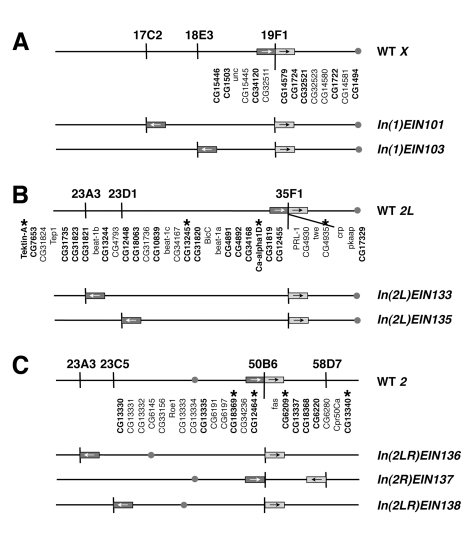
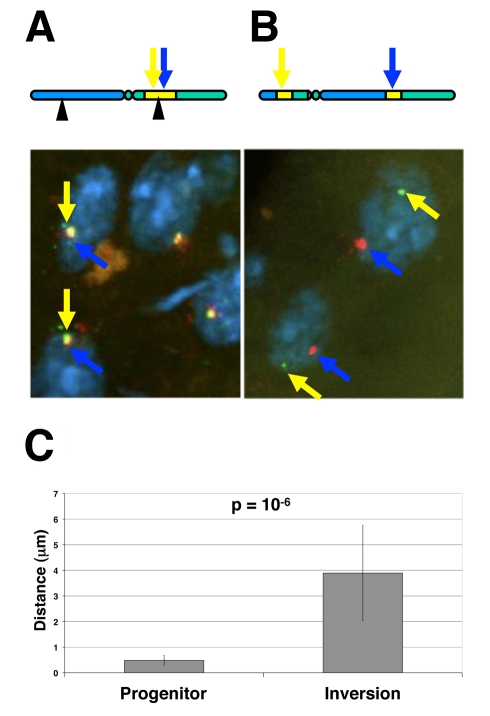
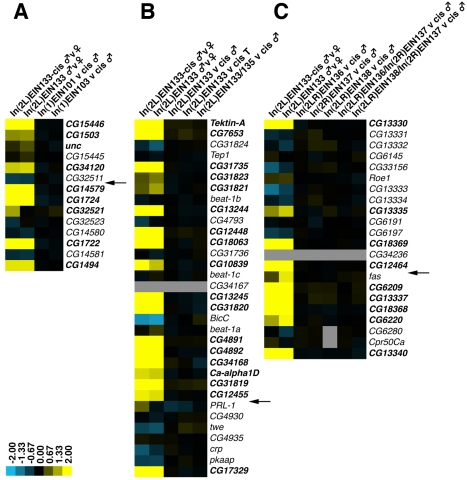
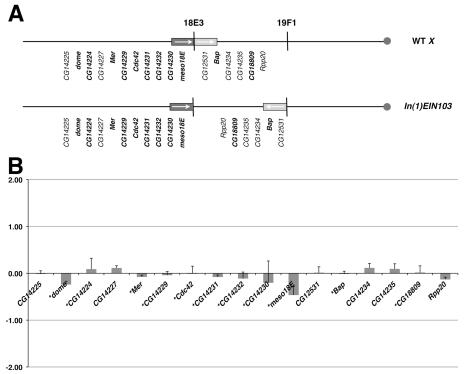
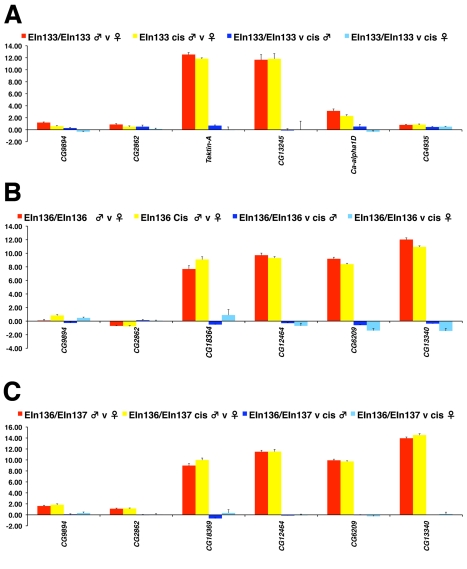
It is now widely accepted that gene organisation in eukaryotic genomes is non-random and it is proposed that such organisation may be important for gene expression and genome evolution. In particular, the results of several large-scale gene expression analyses in a range of organisms from yeast to human indicate that sets of genes with similar tissue-specific or temporal expression profiles are clustered within the genome in gene expression neighbourhoods. While the existence of neighbourhoods is clearly established, the underlying reason for this facet of genome organisation is currently unclear and there is little experimental evidence that addresses the genomic requisites for neighbourhood organisation. We report the targeted disruption of three well-defined male-specific gene expression neighbourhoods in the Drosophila genome by the synthesis of precisely mapped chromosomal inversions. We compare gene expression in individuals carrying inverted chromosomes with their non-inverted but otherwise identical progenitors using whole-transcriptome microarray analysis, validating these data with specific quantitative real-time PCR assays. For each neighbourhood we generate and examine multiple inversions. We find no significant differences in the expression of genes that define each of the neighbourhoods. We further show that the inversions spatially separate both halves of a neighbourhood in the nucleus. Thus, models explaining neighbourhood organisation in terms of local sequence interactions, enhancer crosstalk, or short-range chromatin effects are unlikely to account for this facet of genome organisation. Our study challenges the notion that, at least in the case of the testis, expression neighbourhoods are a feature of eukaryotic genome organisation necessary for correct gene expression.
现在人们普遍认为真核生物基因组中的基因组织是非随机的,并且这种组织可能对基因表达和基因组进化很重要。特别是,在从酵母到人等多种生物中进行的几次大规模基因表达分析的结果表明,具有相似组织特异性或时间表达模式的基因集在基因表达邻域内聚集在基因组中。虽然邻域的存在显然已经确立,但目前尚不清楚这种基因组组织的基本原因,而且几乎没有实验证据可以解决邻域组织的基因组要求。我们通过合成精确映射的染色体倒位,靶向破坏了果蝇基因组中三个明确的雄性特异性基因表达邻域。我们使用全转录组微阵列分析比较了携带倒位染色体的个体与其非倒位但其他方面相同的亲代之间的基因表达情况,并用特定的定量实时 PCR 测定验证了这些数据。对于每个邻域,我们生成并检查多个倒位。我们没有发现定义每个邻域的基因表达存在显着差异。我们进一步表明,这些倒位在核内空间上将邻域的两半部分分开。因此,基于局部序列相互作用、增强子串扰或短程染色质效应的邻域组织模型不太可能解释基因组组织的这一方面。我们的研究挑战了这样一种观点,即在至少在睾丸的情况下,表达邻域是真核生物基因组组织的一个特征,是正确表达基因所必需的。