The Roslin Institute and Royal (Dick) School of Veterinary Studies, University of Edinburgh, Roslin, Midlothian, Scotland, United Kingdom.
PLoS One. 2010 Dec 3;5(12):e14225. doi: 10.1371/journal.pone.0014225.
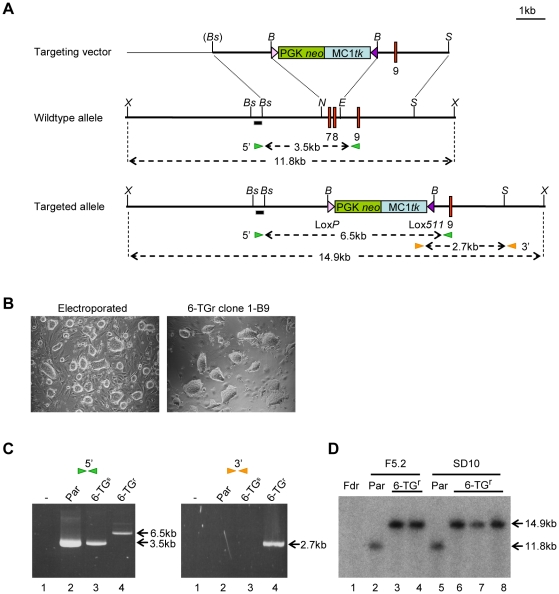
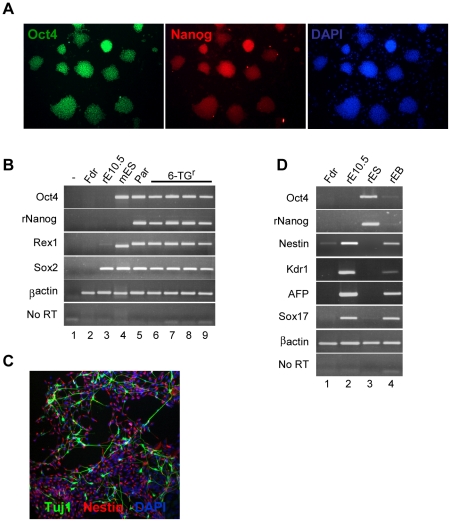
The rat is the preferred experimental animal in many biological studies. With the recent derivation of authentic rat embryonic stem (ES) cells it is now feasible to apply state-of-the art genetic engineering in this species using homologous recombination. To establish whether rat ES cells are amenable to in vivo recombination, we tested targeted disruption of the hypoxanthine phosphoribosyltransferase (hprt) locus in ES cells derived from both inbred and outbred strains of rats. Targeting vectors that replace exons 7 and 8 of the hprt gene with neomycinR/thymidine kinase selection cassettes were electroporated into male Fisher F344 and Sprague Dawley rat ES cells. Approximately 2% of the G418 resistant colonies also tolerated selection with 6-thioguanine, indicating inactivation of the hprt gene. PCR and Southern blot analysis confirmed correct site-specific targeting of the hprt locus in these clones. Embryoid body and monolayer differentiation of targeted cell lines established that they retained differentiation potential following targeting and selection. This report demonstrates that gene modification via homologous recombination in rat ES cells is efficient, and should facilitate implementation of targeted, genetic manipulation in the rat.
大鼠是许多生物学研究中首选的实验动物。由于最近获得了真正的大鼠胚胎干细胞(ES 细胞),现在可以使用同源重组技术在该物种中应用最先进的基因工程技术。为了确定大鼠 ES 细胞是否适合体内重组,我们测试了源自近交系和远交系大鼠的 ES 细胞中次黄嘌呤磷酸核糖转移酶(hprt)基因座的靶向缺失。用含有新霉素 R/胸苷激酶选择盒的靶向载体替换 hprt 基因的外显子 7 和 8,将其电穿孔到雄性 Fisher F344 和 Sprague Dawley 大鼠 ES 细胞中。大约 2%的 G418 抗性集落也耐受 6-硫鸟嘌呤的选择,表明 hprt 基因失活。PCR 和 Southern blot 分析证实了这些克隆中 hprt 基因座的正确定点靶向。靶向细胞系的胚状体和单层分化表明,在靶向和选择后它们保留了分化潜能。本报告表明,大鼠 ES 细胞中通过同源重组进行基因修饰是高效的,这将有助于在大鼠中实施靶向遗传操作。