Srinivasan Subhadra, Ghadyani Hamid R, Pogue Brian W, Paulsen Keith D
Thayer School of Engineering, Dartmouth College, Hanover, NH-03755, USA.
Biomed Opt Express. 2010 Sep 1;1(2):398-413. doi: 10.1364/BOE.1.000398. Epub 2010 Aug 2.
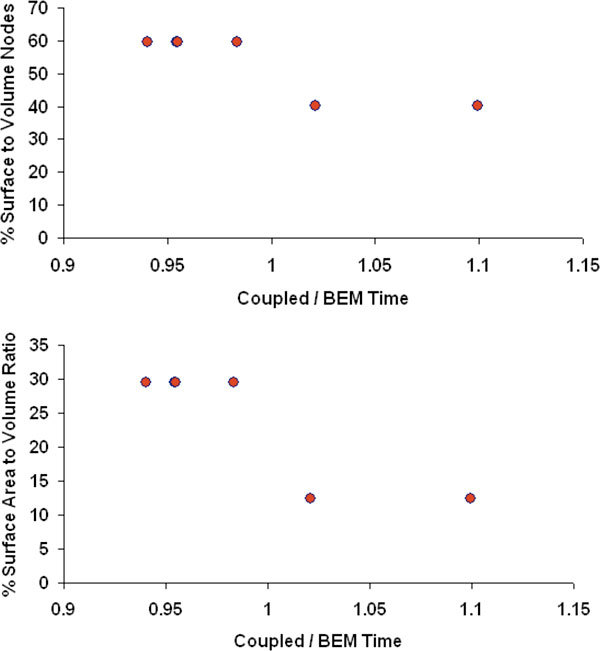
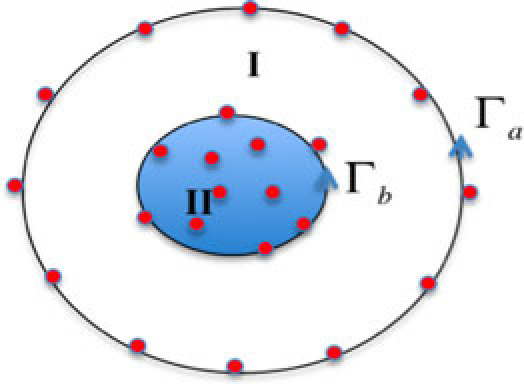
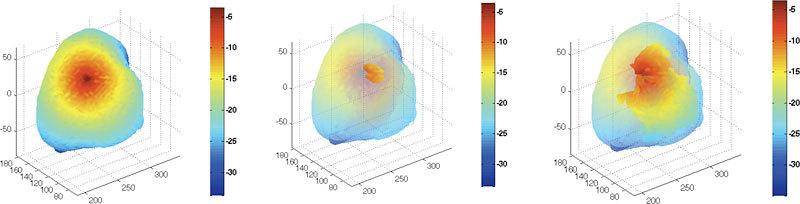
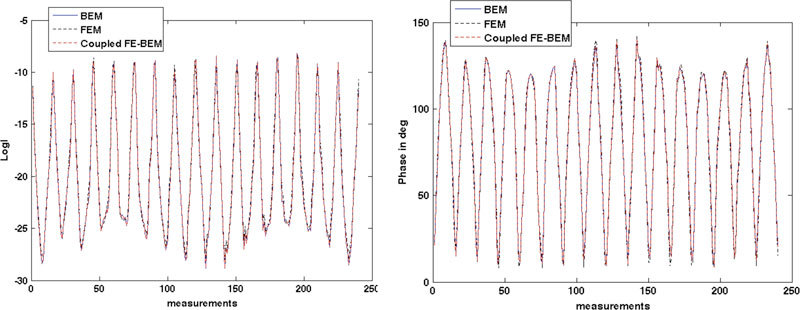
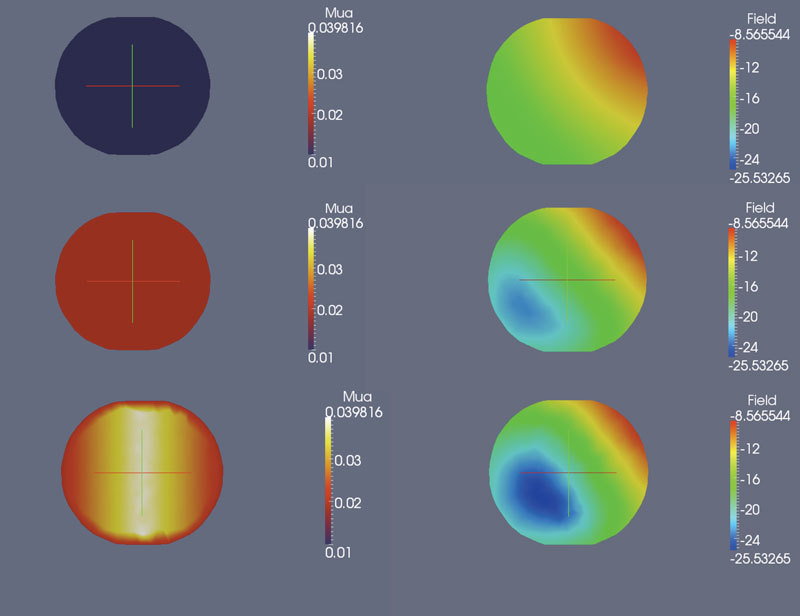
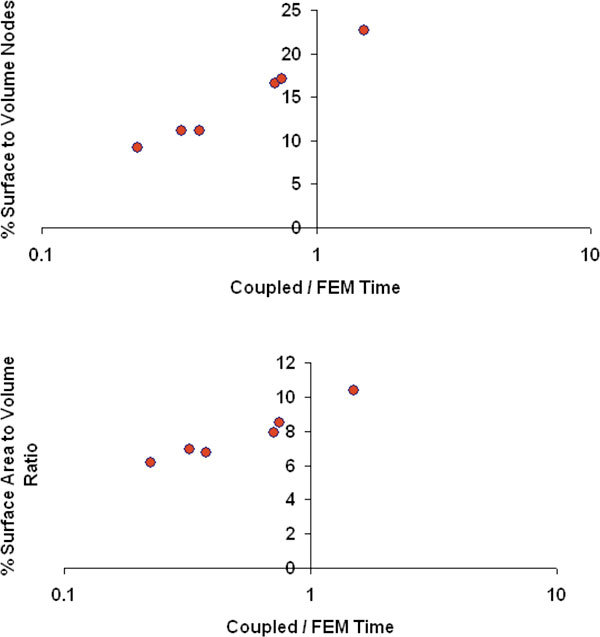
Three dimensional image reconstruction for multi-modality optical spectroscopy systems needs computationally efficient forward solvers with minimum meshing complexity, while allowing the flexibility to apply spatial constraints. Existing models based on the finite element method (FEM) require full 3D volume meshing to incorporate constraints related to anatomical structure via techniques such as regularization. Alternate approaches such as the boundary element method (BEM) require only surface discretization but assume homogeneous or piece-wise constant domains that can be limiting. Here, a coupled finite element-boundary element method (coupled FE-BEM) approach is demonstrated for modeling light diffusion in 3D, which uses surfaces to model exterior tissues with BEM and a small number of volume nodes to model interior tissues with FEM. Such a coupled FE-BEM technique combines strengths of FEM and BEM by assuming homogeneous outer tissue regions and heterogeneous inner tissue regions. Results with FE-BEM show agreement with existing numerical models, having RMS differences of less than 0.5 for the logarithm of intensity and 2.5 degrees for phase of frequency domain boundary data. The coupled FE-BEM approach can model heterogeneity using a fraction of the volume nodes (4-22%) required by conventional FEM techniques. Comparisons of computational times showed that the coupled FE-BEM was faster than stand-alone FEM when the ratio of the number of surface to volume nodes in the mesh (N(s)/N(v)) was less than 20% and was comparable to stand-alone BEM ( ± 10%).
多模态光学光谱系统的三维图像重建需要计算效率高且网格划分复杂度最低的正向求解器,同时要具备应用空间约束的灵活性。现有的基于有限元法(FEM)的模型需要进行完整的三维体网格划分,以便通过正则化等技术纳入与解剖结构相关的约束。诸如边界元法(BEM)等替代方法仅需要表面离散化,但假设为均匀或分段恒定的区域,这可能具有局限性。在此,展示了一种耦合有限元 - 边界元法(耦合FE - BEM)方法用于对三维光扩散进行建模,该方法使用边界元法对外部组织进行表面建模,并使用少量体节点通过有限元法对内部组织进行建模。这种耦合FE - BEM技术通过假设外部组织区域均匀且内部组织区域非均匀,结合了有限元法和边界元法的优势。FE - BEM的结果与现有数值模型一致,强度对数的均方根误差小于0.5,频域边界数据相位的均方根误差小于2.5度。耦合FE - BEM方法可以使用传统有限元法技术所需体节点数量的一小部分(4 - 22%)来对非均匀性进行建模。计算时间的比较表明,当网格中表面节点与体节点数量之比(N(s)/N(v))小于20%时,耦合FE - BEM比单独的有限元法更快,并且与单独的边界元法相当(±10%)。