• 文献检索
  • 文档翻译
  • 深度研究
  • 学术资讯
  • Suppr Zotero 插件Zotero 插件
  • 邀请有礼
  • 套餐&价格
  • 历史记录
应用&插件
Suppr Zotero 插件Zotero 插件浏览器插件Mac 客户端Windows 客户端微信小程序
定价
高级版会员购买积分包购买API积分包
服务
文献检索文档翻译深度研究API 文档MCP 服务
关于我们
关于 Suppr公司介绍联系我们用户协议隐私条款
关注我们

Suppr 超能文献

核心技术专利:CN118964589B侵权必究
粤ICP备2023148730 号-1Suppr @ 2026

文献检索

告别复杂PubMed语法,用中文像聊天一样搜索,搜遍4000万医学文献。AI智能推荐,让科研检索更轻松。

立即免费搜索

文件翻译

保留排版,准确专业,支持PDF/Word/PPT等文件格式,支持 12+语言互译。

免费翻译文档

深度研究

AI帮你快速写综述,25分钟生成高质量综述,智能提取关键信息,辅助科研写作。

立即免费体验

生物分子对多壁碳纳米管的吸附受到肺表面活性剂脂质和表面化学性质的共同影响。

The adsorption of biomolecules to multi-walled carbon nanotubes is influenced by both pulmonary surfactant lipids and surface chemistry.

机构信息

Empa, Swiss Federal Laboratories for Materials Science and Technology, Laboratory for Materials Biology Interactions, St, Gallen, Switzerland.

出版信息

J Nanobiotechnology. 2010 Dec 15;8:31. doi: 10.1186/1477-3155-8-31.

DOI:10.1186/1477-3155-8-31
PMID:21159192
原文链接:https://pmc.ncbi.nlm.nih.gov/articles/PMC3012019/
Abstract

BACKGROUND

During production and processing of multi-walled carbon nanotubes (MWCNTs), they may be inhaled and may enter the pulmonary circulation. It is essential that interactions with involved body fluids like the pulmonary surfactant, the blood and others are investigated, particularly as these interactions could lead to coating of the tubes and may affect their chemical and physical characteristics. The aim of this study was to characterize the possible coatings of different functionalized MWCNTs in a cell free environment.

RESULTS

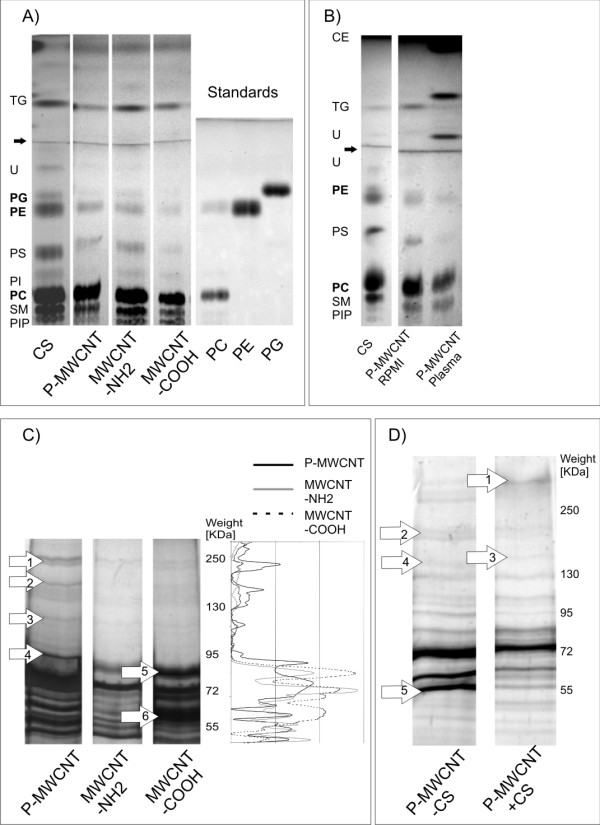
To simulate the first contact in the lung, the tubes were coated with pulmonary surfactant and subsequently bound lipids were characterized. The further coating in the blood circulation was simulated by incubating the tubes in blood plasma. MWCNTs were amino (NH2)- and carboxyl (-COOH)-modified, in order to investigate the influence on the bound lipid and protein patterns. It was shown that surfactant lipids bind unspecifically to different functionalized MWCNTs, in contrast to the blood plasma proteins which showed characteristic binding patterns. Patterns of bound surfactant lipids were altered after a subsequent incubation in blood plasma. In addition, it was found that bound plasma protein patterns were altered when MWCNTs were previously coated with pulmonary surfactant.

CONCLUSIONS

A pulmonary surfactant coating and the functionalization of MWCNTs have both the potential to alter the MWCNTs blood plasma protein coating and to determine their properties and behaviour in biological systems.

摘要

背景

在多壁碳纳米管(MWCNTs)的生产和加工过程中,它们可能会被吸入并进入肺循环。重要的是要研究与涉及的体液(如肺表面活性剂、血液等)的相互作用,特别是因为这些相互作用可能导致管的涂层,并可能影响它们的化学和物理特性。本研究的目的是在无细胞环境中表征不同功能化 MWCNTs 的可能涂层。

结果

为了模拟肺部的初次接触,将管用肺表面活性剂涂层,随后对结合的脂质进行了表征。通过在血浆中孵育管来模拟在血液循环中的进一步涂层。MWCNTs 被氨基(NH2)和羧基(-COOH)修饰,以研究对结合脂质和蛋白质模式的影响。结果表明,表面活性剂脂质与不同功能化的 MWCNTs 非特异性结合,而与血浆蛋白相比,其结合模式具有特征性。在随后在血浆中孵育后,结合的表面活性剂脂质模式发生了改变。此外,发现当 MWCNTs 先前用肺表面活性剂涂层时,结合的血浆蛋白模式发生了改变。

结论

肺表面活性剂涂层和 MWCNTs 的功能化都有可能改变 MWCNTs 与血浆蛋白的涂层,并确定它们在生物系统中的性质和行为。
https://cdn.ncbi.nlm.nih.gov/pmc/blobs/6eef/3012019/905761e929af/1477-3155-8-31-3.jpg
https://cdn.ncbi.nlm.nih.gov/pmc/blobs/6eef/3012019/e773c17e86af/1477-3155-8-31-1.jpg
https://cdn.ncbi.nlm.nih.gov/pmc/blobs/6eef/3012019/67ce4c77a045/1477-3155-8-31-2.jpg
https://cdn.ncbi.nlm.nih.gov/pmc/blobs/6eef/3012019/905761e929af/1477-3155-8-31-3.jpg
https://cdn.ncbi.nlm.nih.gov/pmc/blobs/6eef/3012019/e773c17e86af/1477-3155-8-31-1.jpg
https://cdn.ncbi.nlm.nih.gov/pmc/blobs/6eef/3012019/67ce4c77a045/1477-3155-8-31-2.jpg
https://cdn.ncbi.nlm.nih.gov/pmc/blobs/6eef/3012019/905761e929af/1477-3155-8-31-3.jpg

相似文献

1
The adsorption of biomolecules to multi-walled carbon nanotubes is influenced by both pulmonary surfactant lipids and surface chemistry.生物分子对多壁碳纳米管的吸附受到肺表面活性剂脂质和表面化学性质的共同影响。
J Nanobiotechnology. 2010 Dec 15;8:31. doi: 10.1186/1477-3155-8-31.
2
Pulmonary surfactant coating of multi-walled carbon nanotubes (MWCNTs) influences their oxidative and pro-inflammatory potential in vitro.多壁碳纳米管(MWCNTs)的肺表面活性剂涂层会影响其体外的氧化和促炎潜能。
Part Fibre Toxicol. 2012 May 24;9:17. doi: 10.1186/1743-8977-9-17.
3
Multi-walled carbon nanotubes (MWCNTs) transformed THP-1 macrophages into foam cells: Impact of pulmonary surfactant component dipalmitoylphosphatidylcholine.多壁碳纳米管(MWCNTs)将 THP-1 巨噬细胞转化为泡沫细胞:肺表面活性剂成分二棕榈酰磷脂酰胆碱的影响。
J Hazard Mater. 2020 Jun 15;392:122286. doi: 10.1016/j.jhazmat.2020.122286. Epub 2020 Feb 11.
4
Proteomic investigation on bio-corona of functionalized multi-walled carbon nanotubes.功能化多壁碳纳米管的生物冠状蛋白质组学研究。
Biochim Biophys Acta Gen Subj. 2018 Oct;1862(10):2293-2303. doi: 10.1016/j.bbagen.2018.07.024. Epub 2018 Jul 24.
5
Human epithelial cells exposed to functionalized multiwalled carbon nanotubes: interactions and cell surface modifications.暴露于功能化多壁碳纳米管的人上皮细胞:相互作用与细胞表面修饰
J Microsc. 2015 Sep;259(3):173-84. doi: 10.1111/jmi.12251. Epub 2015 Apr 9.
6
Surface charge and cellular processing of covalently functionalized multiwall carbon nanotubes determine pulmonary toxicity.共价功能化多壁碳纳米管的表面电荷和细胞处理决定了其肺部毒性。
ACS Nano. 2013 Mar 26;7(3):2352-68. doi: 10.1021/nn305567s. Epub 2013 Feb 28.
7
[Effects of length and chemical modification on the activation of vascular endothelial cells induced by multi walled carbon nanotubes].[长度和化学修饰对多壁碳纳米管诱导血管内皮细胞活化的影响]
Beijing Da Xue Xue Bao Yi Xue Ban. 2021 Jun 18;53(3):439-446. doi: 10.19723/j.issn.1671-167X.2021.03.001.
8
[Comparative analysis for the cytotoxicity and genotoxicity of multi-walled carbon nanotubes with different lengths and surface modifications in A549 cells].[不同长度和表面修饰的多壁碳纳米管对A549细胞的细胞毒性和遗传毒性的比较分析]
Beijing Da Xue Xue Bao Yi Xue Ban. 2013 Jun 18;45(3):405-11.
9
Atomic layer deposition coating of carbon nanotubes with zinc oxide causes acute phase immune responses in human monocytes in vitro and in mice after pulmonary exposure.用氧化锌对碳纳米管进行原子层沉积涂层处理,在体外可引起人单核细胞的急性期免疫反应,在肺部暴露后的小鼠体内也会引发这种反应。
Part Fibre Toxicol. 2016 Jun 8;13(1):29. doi: 10.1186/s12989-016-0141-9.
10
CE with multi-walled carbon nanotubes (MWCNTs). Part I. Functionalized and SDS coated MWCNTs as pseudo-stationary phases in nanoparticle EKC - Studies on retention energetics.CE 与多壁碳纳米管(MWCNTs)。第一部分。功能化和 SDS 涂层的 MWCNTs 作为纳米颗粒 EKC 中的伪固定相 - 保留能量学研究。
Talanta. 2019 Jan 15;192:534-544. doi: 10.1016/j.talanta.2018.09.045. Epub 2018 Sep 20.

引用本文的文献

1
Understanding the role of biomolecular coronas in human exposure to nanomaterials.了解生物分子冠层在人类接触纳米材料中的作用。
Environ Sci Nano. 2024 Sep 9;11(11):4421-4448. doi: 10.1039/d4en00488d. eCollection 2024 Nov 7.
2
Interaction of synthetic and lignin-based sulfonated polymers with hydrophilic, hydrophobic, and charged self-assembled monolayers.合成及木质素基磺化聚合物与亲水性、疏水性和带电自组装单分子层的相互作用
RSC Adv. 2020 Oct 6;10(60):36778-36793. doi: 10.1039/d0ra07554j. eCollection 2020 Oct 1.
3
Serum apolipoprotein A-I depletion is causative to silica nanoparticles-induced cardiovascular damage.

本文引用的文献

1
Endosomal leakage and nuclear translocation of multiwalled carbon nanotubes: developing a model for cell uptake.多壁碳纳米管的内体渗漏和核转位:建立细胞摄取模型。
Nano Lett. 2009 Dec;9(12):4370-5. doi: 10.1021/nl902647x.
2
Inhaled carbon nanotubes reach the subpleural tissue in mice.吸入的碳纳米管到达小鼠的胸膜下组织。
Nat Nanotechnol. 2009 Nov;4(11):747-51. doi: 10.1038/nnano.2009.305. Epub 2009 Oct 25.
3
Differential plasma protein binding to metal oxide nanoparticles.金属氧化物纳米颗粒对血浆蛋白的差异结合。
血清载脂蛋白 A-I 耗竭是导致二氧化硅纳米颗粒引起心血管损伤的原因。
Proc Natl Acad Sci U S A. 2021 Nov 2;118(44). doi: 10.1073/pnas.2108131118.
4
An adverse outcome pathway for lung surfactant function inhibition leading to decreased lung function.一条导致肺功能下降的肺表面活性物质功能抑制的不良结局途径。
Curr Res Toxicol. 2021 May 27;2:225-236. doi: 10.1016/j.crtox.2021.05.005. eCollection 2021.
5
Inhaled aerosols: Their role in COVID-19 transmission, including biophysical interactions in the lungs.吸入气雾剂:它们在新冠病毒传播中的作用,包括在肺部的生物物理相互作用。
Curr Opin Colloid Interface Sci. 2021 Aug;54:101451. doi: 10.1016/j.cocis.2021.101451. Epub 2021 Mar 24.
6
Nebulised surface-active hybrid nanoparticles of voriconazole for pulmonary Aspergillosis demonstrate clathrin-mediated cellular uptake, improved antifungal efficacy and lung retention.雾化表面活性杂化伏立康唑纳米粒用于肺部曲霉菌病显示出网格蛋白介导的细胞摄取、增强的抗真菌功效和肺部滞留。
J Nanobiotechnology. 2021 Jan 11;19(1):19. doi: 10.1186/s12951-020-00731-1.
7
Understanding the Lipid and Protein Corona Formation on Different Sized Polymeric Nanoparticles.了解不同粒径的聚合物纳米颗粒上的脂质和蛋白质冠的形成。
Sci Rep. 2020 Jan 24;10(1):1129. doi: 10.1038/s41598-020-57943-6.
8
Nanomaterials Versus Ambient Ultrafine Particles: An Opportunity to Exchange Toxicology Knowledge.纳米材料与环境超细颗粒物:交流毒理学知识的契机。
Environ Health Perspect. 2017 Oct 10;125(10):106002. doi: 10.1289/EHP424.
9
Carbon Nanomaterials: Efficacy and Safety for Nanomedicine.碳纳米材料:纳米医学中的功效与安全性
Materials (Basel). 2012 Feb 21;5(2):350-363. doi: 10.3390/ma5020350.
10
Quantitative analysis of nanoparticle transport through in vitro blood-brain barrier models.纳米颗粒通过体外血脑屏障模型转运的定量分析。
Tissue Barriers. 2016 Jan 28;4(1):e1143545. doi: 10.1080/21688370.2016.1143545. eCollection 2016 Jan-Mar.
Nanotechnology. 2009 Nov 11;20(45):455101. doi: 10.1088/0957-4484/20/45/455101. Epub 2009 Oct 13.
4
Understanding biophysicochemical interactions at the nano-bio interface.理解纳米-生物界面的生物物理化学相互作用。
Nat Mater. 2009 Jul;8(7):543-57. doi: 10.1038/nmat2442. Epub 2009 Jun 14.
5
Suppression of human bone morphogenetic protein signaling by carboxylated single-walled carbon nanotubes.羧化单壁碳纳米管抑制人骨形态发生蛋白信号通路。
ACS Nano. 2009 May 26;3(5):1139-44. doi: 10.1021/nn900252j.
6
Nanoparticle interaction with plasma proteins as it relates to particle biodistribution, biocompatibility and therapeutic efficacy.纳米颗粒与血浆蛋白的相互作用及其与颗粒生物分布、生物相容性和治疗效果的关系。
Adv Drug Deliv Rev. 2009 Jun 21;61(6):428-37. doi: 10.1016/j.addr.2009.03.009. Epub 2009 Apr 17.
7
Nanomaterial cell interactions: how do carbon nanotubes affect cell physiology?纳米材料与细胞的相互作用:碳纳米管如何影响细胞生理?
Nanomedicine (Lond). 2009 Jan;4(1):57-63. doi: 10.2217/17435889.4.1.57.
8
Biodistribution of 1.4- and 18-nm gold particles in rats.1.4纳米和18纳米金颗粒在大鼠体内的生物分布。
Small. 2008 Dec;4(12):2108-11. doi: 10.1002/smll.200800922.
9
The SWISS-MODEL Repository and associated resources.SWISS-MODEL 资源库及相关资源。
Nucleic Acids Res. 2009 Jan;37(Database issue):D387-92. doi: 10.1093/nar/gkn750. Epub 2008 Oct 18.
10
Nanoparticle size and surface properties determine the protein corona with possible implications for biological impacts.纳米颗粒的大小和表面性质决定了蛋白质冠层,这可能对生物影响产生潜在影响。
Proc Natl Acad Sci U S A. 2008 Sep 23;105(38):14265-70. doi: 10.1073/pnas.0805135105. Epub 2008 Sep 22.