ZHANG Bo, ZHU Chengchu, CHEN Baofu, ZHANG Xia, YE Minhua, LIN Aifen
Department of Thoracic Surgery, Taizhou Hospital Affiliated to Wenzhou Medical College, Taizhou 317000, China.
Zhongguo Fei Ai Za Zhi. 2010 Dec;13(12):1132-5. doi: 10.3779/j.issn.1009-3419.2010.12.10.
precious studies proven that the overexpression of eukaryotic translation initiation factor 4E (eIF4E) in a variety of solid tumors has linked with malignant tumorigenesis, invasion and metastasis. The aim of this work is to explore the expression of eIF4E and its clinical significance in non-small cell lung cancer (NSCLC) through immunohistochemical method.
seventy NSCLC specimens were constructed into tissue microarray, simultaneously took 19 cases adjacent tissues and 20 cases normal lung tissue as control, all performed using immunohistochemistry (Envision).
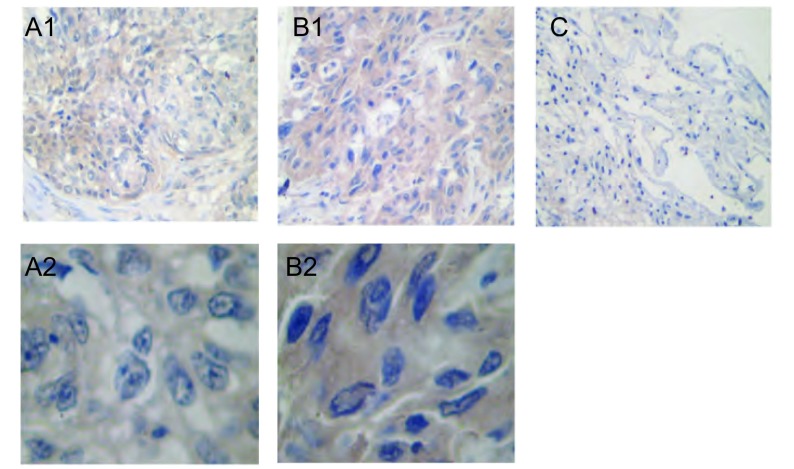
eIF4E expression in NSCLC was significantly higher than that in adjacent tissues and normal lung tissues, statistically significant difference between the groups. The eIF4E positive expression in lymph node metastasis group was significantly higher than that in no-lymph node metastasis. eIF4E protein positive expression of WD/MD cancer tissue was significantly lower than those in PD/ND cancer tissue. There were no significant differences of positive expression of eIF4E with the tumor diameter, age, smoking status, gender of NSCLC patients (P > 0.05).
there were highly over expression rate of eIF4E, and closely correlated with lymphnode metastasis in NSCLC, which implies that the eIF4E expression may be related to tumorgenesis, invasion and metastasis of lung cancer. eIF4E may be a new marker for lung cancer and objective indicators assessing the development of lung cancer.
既往研究证实,真核生物翻译起始因子4E(eIF4E)在多种实体瘤中的过表达与恶性肿瘤的发生、侵袭及转移相关。本研究旨在通过免疫组化方法探讨eIF4E在非小细胞肺癌(NSCLC)中的表达及其临床意义。
将70例NSCLC标本制成组织芯片,同时取19例癌旁组织和20例正常肺组织作为对照,均采用免疫组化(Envision法)检测。
NSCLC中eIF4E的表达显著高于癌旁组织和正常肺组织,组间差异有统计学意义。有淋巴结转移组的eIF4E阳性表达显著高于无淋巴结转移组。WD/MD癌组织的eIF4E蛋白阳性表达显著低于PD/ND癌组织。NSCLC患者的eIF4E阳性表达在肿瘤直径、年龄、吸烟状况、性别方面差异无统计学意义(P>0.05)。
NSCLC中eIF4E有较高的过表达率,且与淋巴结转移密切相关,提示eIF4E表达可能与肺癌的发生、侵袭及转移有关。eIF4E可能是肺癌的一个新标志物及评估肺癌进展的客观指标。