Department of Medical Oncology, The Fourth Hospital of Hebei Medical University, Shijiazhuang, Hebei, China (mainland).
Department of Medical Oncology, Yantai Yuhuangding Hospital Affiliated to Medical College of Qingdao University, Yantai, Shandong, China (mainland).
Med Sci Monit. 2020 Jun 5;26:e923210. doi: 10.12659/MSM.923210.
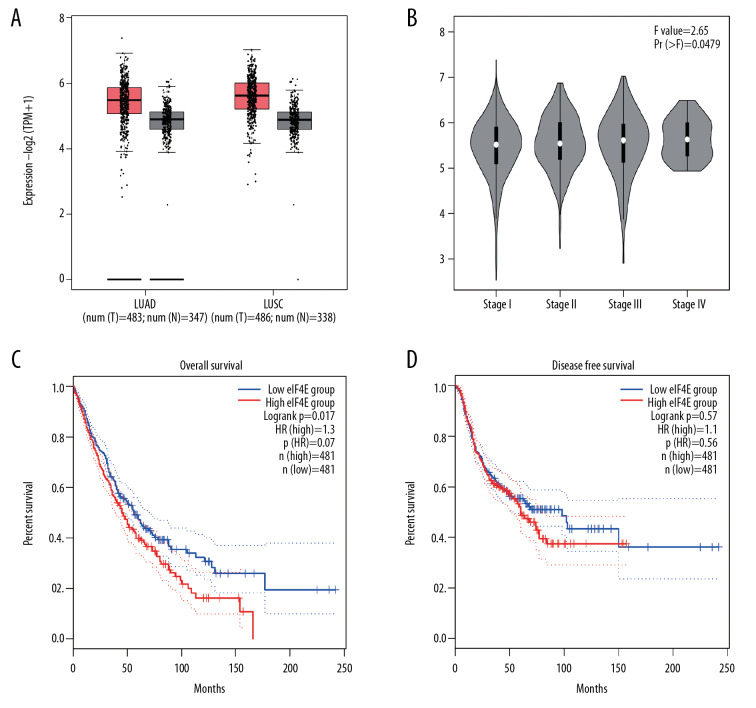
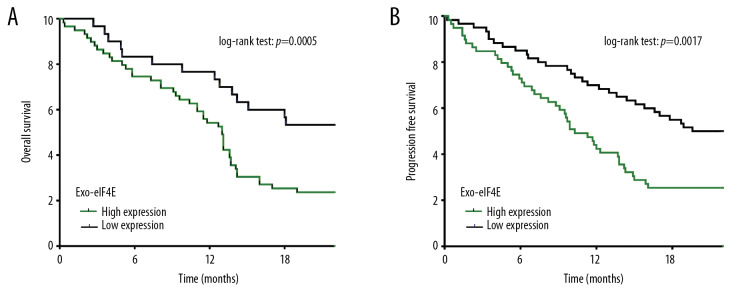
BACKGROUND The aim of this study was to investigate the expression of tumor-derived exosomal RNA eIF4E (exo-eIF4E) in non-small cell lung cancer (NSCLC) and its correlation with prognosis. MATERIAL AND METHODS The Cancer Genome Atlas (TCGA) data was exacted to investigate the role of tissue eIF4E in NSCLC. We enrolled 99 NSCLC patients and 40 healthy volunteers with corresponding serum samples in this study. The levels of exo-eIF4E in the peripheral blood of each group were tested by quantitative polymerase chain reaction (PCR). The chi-squared test and the log-rank test were applied to analyze the correlation between the expression levels of exo-eIF4E and the patients' clinical-pathological data, including the overall survival. RESULTS TCGA data showed that increased eIF4E in NSCLC tissues was associated with late-stage disease (P=0.0497) and inferior overall survival (P=0.017). The expression of exo-eIF4E in the serum of the NSCLC group was significantly higher than that in healthy individuals (P<0.001). Furthermore, advanced TNM stage (P=0.003), distant metastasis (P=0.008), and serum positive cytokeratin fragment 19 (CYFRA21-1) (P=0.023) are more likely present in NSCLC patients with higher exo-eIF4E expression. Moreover, the multivariate combined with univariate analyses verified exo-eIF4E as an independent prognostic factor for shorter overall survival (P=0.01) and progression-free survival (P=0.005). Shorter overall survival (P=0.0005) and inferior progression-free survival (P=0.0017) are more likely present in NSCLC patients with higher exo-eIF4E. CONCLUSIONS Tumor-derived exo-eIF4E in serum can be a practical tool to predict the prognosis of NSCLC.
本研究旨在探讨肿瘤来源的外泌体 RNA eIF4E(exo-eIF4E)在非小细胞肺癌(NSCLC)中的表达及其与预后的相关性。
从癌症基因组图谱(TCGA)数据库中提取组织 eIF4E 在 NSCLC 中的作用数据。本研究纳入了 99 例 NSCLC 患者和 40 例健康志愿者及其相应的血清样本。通过定量聚合酶链反应(PCR)检测各组外周血中外泌体 eIF4E 的水平。采用卡方检验和对数秩检验分析外泌体 eIF4E 表达水平与患者临床病理数据(包括总生存期)的相关性。
TCGA 数据显示 NSCLC 组织中 eIF4E 的增加与晚期疾病(P=0.0497)和较差的总生存期(P=0.017)相关。NSCLC 组血清中外泌体 eIF4E 的表达明显高于健康对照组(P<0.001)。此外,晚期 TNM 分期(P=0.003)、远处转移(P=0.008)和血清阳性细胞角蛋白 19 片段(CYFRA21-1)(P=0.023)更可能存在于外泌体 eIF4E 高表达的 NSCLC 患者中。此外,多变量联合单变量分析验证了外泌体 eIF4E 是总生存期(P=0.01)和无进展生存期(P=0.005)较短的独立预后因素。外泌体 eIF4E 较高的 NSCLC 患者总生存期(P=0.0005)和无进展生存期(P=0.0017)更短。
血清中肿瘤来源的外泌体 eIF4E 可以作为预测 NSCLC 预后的实用工具。