Department of Dermatology, University of Rochester Medical Center, Rochester, NY 14642, USA.
J Allergy Clin Immunol. 2011 Mar;127(3):773-86.e1-7. doi: 10.1016/j.jaci.2010.10.018. Epub 2010 Dec 15.
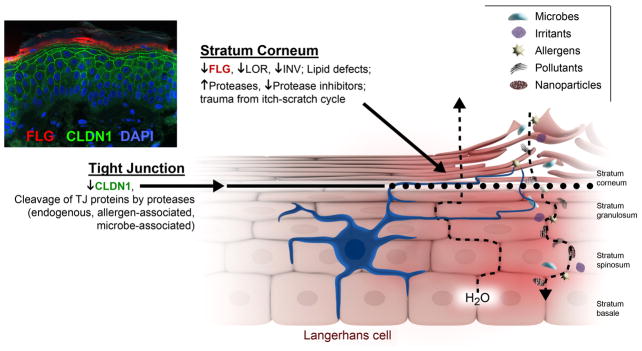
Atopic dermatitis (AD) is characterized by dry skin and a hyperactive immune response to allergens, 2 cardinal features that are caused in part by epidermal barrier defects. Tight junctions (TJs) reside immediately below the stratum corneum and regulate the selective permeability of the paracellular pathway.
We evaluated the expression/function of the TJ protein claudin-1 in epithelium from AD and nonatopic subjects and screened 2 American populations for single nucleotide polymorphisms in the claudin-1 gene (CLDN1).
Expression profiles of nonlesional epithelium from patients with extrinsic AD, nonatopic subjects, and patients with psoriasis were generated using Illumina's BeadChips. Dysregulated intercellular proteins were validated by means of tissue staining and quantitative PCR. Bioelectric properties of epithelium were measured in Ussing chambers. Functional relevance of claudin-1 was assessed by using a knockdown approach in primary human keratinocytes. Twenty-seven haplotype-tagging SNPs in CLDN1 were screened in 2 independent populations with AD.
We observed strikingly reduced expression of the TJ proteins claudin-1 and claudin-23 only in patients with AD, which were validated at the mRNA and protein levels. Claudin-1 expression inversely correlated with T(H)2 biomarkers. We observed a remarkable impairment of the bioelectric barrier function in AD epidermis. In vitro we confirmed that silencing claudin-1 expression in human keratinocytes diminishes TJ function while enhancing keratinocyte proliferation. Finally, CLDN1 haplotype-tagging SNPs revealed associations with AD in 2 North American populations.
Collectively, these data suggest that an impairment in tight junctions contributes to the barrier dysfunction and immune dysregulation observed in AD subjects and that this may be mediated in part by reductions in claudin-1.
特应性皮炎(AD)的特征是皮肤干燥和对过敏原的过度免疫反应,这两个主要特征部分是由表皮屏障缺陷引起的。紧密连接(TJ)位于角质层下方,调节细胞旁途径的选择性渗透性。
我们评估了 TJ 蛋白 Claudin-1 在 AD 和非特应性受试者的上皮细胞中的表达/功能,并对 2 个美国人群进行了 Claudin-1 基因(CLDN1)的单核苷酸多态性筛查。
使用 Illumina 的 BeadChips 生成非病变性 AD 患者、非特应性受试者和银屑病患者的非病变性上皮细胞表达谱。通过组织染色和定量 PCR 验证失调的细胞间蛋白。在 Ussing 室中测量上皮细胞的生物电特性。通过在原代人角质形成细胞中使用敲低方法评估 Claudin-1 的功能相关性。在 2 个具有 AD 的独立人群中筛选了 27 个单倍型标记 SNP 于 CLDN1。
我们观察到仅在 AD 患者中 TJ 蛋白 Claudin-1 和 Claudin-23 的表达明显降低,这在 mRNA 和蛋白水平上得到了验证。Claudin-1 表达与 T(H)2 生物标志物呈负相关。我们观察到 AD 表皮的生物电屏障功能明显受损。在体外,我们证实沉默人角质形成细胞中 Claudin-1 的表达会降低 TJ 功能,同时增强角质形成细胞增殖。最后,CLDN1 单倍型标记 SNP 显示与 2 个北美人群中的 AD 相关。
总的来说,这些数据表明,紧密连接的损伤导致 AD 受试者中观察到的屏障功能障碍和免疫失调,并且这可能部分是通过 Claudin-1 的减少介导的。