Graduate Student, Department of Prosthodontics, Graduate School, Chonnam National University, Gwang-Ju, Korea.
J Adv Prosthodont. 2009 Mar;1(1):47-55. doi: 10.4047/jap.2009.1.1.47. Epub 2009 Mar 31.
A few of studies which compared and continuously measured the stability of various surface treated implants in the same individual had been performed.
We aim to find the clinical significance of surface treatments by observing the differences in the stabilization stages of implant stability.
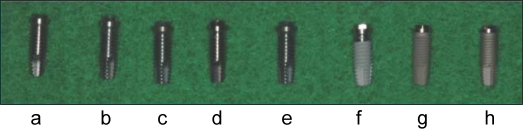
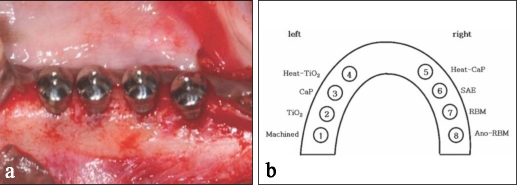
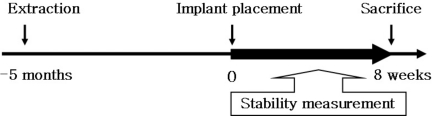
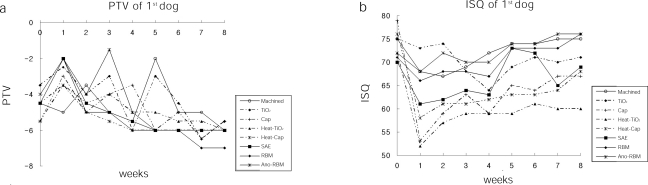
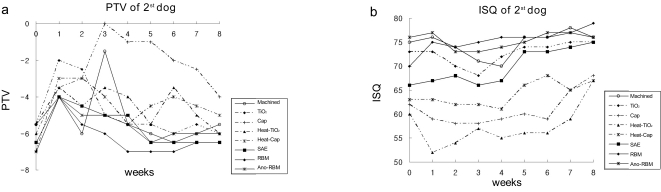
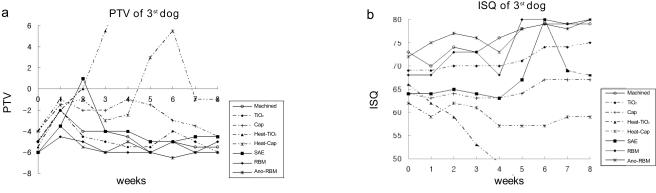
Eight different surface topographies of dental implants were especially designed for the present study. Machined surface implants were used as a control group. 4 nano-treated surface implants (20 nm TiO(2) coating surface, heat-treated 80 nm TiO(2) coating surface, CaP coating surface, heat treated CaP coating surface) and 3 micro-treated surface implants [resorbable blast media (RBM) surface, sandblast and acid-etched (SAE) surface, anodized RBM surface] were used as experiment groups. All 24 implants were placed in 3 adult dogs. Periotest® & ISQ values measured for 8 weeks and all animals were sacrificed at 8 weeks after surgery. Then the histological analyses were done.
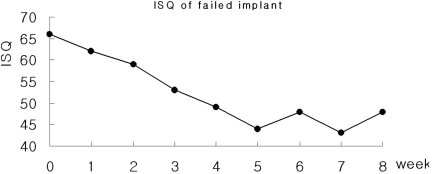
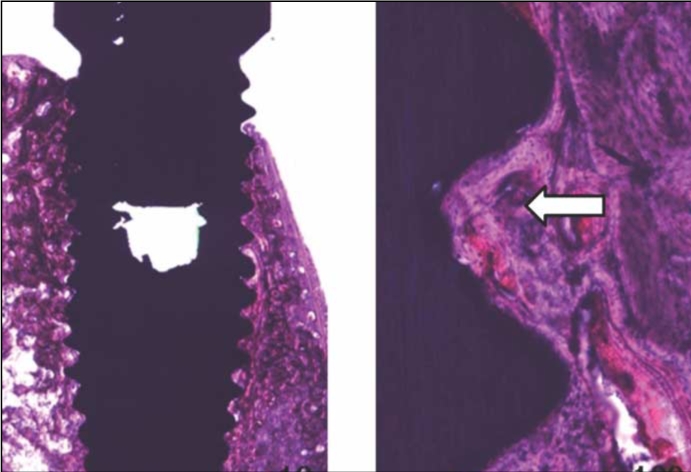
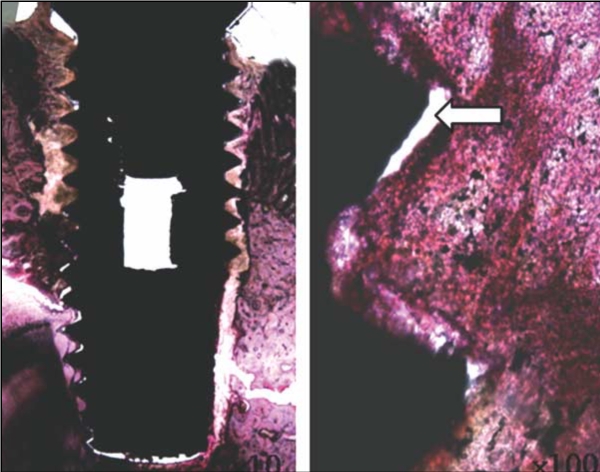
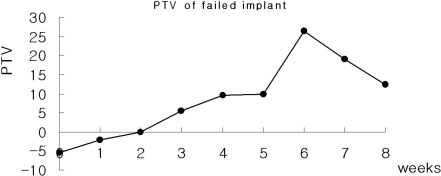
In PTV, all implants were stabilized except 1 failed implants. In ISQ values, The lowest stability was observed at different times for each individual. The ISQ values were showed increased tendency after 5 weeks in every groups. After 4 to 5 weeks, the values were stabilized. There was no statistical correlation between the ISQ values and PTV. In the histological findings, the bone formation was observed to be adequate in general and no differences among the 8 surface treated implants.
In this study, the difference in the stability of the implants was determined not by the differences in the surface treatment but by the individual specificity.
已经有一些研究比较和连续测量了同一患者中各种表面处理种植体的稳定性。
通过观察种植体稳定性的稳定阶段的差异,旨在找到表面处理的临床意义。
本研究特别设计了 8 种不同的牙种植体表面形貌。使用机械加工表面种植体作为对照组。4 种纳米处理表面种植体(20nmTiO2 涂层表面、热处理 80nmTiO2 涂层表面、CaP 涂层表面、热处理 CaP 涂层表面)和 3 种微处理表面种植体[可吸收喷丸介质(RBM)表面、喷砂酸蚀(SAE)表面、阳极氧化 RBM 表面]作为实验组。所有 24 个种植体均植入 3 只成年犬中。在 8 周内测量 Periotest®和 ISQ 值,所有动物均在手术后 8 周处死。然后进行组织学分析。
在 PTV 中,除 1 个失败的种植体外,所有种植体均稳定。在 ISQ 值方面,每个个体的不同时间观察到最低的稳定性。在每个组中,在 5 周后 ISQ 值呈现增加的趋势。4 至 5 周后,数值稳定。ISQ 值与 PTV 之间无统计学相关性。在组织学发现中,总体上观察到骨形成充足,8 种表面处理种植体之间无差异。
在这项研究中,种植体稳定性的差异不是由表面处理的差异决定的,而是由个体特异性决定的。